Thursday, May 31, 2012


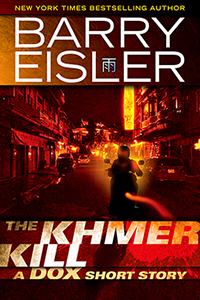
Today's the day -- the new Dox short story, THE KHMER KILL, is available now!

For former Marine sniper Dox, a long-range hit in Cambodia was supposed to be just business as usual.  But when you find yourself mixed up with rogue intelligence operations, gorgeous bar girls, and the world's worst human-trafficking heart of darkness, business is anything but usual.  And making it personal is the most dangerous business of all.

THE KHMER KILL is published by Thomas & Mercer, the good people who brought you THE DETACHMENT, and so will be available exclusively through the Kindle Store.  It's not DRM encumbered, so owners of Nooks and other non-Kindle digital readers, fear not -- you can read it on your device of choice.

Sadly, there won't be a paper version (at least until I've written enough short stories to do an anthology) because there's no cost-effective way to distribute a short story in paper.

And here are some photos of locations in the novel taken by your intrepid correspondent.

Enjoy -- and thanks for reading the stories.

Thursday, May 24, 2012

The Khmer Kill

Hi all, I have some exciting news about the new Dox short story, The Khmer Kill.  The good people of Amazon's Thomas & Mercer imprint (publishers of my novel The Detachment) read TKK, loved it, and want to publish it.  Hence the slight delay in its appearance -- I had hoped to have it up earlier this week, but now there's a bit of paperwork that needs to be sorted out, so the story won't be available until a week from today -- Thursday, May 31.  But that's not too far off, and worth the wait because as T&M demonstrated with their marketing efforts for The Detachment, they can help my stories reach a far larger audience than I could reach on my own.


The Khmer Kill won't be available in paper because alas, there's no cost-effective way to distribute a short story in paper.  And although it will be a Kindle Store exclusive, it won't be DRM encumbered, so owners of Nooks and other non-Kindle digital readers, fear not -- you'll be able to read it on your device of choice.  More information on such matters here.

Thanks for your patience and I hope when you see Dox in action in Cambodia you'll agree it was worth the wait!

Cheers,
Barry

Tuesday, May 01, 2012

Battling Child Sex Slavery

A few years back, I started donating my speaking honoraria to organizations I support -- the ACLU, various independent news groups, the Occupy Movement. I just gave my latest, $2000, to the Somaly Mam Foundation, dedicated to rescuing children from sexual slavery.  Please do what you can to support this vital organization, and I recommend Somaly's heart-wrenching book, too, The Road of Lost Innocence.

Monday, April 30, 2012

Interrogators Speak Out: Why Not a Torture Turing Test?

I'm proud to be part of a series of articles by intelligence and military interrogators denouncing torture this week at the Huff Post.  Here's my entry.

When I wrote my eighth thriller, Inside Out, in 2009, the villains were a group of CIA and other government officials who colluded to destroy a series of tapes depicting Americans torturing war-on-terror prisoners.  The plot was of course based on actual events, and I considered naming one of the characters Jose Rodriguez, the Director of the National Clandestine Service at the time the actual tapes were destroyed.  In the end I decided against real names, though, because, after all, the characters in the book were committing terrible crimes, and to name them after real people seemed a recipe for a libel suit.

I needn't have worried.  Since Inside Out was published, former President Bush and former Vice President Cheney have confessed to ordering waterboarding in their respective memoirs, with no repercussions, legal or otherwise.  And now former Director Rodgriguez, in his own memoir, has himself confessed to ordering the destruction of the videotapes that were the basis for the plot of my novel.  He understands -- correctly, I'm sure -- that he will face no more legal action or damage to his reputation than did the president or vice president.  Such are the times we live in.  After all, President Obama disavowed torture on his second day in office.  No, this was not good news.  It merely ratified the idea that torture, illegal by treaty and US law, is not in fact a crime, but rather merely a policy, which some presidents will permit and others prohibit, entirely at their discretion.  And indeed, although Attorney General Eric Holder acknowledged during his confirmation hearings what everyone already knew -- that waterboarding always has been and always will be torture -- no one has since been charged or prosecuted for ordering it or carrying it out.

Is waterboarding torture?  The Spanish Inquisition, the Nazi Gestapo, and the Khmer Rouge all used it.  And previous US cases have all ruled that waterboarding is inarguably torture.  And it's hard to imagine that any American, Rodriguez included, would argue waterboarding isn't torture if the tapes in question depicted Iranian or Chinese agents waterboarding captured American pilots.  Just a dunk in the water?  A little discomfort, no big deal, all's fair?

But Rodriguez says waterboarding isn't torture, at least when it's Americans doing it, that it merely makes victims "uncomfortable."  He also says it's vital for US national security that we continue to waterboard terror suspects.  So: why not a torture Turing Test?  If Rodriguez can continue to maintain that waterboarding isn't torture even while being waterboarded, he would be infinitely more persuasive.  I wonder why Rodriguez, and so many other apologists with so much on the line, refuse to make this extremely persuasive point?  After all, they say waterboarding causes no permanent harm.  It's just a dunk in the water, a no brainer, merely uncomfortable, no big deal at all.  Are these people not patriots?  Why won't they submit to an easy dunk and demonstrate powerfully and persuasively and once and for all for everyone to see that waterboarding isn't torture, and thereby make a more powerful case that America should continue doing it?  You know, like rightwing talk show host Mancow did.

It's bad enough high government officials like Rodrigez get away with murder, sometimes literally.  It becomes even more galling when they justify their self-interested destruction of evidence of their crimes by claiming the destruction was necessary to protect America.  Remember the English lord in the film Braveheart, showing up with men-at-arms to rape the bride at a Scottish wedding, and describing the act as a way to "bless this marriage"?

I don't know which bodes worse for the future of the republic.  That officials like Rodriguez can claim such stunningly self-interested reasons for having destroyed the evidence of their crimes.  Or that the public is credulous enough to believe them.

Thursday, April 26, 2012

We Don't Want You To Get Robbed, So We'll Just Take Your Wallet Now

Traveling to the Bainbridge Writer's Conference near Seattle this weekend to give the keynote.  I'll be talking about some of the issues I discuss in this Guardian piece on the battle between Amazon and legacy publishers.  The battle fascinates me not just because I write books for a living, but also because it involves some of the topics I find most engaging:  political use of language; the establishment mentality and mindset; the struggle between the forces of control and the forces of democratization.  Enjoy.

Friday, March 30, 2012

Establishment Publishing Kabuki

Today I learned via a mass email from Michael Pietsch, Executive Vice President and Publisher of Little, Brown, that Authors Guild President Scott Turow has an op-ed in Bloomberg on Amazon and the legacy publishing industry. The op-ed is mostly a cut and paste of an open letter Turow posted earlier on the Authors Guild website, and because Joe Konrath and I have already fisked the letter, I won't repeat our arguments here (David Gaughran also had a typically excellent response). Instead, I'd like to point out just one thing I think will be of particular interest to readers of HOTM.

At one point Turow writes, "It may seem strange to hear the president of the Authors Guild expressing sympathy for the plight of American publishers." Well, Turow is expressing more than just sympathy; he's adopting and advocating establishment publishing's philosophy and business practices in a manner indistinguishable from the manner in which establishment publishing executives themselves so advocate (indeed, as I note above, the EVP and Publisher of Little, Brown heartily endorsed Turow's op-ed in a mass email earlier today). But yes, Turow is fundamentally correct: it's as unseemly for the head of an author's guild to defend legacy publishers as it would be for the head of, say, the Pilot's Union to defend United. And Turow is apparently sufficiently aware of, and concerned about, the appearance of his questionable role as legacy publishing spokesperson to call it out.

But here's the reason Turow says you should not only accept his unlikely role as legacy publishing flack, but should in fact find it desirable: you see, the Authors Guild and legacy publishers "have been at each other’s throats since the guild came into being a century ago, and we still have serious differences."

This dodge -- the pretense of a real divergence of interests -- is so significant and widespread I wanted to call it out here.

No establishment wants to present itself to the public accurately -- that is to say, as a monolith. If it did so, people would correctly understand that the utterances of every part of the establishment are merely self-serving, and would discount them accordingly. So what establishments work hard to do instead is to create the appearance of conflict, competition, and a divergence of interests. In this way, for example, The New Republic can be used by conservatives, as in, "Even the liberal New Republic says…". Similarly, Blue Dog and other corporate-serving Democrats can be cited by Republicans as "Even Democrats acknowledge that…". And now, as we see, the Publisher of Little Brown gets to say, "Even Authors Guild President Scott Turow says…".

I've written about this phenomenon before as it exists in the establishment media. The apparent divergence of views among NPR and other such "leftwing" media, on the one hand, and the Wall Street Journal, Fox News, and other such "rightwing" media, on the other, is intended to distract from the much more important commonality of interests among these establishment media outlets (and here's Glenn Greenwald with a recent piece on what these interests are). I call this kind of competition Kabuki Competition, and not coincidentally, it's the same kind of "competition" that exists among legacy publishers. Yes, they battle over author and employee talent, but these battles are vastly outweighed by the areas in which they cooperate: author royalties, means of distribution, and all the other fundamentals of maintaining their privileged station in the world of books. Remember, Europe's royal clans once fought real battles, too, but what they agreed on was much more important than what they fought over. And what they agreed on was the entire feudal system that was the basis for their profits, their position, and their power. They agreed on their place, and the place of the peasants, and all their battles were fought within those bounds.

So don't be misled: despite what they would have you believe, players like Turow and Pietsch are not fundamentally adversarial. They may differ, and they might actually fight, over how the system's spoils should be properly divided. But on the preservation of that system itself, they are of entirely the same mind and have entirely the same interests.

P.S. Michael, in your mass email praising Scott's latest, you said, "These are interesting times for all of us and I welcome your questions and thoughts about the issues facing our industry. I hope you agree that our open exchange of ideas is critical for continued success." I do! Which is why I've taken the trouble to respond to Scott and now to you, too. Won't you do the same? If not, then particularly given Scott's failure to address any of the numerous thorough and cogent responses to his arguments, which you have now publicly endorsed, people might start to feel that what interests you isn't in fact an open exchange of ideas, but instead a one-sided coordinated campaign of self-serving propaganda.

Saturday, March 10, 2012

Scott Turow, Servant of Establishment Publishing

Scott Turow is the president of the Authors Guild, yet his real concern seems to be protecting legacy publishers at the expense of the authors whose interests he claims to represent. Today Joe Konrath and I fisked Turow's defense of legacy publishing price collusion, currently the subject of a Justice Department investigation. We weren't gentle, but when someone pisses down your back and tells you it's raining, you have to call 'em on it. Here's your link.

Friday, March 09, 2012

Publishing, Politics, and Persuasion

Today I did a long interview with the awesome Catherine Ryan Hide, author of eighteen award-winning novels including Pay It Forward. Catherine asked me some great questions, and I talk about publishing; establishments; how the one percent couldn't exist without the support and reverence of substantial parts of the 99%; false-binary thinking; why nothing, not even the Holocaust or child-molestation, should be off-limits to humor; what motivates dudgeon demons and mobs; the Amazon bogeyman; what makes an effective or ineffective book cover; what the publishing industry will look like in ten years; Chihuahuas; and lots more.

Read the whole thing on Catherine's blog. And be careful! Some of it might offend you, after which, you could suffer from feelings of being offended, which many people find troubling.

Monday, February 13, 2012

A Few Book Recommendations

Whenever I read a good book, I try to post an Amazon and Goodreads review, and it occurred to me that I ought to be doing so here, too. So here are three recent ones I thought were outstanding:

Glenn Greenwald, With Liberty and Justice for Some: How the Law Is Used to Destroy Equality and Protect the Powerful

This superb book is a powerful indictment of America's two-tiered system of "justice" and the perversion of American ideals by the American establishment (better understood as an oligarchy). It could serve as a manifesto of the Occupy movement, which, contrary to variously naive and opportunistic mischaracterizations, has no problem with people winning, and is opposed instead to systemic, institutionalized cheating.

If you think certain classes of people should be above the law, or that the law (including the Constitution) should be treated more as a kind of guideline, suggestion, or recommendation than as a binding authority equally applicable to all, you won't agree with the book's clear argument and you'll find a way to ignore its overwhelming evidence. But if you recognize that, as Thomas Paine said, in America it is the law that is king, you'll be grateful that Greenwald has written such a cogent appeal for Americans to live up to our ideals.


Michael Hastings, The Operators: The Wild and Terrifying Inside Story of America's War in Afghanistan

The Operators covers, in excellent prose and with perfect pacing, three broad topics. First, the insanity and futility of America's war in Afghanistan. Second, the way decisions are made in Washington and at the Pentagon -- the bureaucratic battles, the petty resentments and one-upmanship, the alliances and betrayals. And third, the realities of journalism -- the tradeoffs journalists engage in between access and honesty, the way journalists allow themselves to be seduced and suborned by the powerful figures they purport to hold to account.

For nonfiction, the book was an unusually gripping read (I listened to the audio version in my car, and many evenings sat in the driveway after getting home, unable to turn it off). Hastings turns this trick by avoiding preaching, and instead illuminating his broad themes through a specific focus. The insanity and futility of the war are represented by the heart-aching death of Army Corporal Mike Ingram. The White House and Pentagon turmoil is told via the story of the rise and fall of General Stanley McChrystal, America's commander of the International Security Assistance Force in Afghanistan. And the realities of journalism are presented through Hastings' account of his own decision-making process; of the temptations he felt (and, to his credit, resisted); and of the reactions of other journalists to his coverage of McChrystal and the war.

The subtitle is spot-on: this really is a wild and terrifying inside account, and a deeply affecting one, too. I highly recommend it.


Writers Anonymous, Seven At The Sevens: A Collection of Seven-Word Stories, Memoirs and Poems

I completely enjoyed this eclectic and wonderful book, which the authors were kind enough to give me when I spoke at Grub Street Writers in Boston this past November. I wouldn't have thought a book grouped around the concept of seven-word observations, poems, stories, and aphorisms would be so engaging, but I would have been wrong about that (and I should have known better, as I suppose you could say the same thing about haiku).

If you love writing, this book will make you feel connected with a passionate and funny (and anonymous, though their bios provide delightful glimpses) group of people who share your love. The illustrations are memorable, and sometimes haunting. The quotes from Steve Jobs, Hemingway, and others will inspire you. I'm indebted to the authors for introducing me to the work of Katherine Mansfield -- her short story The Fly is a magic act. Magic.

A particularly fine read in a favorite coffee shop (mine is Hatou in Tokyo). Also goes with Charlie Haden's American Dream. I hope you'll have as much fun with this slim volume as I did.

Wednesday, December 07, 2011

Hachette: We Are Still Relevant!

This time I remembered to link to where I'm guest blogging.

Today, there was a leak of an internal Hachette memo on why Hachette (and, by extension, legacy publishing generally) is still relevant. I fisk it with Joe Konrath over at Joe's blog. It's pretty bad... but see for yourself.

Tuesday, December 06, 2011

Leon Panetta is Full of Shit

Defense Secretary Leon Panetta wants you to be scared.

In a letter to Senators Lindsey Graham and John McCain, Panetta warned that after possible cuts in the military budget, "we would have the smallest ground force since 1940, the smallest number of ships since 1915, and the smallest Air Force in its history."

Which would be pretty damn bad… if we wound up having to go to war with America's 1940 army, 1915 navy, or some historical version of America's Air Force. If we're lucky, though, and don't have to go to war with past incarnations of our military, Panetta's comparison is logically nearly irrelevant. In fact, even the most massive cuts currently under consideration would return American military spending only to 2007 levels. So as long as we don't have to go to war with our 2007 military, we should be okay.

If Panetta had been interested in logical relevance, though, he wouldn't have referred to the past at all. He would have focused on the present, and in the present, we spend more on our military than the rest of the world spends combined. And we spend more than five times more on our military than the second biggest military spender, which is China (numbers 3 and 4 are France and the UK, American allies).

But Panetta doesn't want you to know these numbers. If you did, you might laugh at him when he describes military cuts as meaning "doomsday" for America.

That's right. According to Panetta, returning to 2007 military spending levels, and still spending about as much as the rest of the world combined -- means doomsday for America. Shit, I'm laughing at him right now.

The rest of Panetta's Very Scary Letter is equally misleading. "You cannot buy three quarters of a ship or a building," he warns. Well, true, three quarters of a ship wouldn't be very useful. I mean, it would be like three quarters of a bullet, or something! But you could settle for, I don't know, say, nine out of the twelve new ships you wanted -- three quarters overall. Either Panetta is too stupid to know this, or he's hoping the public is too stupid to notice it for him.

The closest Panetta comes to anything specific about America's defense needs is to note that cuts would be bad for contractors. At which point, you start to get a feel for what really drives him and who he really represents.

When a spokesperson for a cause invents arguments as irrelevant and scaremongering as Panetta's, while ignoring relevant data and reasoned argument, you can safely conclude you are being bullshitted. It's long past time that Americans understood the military is, among other things, a special interest, and reacted to its lobbyists' Be Afraid! screeching accordingly.

UPDATE: Here's a tweet in response, from George Little, Secretary Panetta's spokesperson at the Pentagon:

@barryeisler Calling the US mil a special interest is insulting to those who risk their lives to protect your freedom to call them that.


Well, I could be wrong in suspecting an organization -- any organization -- with a trillion-dollar budget might have a few interests not necessarily consonant with those of the nation at large, but maybe I'm being unfair. Maybe the Pentagon is in fact composed of and run by men so selfless that they defy all rules of human nature and bureaucratic dynamics. Maybe criticizing the trillion-dollar military bureaucracy is the same as insulting individual soldiers. If so, criticizing the Pentagon would be bad form, and maybe even unpatriotic!

Or maybe Mr. Little came up with his clever little "how dare you insult the troops" dodge because he doesn't have the wherewithal to respond to any of my substantive arguments. In which case, Mr. Little, I must regretfully conclude that you're just as full of shit as your boss. I'm sure being the Pentagon Press Secretary and SecDef Spokesman has its perks, but wouldn't you rather have some integrity?

Wednesday, November 30, 2011

Guest Blogging

I need to get better about linking here when I'm blogging elsewhere. Here are a few recent guest posts:

First, on novelist J.A. Konrath's blog, on how to decide between a legacy publishing contract and self-publishing.

Next, at Writer Unboxed, on The Critical Aspects of Digital Publishing. [link fixed]

And today on Techdirt, I'm interviewed by Mike Masnick on Copyright, Piracy And Why SOPA/PIPA Are "Extremely Disturbing"

I should mention too that I'll be doing the keynote at the annual Writers Digest Conference in New York, January 20-22.

Finally, here are some of the highlights of my recent talk at Grub Street Writers in Boston, all about the digital revolution in publishing.

Barry Eisler, Publish It Forward Lecture Part 1 from Grub Street on Vimeo.


Barry Eisler, Publish It Forward Part 2 (Q&A) from Grub Street on Vimeo.


Barry Eisler, Publish It Forward Part 3 (Q&A) from Grub Street on Vimeo.

Monday, October 31, 2011

To Fly. To Serve. To Do The Absolute Minimum

Readers of HOTM know that as interested as I am in the branding of politicians, I'm also interested in the psychology and mechanics of branding generally. Which is why I was struck by an ad I saw recently for British Airways, which has decided to ditch it's current slogan, "The World's Favourite Airline," in favor of something it was using 90 years ago:

"To Fly. To Serve."

The ad I saw described the change this way: "It's not a slogan. It's a promise."

Well… let's be fair. It's actually both. And what makes this such a very poor slogan is precisely the minimalism of its promise. I mean, what does an airline absolutely have to do to be an airline? It has to fly customers. That's really it. It has to fly. It has to serve. If it doesn't do those things, it's not an airline. So it's no coincidence that every single airline in the history of the world has, at a bare minimum, flown. And served.

"So what?" you might ask. "It's true, isn't it? They fly and they serve. Just telling it like it is."

Yes, it is true, and alongside something like Fox's "Fair and Balanced," truth is much to be admired. There's also something to be said for under-promising and over-delivering. But a slogan, ideally, should do at least two things: (1) promise something more than the minimum customers already assume; and (2) promise something that distinguishes you from your competitors. Being memorable is also nice, so let's make memorable a #3.

Back in my Jersey days, I used to come across a radio news station called Ten-Ten WINS (1010 on the AM dial). Their slogan was, "You give us 22 minutes, we'll give you the world." That's a good slogan! Big promise, distinguishes you from the competition, and memorable. The British Airways equivalent would be, "Ten-Ten WINS… we tell you news."

So I hope it's now clear that AT&T, for example, shouldn't use a slogan like, "We let you talk on the phone." McDonald's should steer clear of, "We serve people hamburgers." The New York Times would probably be ill-served by, "We print news" (actually, "All the news that's fit to print" is a nice slogan -- big promise, distinguishing, and memorable, too. Not terribly accurate, IMO, but accuracy is a lot to ask of a corporation, and anyway I expect the Times' management believes it's true).

Now, none of this is terribly important, but the principles I discuss here are so fundamental and so obvious that sometimes I'm quietly in awe of not just at what these giant companies come up with, but also at the thought of what they must have invested in the exercise. How many employees and outside consultants, how many millions of dollars went into coming up with such a patently bad corporate slogan? I assume these companies understand how important branding is and how crucial a slogan can be to any branding effort. I assume that when they work to come up with a new corporate slogan, they bring their A game and their A dollars. And this is the best they can do?

I'm not sure if this qualifies as good news for British Airways, but they're hardly alone. Delta once thought it would be useful to promise customers, "Delta gets you there." In fact, one handy way of knowing if a corporate slogan is terrible is to ask of it, "Is anything else even possible? Delta leaves you stranded on the tarmac? Delta goes down in the ocean? Delta *doesn't* get you there?"

And look at MSNBC: "Lean Forward." Come on, what happens when you're leaning forward (or in any other direction)? Well, the first thing that happens is, you're not moving. You might even be in danger of falling, if you lean too far. So MSNBC paid millions of dollars to a bunch of branding consultants, who then came up with the equivalent of, "MSNBC. We're not going anywhere. And we might even fall down."

I think even MSNBC knows how weak this is, because, like those restroom electric hand dryers that come with their own propaganda ("This slow and noisy hand dryer is saving lots of paper!"), MSNBC wants you to know that, "To Lean Forward is to think bigger, listen closer, fight smarter, and act faster. To celebrate the best ideas no matter where they come from. To dare to dream of a nation that's better tomorrow than it is today."

Well, maybe that's what Lean Forward means to MSNBC, the executives of which have had lots of time and substantial motivation to convince themselves. But I think most people who come across the slogan will just imagine MSNBC leaning there, immobilized. And who even really cares in which direction you're leaning? I guess forward is minimally better than backward, because the latter is more tiring and more likely to make you lose your balance, but really, MSNBC… your identify, your value to your customers, it's all built on the fact that you lean?

Hey British Airways and MSNBC, if you're reading this: I know my shit and I work cheap (that's a promise, and also a slogan). Call me. And if anyone has examples of other particularly good or particularly bad corporate slogans, I'd be curious. Post 'em here -- thanks.

P.S. Forgot to mention earlier, for anyone interested in the question of why many authors fear a future Amazon publishing monopoly but are sanguine about the existing New York publishing monopoly, here's a guest post I did with novelist and blogger J.A. Konrath, The Bogeyman and The Axe Murderer.

Tuesday, October 18, 2011

Occupy Wall Street

Today The Detachment comes out in paper, and I'm in New York briefly for some book stuff. Naturally, I spent the afternoon at OccupyWallStreet, a movement that is spreading incredibly fast. Here are some impressions.


First, the notion that the movement doesn't know or can't articulate what it wants is nonsense. As I think the photos in this post (I had trouble uploading the videos; will try again later) will make clear, the fundamental grievance that has motivated people to interrupt their lives and endure ridicule, discomfort, and attacks by the police, is their understanding that America's political processes have been captured by oligarchic interests, and that politicians serve not the people, but the powerful.


This is not a movement against capitalism; it is a movement against America's current version of capitalism, which we might loosely label with the oxymoron "crony capitalism," which, by definition, isn't capitalism at all.

I was impressed by the determination and organization I witnessed. There were people engaged primarily in occupying the park; people holding signs; people running services -- information, food, sanitation, trash disposal, medical. My sense was of a collection of citizens who had come to realize that America's political system is so broken, that our democracy has become so inverted and perverted, that they had to do something, had to do whatever they could, even if that something was just to deploy their bodies and their voices and to declare together, Enough.


Where will it all lead? I don't know. But I have a feeling that all such protests against inequality, corruption, and repression must initially seem doomed to failure. Who could have believed in 1980, when Solidarity was formed in Poland, that ten years later Lech Walesa would be president? Who would have predicted when Tahrir Square in Egypt was first occupied that Mubarak would soon be forced to step down? And I'll bet that even as Thomas Jefferson penned The Declaration of Independence, he had moments of, "What the hell am I doing? We've really got a chance against Britain?!"

It must always seem hopeless at the outset. Except sometimes it turns out not to be.


P.S. If you're around on Friday, October 21, come by the Palo Alto Four Seasons for the Detachment launch party, generously hosted by the Four Seasons with legendary local independent bookseller Kepler's Books. Come by at 6:00 pm for wine and light bites, after which, at 7:00, I'll say a few words about the book and take questions. I'll then sign books, which Kepler's will be selling on the premises (autographed copies make great gifts, you know… ;)). After the signing, I'm going to hit the bar -- and hope you'll join me! If you like gin, order a Purple Rain (it's not on the menu). Buy a book from Kepler's, and have dinner after at the wonderful hotel restaurant, Quattro -- what could be better?

Friday, October 21, 6:00 pm
Four Seasons Palo Alto
2050 University Avenue
East Palo Alto, CA 94303
(650) 566-1200

Update: Okay, I couldn't get the video to upload directly here, so posted it on YouTube and will now embed. Here you go:


Saturday, October 01, 2011

Beneficent, Benign Establishments

First, apologies for my long blogging hiatus. I made a number of significant decisions and changes in my writing business, then wrote two short stories, a political essay, and co-authored a (free) short book on what's going on in the publishing industry, then had to finish the new novel, The Detachment… all of which kept me from posting here as often as I'd like. I'll try to be more regular now, and to that end, I think I'll post more shorter pieces, in addition to the longer essays to which I seem naturally to gravitate. This post will be one of those shorter ones.

Last week, I gave a talk at my alma mater, Cornell Law. Before the talk got started, I was chatting with a few people, including a retired judge who likes my books and who asked me why I take such a dim view of establishments (he described himself as an establishmentarian). We didn't have time to talk about it much, so I thought I'd use the question, which is an interesting one, as the basis for this post.

For me, it comes down to this: who does the establishment serve?

If you're a member of the establishment (which I think is better understood as an oligarchy), naturally you'll believe it primarily serves society. But I believe establishments are like bureaucracies, and therefore subject to Jerry Pournelle's Iron Law of Bureaucracy, which suggests:

...in any bureaucratic organization there will be two kinds of people: those who work to further the actual goals of the organization, and those who work for the organization itself. Examples in education would be teachers who work and sacrifice to teach children, vs. union representatives who work to protect any teacher including the most incompetent. The Iron Law states that in all cases, the second type of person will always gain control of the organization, and will always write the rules under which the organization functions.


In fact, there is even a related concept, known at the Iron Law of Oligarchy.

There might have been some period in the golden past when the American establishment primarily served the interests of the wider society (I doubt this, but am willing to concede for the sake of argument). Regardless, over time, the establishment has inevitably come primarily to serve its own interests, probably through the psychological mechanism of equating society's interests with its own. L'etat, c'est moi.

It's all about human nature. Having achieved, or having been handed, a position of power, profit, and privilege in society, people will naturally seek to preserve that position, even at the expense of society's other members. To argue otherwise requires a view of human nature for which I see scant evidence. And in the behavior of politicians, bankers, corporate media organs, corporations -- and particularly up close and personal in the business practices and articulated worldview of members of the New York publishing establishment -- I see overwhelming evidence in support of my less sanguine view.

I therefore look at Amerca's oligarchy -- yes, more politely and generously known in some quarters as America's establishment -- as primarily parasitical, not as primarily beneficial. And naturally, I try to reflect this view in my books.

P.S. One other thing that's been keeping me from blogging here is that I've been guest blogging elsewhere. Here's a new piece I did with novelist J.A. Konrath on his blog, debunking some foolish and pernicious thinking about self-publishing from a reasonably well known literary agent.

Thursday, September 15, 2011

Today's The Day: John Rain Is Back

I'm delighted to announce that the digital and audio versions of the new Rain novel, The Detachment, are available now, exclusively through the Amazon Kindle Store and through Amazon's affiliates, Brilliance and Audible (I did the audio version, and you can listen to a sample here). The paper and CD audio versions will be available wherever books are sold on October 18 (and can be preordered now through Amazon). Tour dates—which will coincide with the paper release—will be up on my website soon. Here's more:

John Rain is back. And "the most charismatic assassin since James Bond" (San Francisco Chronicle) is up against his most formidable enemy yet: the nexus of political, military, media, and corporate factions known only as the Oligarchy.

When legendary black ops veteran Colonel Scott "Hort" Horton tracks Rain down in Tokyo, Rain can't resist the offer: a multi-million dollar payday for the "natural causes" demise of three ultra-high-profile targets who are dangerously close to launching a coup in America.

But the opposition on this job is going to be too much for even Rain to pull it off alone. He'll need a detachment of other deniable irregulars: his partner, the former Marine sniper, Dox. Ben Treven, a covert operator with ambivalent motives and conflicted loyalties. And Larison, a man with a hair trigger and a secret he'll kill to protect.

From the shadowy backstreets of Tokyo and Vienna, to the deceptive glitz and glamour of Los Angeles and Las Vegas, and finally to a Washington, D.C. in a permanent state of war, these four lone-wolf killers will have to survive presidential hit teams, secret CIA prisons, and a national security state as obsessed with guarding its own secrets as it is with invading the privacy of the populace.

But first, they'll have to survive each other.
The Detachment is what fans of Eisler, "one of the most talented and literary writers in the thriller genre" (Chicago Sun-Times), have been waiting for: the worlds of the award-winning Rain series, and of the bestselling Fault Line and Inside Out, colliding in one explosive thriller as real as today's headlines and as frightening as tomorrow's.


Want to read Q&A on various aspects of the book, along with the first five chapters? I'm a guest today at five excellent blogs. Here's where to go:

Chapter 1 – Truthout: The politics of The Detachment
Chapter 2 – A Brain Scientist’s Take on Writing: The book’s unusual path to publication
Chapter 3 – Buzz, Balls & Hype: The book’s image system
Chapter 4 – Jungle Red Writers: Combining the series worlds of Rain and Treven
Chapter 5 – A Newbie’s Guide to Writing: Publishing a book with Amazon

For more on digital books, please see the Digital FAQ on my website. There's also a program called Kindle for PC that will allow you to download the book from the Kindle Store and read it on your PC, a program called Kindle for Android that will allow you to download it from the Kindle Store and read it on your Android device, and a program called Kindle for Mac (available from Amazon and Apple's App Store) that will allow you to download it from the Kindle Store and read it on your Mac computer, iPad, or iPhone.

If you're wondering why the digital edition of The Detachment is available before the paper edition, the reason is that paper takes longer to prepare and ship (glue, boxes, trucks, warehouses) than digital. My goal, and Amazon's, is to get all editions to readers as quickly as possible, and because, by its nature, digital can be readied for publication more quickly, the digital edition of The Detachment is being released first. Syncing up the release of the digital and paper versions would mean sitting on the digital edition until October 18th, and that doesn't strike me as a fair or sensible approach. This way, all readers can get the edition they want as soon as it's ready.

Thanks for all your support, and I hope you enjoy reading The Detachment as much as I enjoyed writing it!

Barry

Update: Nook and other ePub reader users, the book was mistakenly DRMed. The problem is now fixed, and if you had a problem converting, please just follow the instructions below and you should be good to go. My apologies for the mistake and the inconvenience.

"All they need to do is delete the file from their local application/device (Kindle for the PC, Kindle for the Mac, etc) and then re-download the book from their Amazon account to get the DRM free version. If people have questions – they can call Amazon Kindle CS team at 866-321-8851. We posted an article about it so that our CS reps are aware of the situation and how to fix the problem."

Monday, May 16, 2011

The Ass Is A Poor Receptacle For The Head


Hi all, my new political essay, The Ass Is A Poor Receptacle For The Head: Why Democrats Suck At Communication, And How They Could Improve, is available now. If you read this blog (and I think that might be a fair assumption since you're reading this right now), you know I'm interested in language as it influences politics, and in politics as an exercise in branding and marketing. The Ass Is A Poor Receptacle is both primer and manifesto on these topics, and includes references from Shakespeare to Schwarzenegger and from Orwell to Animal House to illustrate its many points. Here's a bit more:


Regardless of what you think of their policies, the sad truth is that Democrats suck at selling their ideas to the public. In this hilarious and hard-hitting essay, best-selling novelist and political blogger Barry Eisler draws on his expertise in narrative, his CIA training in persuasion, his time as an international intellectual property lawyer, and his background in technology marketing to offer Democrats some sound advice on how to improve their communications strategy. Borrowing principles from judo and boxing; using examples from advertising, movies, plays, speeches, and debates; and offering case studies of actual policy rollout successes and disasters, Eisler encourages Democrats to force Republicans to fight on Democratic terms, to use Republicans' own moves against them, and to not just slip a punch, but to hammer their opponents into a rhetorical corner and knock them the hell out.

The Ass Is A Poor Receptacle is about 10,000 words, or about 50 pages in paper. You can download it to your Amazon Kindle, your B&N Nook, or via Smashwords directly to your computer as a PDF. There's also a program called Kindle for Mac, available from Amazon and Apple's App Store, that will allow you to download it from the Kindle store and read it on your Mac computer, iPad, or iPhone.
Thanks for reading, and please help spread the word to Democrats who might want to get their heads out, if only someone would show them how.

Wednesday, April 27, 2011

PARIS IS A BITCH—A Rain/Delilah Short Story


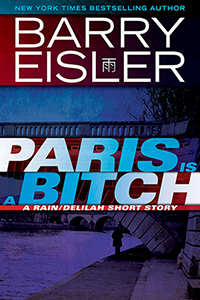
Hi all, my new John Rain/Delilah short story, Paris Is A Bitch, is available now. It covers an important event that occurs sometime between the end of Requiem for an Assassin and the start of The Detachment, the new Rain book that'll be out this summer. You can download it to your Amazon Kindle, your B&N Nook, or via Smashwords directly to your computer as a PDF. There's also a program called Kindle for Mac, available from Amazon and Apple's App Store, that will allow you to download it from the Kindle store and read it on your Mac computer, iPad, or iPhone.


For most couples, a quiet dinner for two at Auberge de la Reine Blanche on the Ile Saint Louis would be just the thing to smooth out the complications in a romance. But for gorgeous Mossad operative Delilah and trying-to-retire contract killer John Rain, nothing is ever easy, and when Rain sees a crew of hard-looking men setting up outside the restaurant, he realizes someone has been bringing her work home with her. Is it a hit—or something even worse? When it comes to killing, business and pleasure are the most dangerous mix of all.

This short story is about 8500 words, or a little under 40 pages in paper. The download comes with the first three chapters of the new John Rain novel, The Detachment (available soon), plus an essay called Personal Safety Tips from Assassin John Rain, which includes information that will be at least as valuable to civilians as it has been to Rain.

Here's a collection of photos of locations that appear in the story. Tough research, I know. :)

Enjoy!

Monday, April 11, 2011

2:46: Aftershocks: Stories from the Japan Earthquake

Even as the aftershocks of the March 11 Touhoku quake continued to rock Japan, a group of people came together and determined to do something in response. The Wall Street Journal chronicled their efforts, and the result is a remarkable book, called "2:46: Aftershocks: Stories from the Japan Earthquake." Recorded, written, and published in just over one week, and available as of this morning, it's a stunning collection of firsthand accounts, photographs, art, and essays (including an original by cyberpunk science fiction legend William Gibson), 100% of the proceeds of which go to the Japanese Red Cross and its critical work of aiding the quake's victims. I'm very proud to have contributed the foreword, which I'm posting here in hopes it will entice more people to get involved. Please, buy a copy of the book, share on Facebook, like Quakebook on Facebook, post something about it on your blog, follow Quakebook on Twitter, tweet about it with the hashtag #Quakebook-- whatever you can do to help get out the word and help a nation and people that desperately need it. Thank you.

****************

For me, Tokyo was metropolitan love at first sight.

It was 1992, and the government sent me for a language homestay. I got off the Skyliner at Ueno Station from Narita and that was it, I was done for. I could try to tell you why -- the energy of the place, its strangeness, the feeling of method to the madness -- but really, you might as well try to explain your first crush, your first love, the attraction of a lifelong romance. Whatever you can explain in words won't quite be it. The real connection is always too deep, too elusive, too mysterious ever to be corralled by language. The words will never get it right.

Still, if you're in love and you're a writer, you have to try. You might even create a character, say, a half-Japanese, half-American assassin, to help you:

Tokyo is so vast, and can be so cruelly impersonal, that the succor provided by its occasional oasis is sweeter than that of any other place I've known. There is the quiet of shrines like Hikawa, inducing a somber sort of reflection that for me has always been the same pitch as the reverberation of a temple chime; the solace of tiny nomiya, neighborhood watering holes, with only two or perhaps four seats facing a bar less than half the length of a door, presided over by an ageless mama-san, who can be soothing or stern, depending on the needs of her customer, an arrangement that dispenses more comfort and understanding than any psychiatrist’s couch; the strangely anonymous camaraderie of yatai and tachinomi, the outdoor eating stalls that serve beer in large mugs and grilled food on skewers, stalls that sprout like wild mushrooms on dark corners and in the shadows of elevated train tracks, the laughter of their patrons diffusing into the night air like little pockets of light against the darkness without.


And:

At first light, the whole of Shibuya feels like a giant sleeping off a hangover. You can still sense the merriment, the heedless laughter of the night before, you can hear it echoed in the strange silences and deserted spaces of the area’s twisting backstreets. The drunken voices of karaoke revelers, the unctuous pitches of the club touts, the secret whispers of lovers walking arm in arm, all are departed, but somehow, for just a few evanescent hours in the quiet of early morning, their shadows linger, like ghosts who refuse to believe the night has ended, that there are no more parties to attend.


If my books have been love letters to Japan, this one is more an SOS. I'm both proud and humbled to be part of it, to be in a position to reach others who love Japan and long for Japan so together we can give back some of what we've received, and do something to help Japan back to her feet.

Sunday, April 03, 2011

Libya: America Has No Choice?

This post is in response to a post by Juan Cole, a blogger and expert on the Arab and Muslim worlds from whom I've learned a great deal and who I greatly respect, arguing that America has a moral obligation to assist its NATO allies in the war against Libya.

Hi Juan, I'm no expert on NATO and the UN, but Article 5 of the NATO Charter seems entirely clear:

The Parties agree that an armed attack against one or more of them in Europe or North America shall be considered an attack against them all and consequently they agree that, if such an armed attack occurs, each of them, in exercise of the right of individual or collective self-defence recognised by Article 51 of the Charter of the United Nations, will assist the Party or Parties so attacked by taking forthwith, individually and in concert with the other Parties, such action as it deems necessary, including the use of armed force, to restore and maintain the security of the North Atlantic area.


So Article 5 applies only to attacks in Europe and North America, which would seem to exclude events in North Africa. And even if we read the phrase, "to restore and maintain the security of the North Atlantic area" as broadly as possible, it's hard to see how it could be stretched to an African country on the Mediterranean.

But I think your argument might find some support in Article 6, which provides:

For the purpose of Article 5, an armed attack on one or more of the Parties is deemed to include an armed attack:

on the territory of any of the Parties in Europe or North America, on the Algerian Departments of France (2), on the territory of or on the Islands under the jurisdiction of any of the Parties in the North Atlantic area north of the Tropic of Cancer;

on the forces, vessels, or aircraft of any of the Parties, when in or over these territories or any other area in Europe in which occupation forces of any of the Parties were stationed on the date when the Treaty entered into force or the Mediterranean Sea or the North Atlantic area north of the Tropic of Cancer.


Again, I know little about the NATO Charter and am unfamiliar with other attempts to interpret it, but on its face, Article 6 seems to provide that if NATO forces are attacked in the Mediterranean, the attack will be deemed to be an Article 5 attack. That said, as a former lawyer, I'm struck by the sloppy drafting of Article 6. As drafted, it seems to have the effect of dramatically expanding the geographical ambit of Article 5, making me wonder why, if such an expansion was the intent of the drafters, they didn't just forthrightly provide for the proper geographical scope of the treaty in one place. Another drafting anomaly in Article 6 is the repetition of the notion that an armed attack on Europe means an armed attack on Europe. Finally, we should mindful of what NATO stands for: North Atlantic Treaty Organization. Legal documents are often construed without regard to their titles and headings, but still, it's fair to wonder why the drafters would have called the organization and the treaty NATO if they intended the alliance to apply equally to the Mediterranean. NAMTO would have worked as an acronym, too.

These anomalies are why I hesitate to opine too strongly in the absence of familiarity with something equivalent to case law (I couldn't find any, BTW). My guess is that the drafters intended that limiting phrase, "in which occupation forces of any of the Parties were stationed on the date when the Treaty entered into force" to apply not just to Europe, but to the Mediterranean and other areas mentioned in Article 6, too. Regardless, on its face, Article 6 does seem to provide support for the notion that if NATO forces are attacked in the Mediterranean, the alliance will treat such attacks as an attack against all, in which case each NATO party is obligated to assist the parties that have been attacked.

All that said, you wrote, "So my question is, does that decision not lay a moral obligation on the US to lend support to the effort of its allies?" As you can see from my attempts to parse the NATO Charter, I think the better question is, "Does that decision create a legal obligation for the United States?" Because, after all, if the NATO Council decided to pick a fight outside the treaty's ambit and then tried to invoke the treaty as a way of forcing America to join in that fight, I would argue that no, America certainly has no moral obligation to join in the fight, and I would only be concerned with whether America would be legally obligated to join. As a matter of common sense, it seems dubious that NATO could launch a war not authorized by the treaty and then invoke the treaty to force a member to join that war, but still, the Charter says what it says and regardless of common sense the document of course needs to be addressed.

You ask: Had Washington demurred, "would not the allies have had a legitimate grounds for absolute fury?" I think this is the wrong question. America shouldn't be pressured into war by fear of third party emotions. If America has a legal obligation to join, America should honor that obligation. If no such obligation exists, the potential emotional reaction in foreign capitals ought to be a matter of diplomacy, but ought not to be a basis for America's participation in a war.

You mention that NATO invoked Article 5 following the September 11 attacks. But this was entirely proper, as the territory of a member state had been attacked. Libya has attacked no member state, and your argument would seem to imply that when NATO acts properly in situation x, member states are therefore obligated to act improperly in situation y. Such a tit for tat interpretation of the treaty makes no sense, either legally or common sensically. Moreover, the treaty makes no mention of public support for or opposition to responses by member states, so the foreign public opposition you mention to NATO's assistance to America in Afghanistan again seems relevant only to matters of diplomacy, not to whether an alliance member is legally or even morally obligated to assist another alliance member.

Similarly, your concern that an American demurral would mean the end of NATO is a matter of diplomacy only. Why would America want to be part of an organization that could force America into a war just by threatening the organization's dissolution if America failed to join in? If America really wanted to stay out and believed it had no legal obligation to join in, presumably it could head off such a crisis by early diplomatic intervention. If it couldn't, it might be worth discussing the value of an organization that no longer has a Soviet Union to deter and that seeks to force America to participate in actions outside the ambit of the treaty America has signed.

Granted, Resolution 1973 authorizes UN member states to attack Libya. But I don't see how it follows that America or any other NATO member is then legally obligated to participate in a war launched pursuant to the UN's resolution. Resolution 1973 authorized military action in Libya; it did not require it. Allowing a UN authorization to act as a legal trigger for a NATO requirement would greatly expand the potential applicability of the treaty. France's and Britain's actions in Libya make sense to you, but their next ones might not, and you might regret the creation of a principle that winds up obligating America to participate in every UN-authorized war that a NATO member decides to engage in. I know I would.

You close by asking again whether America has a moral obligation to assist its NATO allies in Libya. Again, I respond by saying respectfully that this is the wrong question. The right question is, Is America legally obligated to assist? Though the ambiguities in Article 6 leave room for argument, on balance I would say that no, America has no such legal obligation, and that in the absence of a legal obligation to act under a treaty, there is no moral basis to act under a treaty. If it were otherwise, we could dispense with treaties entirely and choose our wars case by case on a purely "moral" basis.

With sincere respect,
Barry Eisler