Saturday, July 13, 2013

What's the NSA Story? It's Up to You


There's been a lot said already about MSNBC host Melissa Harris-Perry's weird "Edward Snowden, Come On Home" letter -- much of it in the comments on her website.  On Twitter, I noted how bizarre it was to hear someone non-satirically begging Snowden to help her stop talking about him ("So come on home, Ed. So we could talk about, you know, something else").  Her recognition that in America we have more than 80,000 people held in solitary confinement, and that the government's treatment of whistleblower Bradley Manning has been cruel and inhuman, coupled with her assurances that Snowden has nothing to worry about with regard to his own potential treatment by US authorities, was also strange.  And of course, most fundamentally, did Harris-Perry really believe Snowden might read this thing and think, "You know, she makes some really good points in there, maybe I should just surrender?"  Overall, the whole letter comes across as embarrassingly thoughtless and self-indulgent.

Reading Harris-Perry's piece, I wondered what would cause someone who's likely otherwise intelligent and thoughtful to write something so stupid.  And then I noticed what I think is the answer, right in the letter itself.

It's contempt.

Read the letter.  Note how Harris-Perry calls someone she doesn't know, whose first name to my knowledge has never been described in news reports as other than Edward (she identifies him as such herself), "Ed."  Not just once, but six times throughout the short letter -- "Ed."  And not merely adopting a first-name basis with someone she doesn't know, but unilaterally shortening his name to a nickname, too.  Note too the exclamation points, the ellipses, the "you know," the overall tone.  The letter is just dripping with contempt.

I think it was this contempt that blinded Harris-Perry to the ridiculousness of her letter.  And it occurs to me that this is a good reason to treat contempt with great care.  It's not just impolite to the other person.  It's dangerous to you.  It gives you permission to dismiss facts and logic and context, all in the service of indulging the pleasure of feeling superior.

Contempt is a like a drug.  It feels good, but it impairs you.  It you want to ingest it, it's best to do so only with great caution, and not while you're operating heavy machinery like a public letter or a television appearance.  And it follows that courtesy isn't something you offer only out of respect for the other person.  It's also something you offer to help keep yourself honest -- and smart.

Harris-Perry does one other thing in the letter that always strikes me as odd:  she refers repeatedly to "we."  In fact, I counted 13 instances of the word "we" in her short letter.  As I said in a recent post on another exercise in emotionally-driven embarrassment:

I have to add, I loved that "we," too.  Back in the day in Japan, the Emperor, after a particularly fulfilling meal, would lean back and proclaim, "Yo wa manzoku ja" -- literally, "The world is satisfied."  Because, if the Emperor is contented, that means all must be well throughout the entire world.  I'm always reminded of this species of royal neurosis when I encounter the Jonathan Chaits of the world, losing sight of where their preferences and feelings end and those of the rest of the world begin.

Who is this "we"?  Is it the royal we?  Has someone appointed Harris-Perry the representative of like-minded people?  Of the media?  Of all of America?  Who is she talking about, and how did she come to believe she represents that group?

This form of narcissism is fairly widespread in the news.  I was hoping it would get a specific entry in the DSM-5, but alas.  Even though it hasn't yet been formally recognized as a neurosis, though, I'd still like to point it out, along with contempt, as a danger sign.  Understanding that your opinions are your own helps keep you aware that you should have a proper basis for them.  Deluding yourself that your opinions are shared by everyone else -- that you, in effect, somehow stand for everyone else -- makes you lazy and sloppy.  Why would you need evidence when everyone else feels the same way?

I don't know Harris-Perry and she probably does a lot of good work.  If she could have been more aware of her contempt for Snowden and of the fact that her opinions belong only to her, I think she would have realized she was about to say some very stupid things -- before she actually said them.  Her mistake was a good lesson for me, and I hope it will be for others, too -- Harris-Perry included.

I want to add one more thing -- about Harris-Perry's underlying notion that the media's focus on revelations of illegal NSA domestic spying, on the one hand, and on Snowden himself, on the other, is somehow a zero-sum game, with a focus on one achievable only at the expense of the other.  I think this is simplistic.  I'm sure there are instances where a focus on one thing can only be achieved at the expense of a focus on another (the notion in implicit in the concept of "focus" itself), but is this really one of them?  I wonder if it's possible that some of the fascination with Snowden himself isn't part of what has increased attention to and awareness of the substance of his revelations.  My sense, in fact, is that Snowden's involvement in the story has made the story itself much bigger, thereby increasing the overall size of the story's substantive aspects.  I can't really prove this notion, but it's at least a possibility, and I don't know why so many people seem blind to it and instead reflexively assume that a certain amount of discussion of Snowden himself must be smothering attention to substance.

If I'm right in believing that Snowden/NSA is more synergistic than it is zero-sum, it means the way the government and its servants in the establishment media are fighting the substance of Snowden's leaks is a high-risk strategy.  The game is to convert the substantive story into a tabloid fascination with the weird, marginalized, untrustworthy loser who leaked it.  When the strategy works, people discount or otherwise stop caring about substance.  But to get to that point, the establishment first has to draw a lot of attention to the whistleblower him- or herself.  Paradoxically, the establishment's efforts to distract from the substance of the story by talking about the whistleblower means that for a while, at least, the establishment is growing the story overall.  If their overall efforts fail, they're left with a much bigger overall story than would have been the case had they not tried so hard to derail it.

For the moment, the establishment's strategy seems not to be working -- amazingly, in the face of a coordinated government/establishment media demonization campaign, 55% of Americans believe Snowden is a whistleblower while only 34% believe he's a traitor.  Recognizing this, I expect the powers-that-be will double down on their strategy.  Ironically, if it continues to go poorly, they will succeed only in generating more attention to the substance of Snowden's revelations.  It's up to each of us to help make the demonization strategy fail, and a great way to do it is by recognizing that we can focus on whatever aspects of the overall story we think are most important.  Ms. Harris-Perry, that includes you.

Friday, July 12, 2013

A Simple Way to Get the NSA to Tell the Truth

Today, the New York Times reported that Senator Ron Wyden, a member of the Senate Intelligence Committee and the guy Director of National Intelligence James Clapper lied to when asked if the NSA collects "any type of data at all on millions or hundreds of millions of Americans," said he believed the NSA might soon abandon the bulk collection of the telephone calling data of millions of Americans.  According to the Times:
"I have a feeling that the administration is getting concerned about the bulk phone records collection, and that they are thinking about whether to move administratively to stop it," [Wyden] said.  He added he believed that the continuing controversy prompted by Mr. Snowden had changed the political calculus in Congress over the balance between security and civil liberties, which has been heavily weighted toward security since the September 11 terrorist attacks.

If Wyden's remarks are accurate, it would be a powerful example of what NYU media professor Jay Rosen calls the Snowden Effect -- the indirect effects of Snowden's whistleblowing.  But upon reflection, I'm not optimistic. Here's why.

First, three axioms:

1.  The NSA is comprised of people, and people respond to incentives.
2.  If you demonstrate to people that there are no consequences to misbehavior, most people will misbehave.
3.  As Alexander Hamilton said in Federalist No. 15, "It is essential to the idea of a law that it be attended with a sanction; or, in other words, a penalty or punishment for disobedience."

Now, Wyden says he thinks the NSA might rein in some of its illegal, unconstitutional behavior.  But what do we have to rely on in this regard?  Ultimately, only the word of the NSA's representatives.  And yet DNI Clapper has already proven himself willing to lie to Congress about what the NSA is up to.  And Senator Wyden has proven himself willing to overlook those lies -- that is, to accept them without "a penalty or punishment for disobedience."  Under these circumstances, if you were a simple Martian rather than a sophisticated earthling, how sure would you be that what the NSA tells you going forward is the truth?

If we want to have any meaningful level of confidence in the truthfulness of government officials testifying to Congress, it is essential -- it is a requirement -- that officials who are caught lying be punished for it in accordance with the law.  Remove punishment -- remove the disincentive for lying -- and you guarantee lying.  It's not much more complicated than that.  To believe whatever the NSA says about its activities if Clapper goes unpunished is to believe in a fairy tale.  If Congress is serious about its oversight function, if it wants the testimony it reveals to be truthful, it will punish Clapper in accordance with the law.  If Congress does not punish Clapper, Congress is agreeing to continue to be lied to, and the NSA will continue to be democratically unaccountable.

A child would recognize all this, and certainly Wyden understands it as well.  What prevents him from acting on it, I suspect, is the same sense of solidarity with other members of the ruling class that causes the New York Times to refer to Clapper's lying and perjury merely as "murky" and "misleading," that causes Walter Mondale to characterize it as "fibbing," that causes most of the establishment media to bay for the blood of whistleblowers while yawning at the notion that civilian oversight is meaningless if officials lie in their testimony to Congress.  It's a kind of professional courtesy the powerful extend to the powerful, and it's extremely caustic to democracy and the rule of law.

This is a critical moment for democracy in America.  Failing to prosecute Clapper is tantamount to Congress ceding civilian oversight over an already metastasized intelligence conglomerate.  All the pretty talk in the world about reform won't change a thing if the law is proven to have no sanction.  Wyden can't whistle past this graveyard.  There really is something lurking in there, and Wyden has to confront it.  If he doesn't, it won't get better.  It'll get worse.


P.S  Two terrific related articles:

America Against Democracy

That would have been some real democracy-promotion, right here in the homeland. What happened? Is it naive to think Mr Obama really believed this stuff? I'll admit, with some embarrassment, that I'd thought he did believe it. But this "commitment" has been so thoroughly forsaken one is forced to consider whether it was ever sincere. It has been so thoroughly forsaken one wonders whether to laugh or cry. What kind of message are we sending about the viability these democratic ideals—about openness, transparency, public participation, public collaboration? How hollow must American exhortations to democracy sound to foreign ears? Mr Snowden may be responsible for having exposed this hypocrisy, for having betrayed the thug omertà at the heart of America's domestic democracy-suppression programme, but the hypocrisy is America's. I'd very much like to know what led Mr Obama to change his mind, to conclude that America is not after all safe for democracy, though I know he's not about to tell us. The matter is settled. It has been decided, and not by us. We can't handle the truth.

What, Me Worry?

The Secret police—the NSA, the CIA, et al—are by their very nature antithetical to those ideals, because openness and transparency about rules are essential to democratic public justification, and therefore to the legitimacy of state power. What must be secret cannot be fully democratic. One may well worry whether we can afford such a demanding standard of legitimate government in such a dangerous world. Perhaps we cannot. Perhaps it is foolish to be too good. But in that case we need to be clear-headed about it, and understand that secret police are a straightforwardly anti-democratic concession we make to a dangerous world. And we ought to accept that any strengthening of the powers of the secret police—especially the secret strengthening of the powers of the secret police—is a further blow to democracy and the legitimacy of our laws. The NSA's digital dragnet is a silent coup. The filibuster is rain on election day.

Monday, July 01, 2013

The Greatest Trick the Devil Ever Pulled


A few months ago, I wrote a post called, "That Power of Accurate Observation Is Called Political By Those Who Have Not Got It."  The post was about critiques of my novels as being "political" because of some of their themes -- such as depicting gays as human beings deserving of equal protection under the law; depicting the blow-back costs of US drone warfare; depicting the personal doubts of western spies about the efficacy of their means and the morality of their mission.  My conclusion:  of course my novels are political (they're political thrillers, after all).  But what's important to understand is that all novels are in various ways political. Choosing "not to be political" is like choosing "not to make a choice" -- it's a logical and practical impossibility.  Choosing not to make a choice is a choice.  And choosing not to be political is a profoundly political act.

Consider these quotes:

Sooner or later...one has to take sides -- if one is to remain human.  -- Graham Greene, The Quiet American


If you are neutral in situations of injustice, you have chosen the side of the oppressor.  -- Desmond Tutu


All that is necessary for the triumph of evil is that good men do nothing.  -- Edmund Burke


The concept behind the quotes above seems axiomatic to me:  we cannot help but choose, and our choices are inherently political.  It's important to understand this about novels, and at least as important to understand it about journalism.

Why journalism, you ask?  Aren't reporters just objective reporters of the facts, reporting impartially without fear or favor, all the news that's fit to print, fair and balanced and all that?

No, they are not.  It is impossible not to be political (or call it biased, or activist, or polemical, or whatever else dishonest and ignorant people would have you believe) in journalism.  Because even the journalistic decision that seems least obtrusive is in fact the most consequential:  that is, what topic to cover.  If you provide coverage to what whistleblower Edward Snowden's girlfriend does for exercise and not to how Director of National Intelligence James Clapper perjured himself to Congress, then whether you're aware of it or not you are making a political decision, because you are implying gossipy bullshit is more important than governmental lying (and yes, of course, prioritizing governmental lying over gossipy bullshit is also political -- the point is, they both are).  If you obsess over the personality of another journalist instead of dedicating yourself to uncovering the truth about the NSA's massive, illegal domestic spying operation, you are implicitly claiming (and explicitly trying to achieve) that people should focus on the former rather than on the latter -- that what is best for society is that we focus on individual personalities rather than on governmental misdeeds.  I think such priorities are terrible, but that's not really the point.  The point is, these are political priorities, and inherently, inescapably so.  Not even a computer could provide apolitical coverage.  Certainly no human can.

And it's not just topics that are impossible to choose without making political decisions -- it's diction, too.  If you use phrases like "aid and abet" when you ask about a journalist's activities, that is a political choice (and so again, obviously, is the decision to focus on the reporter rather than on what's been reported).  When you choose whether to call someone a journalist, a reporter, an investigative reporter, a blogger, an activist, a polemicist… these are all inherently (albeit insidiously) political choices.  When news organizations use phrases like "harsh interrogation" to describe what they had previously described as "torture," they are making political choices.  "Targeted killing" vs assassination… "detainee" vs prisoner… "detainment facility" vs gulag… "security fence" vs wall… even phrases we might not otherwise pause to consider, such as "oil spill" rather than geyser or eruption… all of these inescapably involve profoundly political choices.

Why is it so important to understand all this?

Because so many journalists are invested in fooling you (and perhaps in fooling themselves) into believing that those bad reporters are political, while we good reporters are not.  The message is, "Trust and empower me, the good objective journalist, not that bad political one over there!"

This is bullshit intended to fool you into giving greater credence to the journalists who pretend not to be political while marginalizing the ones who don't engage in such dishonesty and denial.  Remember that great line from The Usual Suspects about Keyser Soze?  "The greatest trick the Devil ever pulled was convincing the world he didn't exist" (careful about clicking on the link... there's so much amazing dialogue in that movie you might spend a half hour there, the way I just did).  That's precisely the insidious tactic of ignorant and dishonest journalists everywhere.  In fact, what should cause us to doubt a journalist's worth isn't the presence of politics, which are inescapable, but the ability and willingness of a journalist to acknowledge that he is no less inherently political than anyone else.  Trust should begin with honesty, and any journalist who tries to make you think she's not political is not being honest.

What matters in journalism isn't politics, which are as universal and inescapable as breathing.  What matters -- along with a fundamentally adversarial attitude toward government, without which "journalism" is simply public relations -- is integrity, transparency, evidence, coherence, and principle.  These are the principles on which we should evaluate the quality of journalism, and their absence is why some journalists are so desperate to get you to focus on something else.

P.S.  There's been a lot of excellent commentary on this topic of late.  For anyone as obsessed about it as I am, here are some articles.

Matt Taibbi, Rolling Stone

Margaret Sullivan, New York Times

Jay Rosen, NYU

Frank Rich, New York Magazine

Jay Rosen, NYU

Kevin Gosztola, Firedoglake

David Carr, New York Times


Barton Gellman, Washington Post

Sunday, June 30, 2013

Greenwald Derangement Syndrome


I just read an article by Jonathan Chait in New York Magazine that was so silly and self-indulgent I wasn't going to comment on it.  What's the point of comparing Greenwald to Ralph Nader (or to anyone else, really)?  What's the point of discussing Greenwald at all, compared to the importance of his reporting?  Can you really try to castigate Greenwald for arguing that in various ways Obama is worse than Bush, when so many Constitutional law experts are arguing that indeed, Obama is worse than Nixon?  Is Chait ignorant of the mountain of evidence behind this argument, or of the other people making it?  Why does he refer to but fail to address the actual evidence in the supporting piece he links to, instead treating the argument itself as ipso facto evidence of sanctimony?  What does it mean that liberals might break with Greenwald because he believes "even if Obama is the lesser of two evils, he’s the more effective of two evils" (oh no, the cool kids will stop inviting him to play dates... and is this more a reflection on Greenwald, or on liberals)?  And most glaring of all, did Chait really complain that "For Greenwald... the evils of liberals loom far larger than the evils of conservatives," when he's talking about a guy who's written no fewer than three books (and God knows how many blog posts) on the failings of conservatives -- with titles like How Would a Patriot Act? Defending American Values from a President [Bush] Run Amok; and A Tragic Legacy: How a Good vs. Evil Mentality Destroyed the Bush Presidency; and Great American Hypocrites: Toppling the Big Myths of Republican Politics?

My initial reaction was just to shake my head at how someone could put his name on something so sloppily argued, and to briefly wonder why anyone would publish it.  But then, as sometimes happens when I've rolled my eyes and am about to click on a (hopefully) better link, something struck me that I thought was worth calling out.

That something is a remarkable case of psychological projection -- the "defense mechanism in which a person unconsciously rejects his or her own unacceptable attributes by ascribing them to objects or persons in the outside world."  In an odd cri de coeur, Chait declares:

I won't pretend to be neutral here -- I've tangled with Greenwald numerous times.  So, for instance, he called me a "McCain worshiper," and it is true that I have written some highly favorable things about John McCain.  I've also written some highly critical things.  I pointed out to Greenwald that, when I have called McCain, among other things, a "dangerous sociopath," it would at least complicate the picture in such a way as to preclude me from being called a "worshiper."  But no, Greenwald dug in deeper, assembling all the evidence he could muster for his side and ignoring all the evidence pointing in the opposite direction.

I'm glad Chait thought to include that paragraph.  If he hadn't, I would have wondered what had caused him to write such a bizarre and illogical piece.  Now I get it -- at some point, Greenwald hurt his feelings.  But what most fascinates me about the paragraph in question is that Chait included it in the very piece in which he accused Greenwald of focusing more on the evils of liberals than of conservatives -- without even pausing to explain, or even acknowledge, all those books (and posts) of Greenwald's that would seem pretty clearly not just to mitigate the claim, but to outright belie it.

This is pretty weird behavior.  How could it happen?  I don't know Chait, but I doubt he could be that unintelligent.  Or that uninformed.  So I think what happened instead is that he's so blinded by personal animus he wasn't able to see the evidence completely neutering what he was trying to argue.  Even more interesting is that the blindness is profound enough to prevent him from seeing that he is doing the very same thing -- cherry-picking to make an argument -- that he accuses Greenwald of doing to him, and that he apparently found so hurtful when it happened.

I want to add in Chait's defense that in my experience, one of the animating themes of all Greenwald's writing is a loathing of hypocrisy.  So it stands to reason that Greenwald might find a little extra ire for "liberals" who opposed Bush's authoritarian programs but are now excusing and justifying the same or worse as perpetrated by Obama.  As in, when Dick Cheney argues that unaccountable surveillance is good, at least he's being consistent.  When liberals who were against such things before make Chenyesque arguments now that Obama is in the White House, something else seems to be going on, and deeply held principle isn't it.  So yes, Greenwald does have a tendency to point out -- correctly and usefully -- liberal hypocrisy on these issues.  But is this really what Chait means with his notion that "the evils of liberals loom far larger" for Greenwald?  Pointing out glaring hypocrisy seems a pretty slim reed on which to hang such a charge (and again, look at the title of one of those books --  Great American Hypocrites: Toppling the Big Myths of Republican Politics!  Greenwald seems evenhanded even with his charges of hypocrisy).

That's about as charitable an explanation as I can come up with for the shortcomings in Chait's article.  Maybe he can offer something better.

The reason the projection, and the sloppiness and cherry-picking to which the projection blinds Chait, is significant is because of what's behind it.  Look, arguments on the Internet can get pretty rough sometimes, and people's feelings can get hurt.  But it's important for everyone, and especially for journalists, to try to set those feelings aside and be as dispassionate and principled as possible.  It's hard for me to imagine that anyone reasonably dispassionate about Greenwald would be more focused on him than on the massive, illegal NSA spying operation he's recently been breaking so much news on.  How could a journalist worth a damn care more about the former than about the latter?  Only if he were unhealthily personally engaged, I would imagine.  Chait seems to sense as much, opening his article by saying, "The debate over domestic surveillance is not a debate about what we think about Glenn Greenwald.  But…"  Yes, but!  Because then Chait goes on to write an entire article that consists of nothing but his feelings about Greenwald.  If only that tiny voice of reason he was hearing could have spoken up a little louder.  Or if Chait's ears weren't too stopped up to hear it.

I have to add, I loved that "we," too.  Back in the day in Japan, the Emperor, after a particularly fulfilling meal, would lean back and proclaim, "Yo wa manzoku ja" -- literally, "The world is satisfied."  Because, if the Emperor is contented, that means all must be well throughout the entire world.  I'm always reminded of this species of royal neurosis when I encounter the Jonathan Chaits of the world, losing sight of where their preferences and feelings end and those of the rest of the world begin.

If Chait were the only one whose priorities and judgment were being distorted by personal antipathy for Greenwald, it would hardly be worth noting.  But I've now seen this kind of thing from (in no particular order of importance) David Gregory, Joy Reid, Andrew Ross Sorkin, Edward Epstein, Alan "Torture Warrants" Dershowitz, and many others.  Irrelevant questions; questions about things that have already been repeatedly asked and answered and are easily findable with a rudimentary Google search; a focus on bullshit and gossip instead of a discussion about how the government has been illegally spying on the American people.  It's enough to make me wonder whether there might be a Greenwald Derangement Syndrome at work.  If so, it seems pretty virulent:  it causes journalists (and others) to experience swollen egos and shrunken reason; to place the personal above the professional and the petty above the profound; and most insidiously of all, to become blind to the very behaviors that should alert them they've taken ill.  It's a little late for GDS to make it into the new DSM V, but maybe it'll get an entry in Wikipedia.  Certainly there are enough people who are showing symptoms.

What a shame.  Journalists like Chait who let their feelings get the better of them aren't just embarrassing themselves.  They're also doing a disservice to their readers.  It would be great if they could take a deep breath, recite a brief mantra of, "It doesn't matter how I personally feel about Greenwald, I'm bigger than that," and carry on as professionals.

Here's hoping.

Saturday, June 29, 2013

Alec Baldwin: Dudgeon is Easy; Understanding, Hard


I think I'm a little late to the Alec Baldwin two-minutes hate, but hopefully not too late to suggest a slightly different perspective.

Apparently, what happened is that Baldwin got enraged by a guy named George Stark, who Baldwin believes is gay (I've never heard of Stark and have no idea one way or the other).  So Baldwin tweeted, among other things, "I'd put my foot up your fucking ass, George Stark, but I'm sure you'd dig it too much … I’m gonna find you, George Stark, you toxic little queen, and I'm gonna fuck…you…up."

From this, various people are accusing Baldwin of homophobia.  Which certainly could be one explanation, but I also gather that Baldwin has done a lot to promote gay equality.  How likely is it that someone who promotes equal rights for gays is homophobic?  Those two things aren't easy to reconcile.  So can I propose another explanation?

I don't think it's so hard to imagine that someone could have no animus toward gays in general while simultaneously, for whatever reason, wanting badly to hurt one person in particular who happens to be gay.  It's been my experience (firsthand and observation) that when someone is gripped by rage, his overriding motive is to hurt the person he's enraged at.  If the only way he can hurt that person is with words, he'll use the words he believes will be most hurtful.  So my guess (and obviously, I'm not psychic so I can't really know) is that Baldwin has no animus toward gays in general, but in the instant in which he desperately wanted to hurt someone who happens to be gay, Baldwin chose the words his enraged mind instinctively sensed would be the most likely to cause hurt.

The thing about rage is, it's a quite primitive state (one reason it's a state better to avoid if you can).  When we're in a primitive state, we do primitive things, including resorting to slurs.  If Baldwin didn't know Stark is gay, presumably he would have chosen some other phrase intended to cause maximal hurt.  If Stark had a skin condition, Baldwin might have called him pizza-face.  If he wore glasses, maybe Baldwin would have gone with four-eyes.  If Stark were overweight, Baldwin could have resorted to fatso.  If Stark were short, I can imagine Baldwin calling him shortie.  Or whatever.  Yet I doubt in these hypotheticals anyone would accuse Baldwin of hating people with acne, or who wear eyeglasses, or who are overweight, or who are short, etc.  Instead, we'd recognize the insults for what they would be:  crude attempts to verbally wound a specific person as badly as possible.

To put it another way:  what's more likely, that Baldwin, who has a history of using his celebrity to promote gay equality, secretly hates gays?  Or that in a moment of pure rage (justified or not, that's not really the point), Baldwin just reached for the words he thought could most hurt the target of his rage?

It's pretty obvious to me the second explanation is the more likely.  And I think the reason people are overlooking it is that it feels better to denounce than it does to try to explain.  Denouncing does feel good, after all -- by creating a clear separation between what the person you're denouncing has done and what you yourself would ever do, it implies moral and character superiority; it often puts you in the company of a mob, which can feel empowering; and it requires no honest reflection or soul-searching.  Whereas my explanation, though I think it does make more sense, offers none of these emotional advantages.

Now, even though I know it should go without saying, I realize I should add that I think Baldwin's words were appalling, especially the part where he calls on his million-plus Twitter followers "and beyond to straighten out this fucking little bitch."  And his apologies are, in my opinion, extremely lame.  But it doesn't necessarily follow from any of that that what was behind his outburst was homophobia, and I don't think it's helpful, in terms of raising consciousness or otherwise, to reflexively misdiagnosis the cause of bad behavior.  Remember, explaining something is not the same thing as justifying it.  And even though I've added this paragraph to explicitly remind people that, in trying to more accurately understand and explain Baldwin's motivations, I am in no way condoning his behavior, I guarantee you some people are going to accuse me justifying what Baldwin did.  Welcome to the Internet, where dudgeon dies hard.

The fact that an individual bears no animus to a minority group -- gays, Jews, blacks, women, Asians, whoever -- probably doesn't prevent the individual from realizing that being part of a minority group can make a person the target of some of the most vicious insults possible.  Remember when Michael Richards, formerly of Kramer, called a heckler a nigger?  The same explanations were immediately trotted out:  Richards had outed himself as a racist!  Maybe that was it -- again, I'm not psychic.  But it seems more likely to me that what was really going on in that instant was blind rage against an individual and a desperate need to hurt that individual.  Trying to hurt another person as badly as possible with words is, by my standards, shameful behavior.  But it's not necessarily the product of racism, homophobia, or misogyny, either.

I could offer other examples.  A good friend of mine who I know has nothing but respect for women once lashed out in misogynist terms against a woman who had offended him.  And to my great shame, I once found myself engaging in similar behavior with a member of a minority group who had scammed me.  I tried to learn from that personal incident, and what it revealed to me wasn't that I'm a closet racist, but that I was capable of saying the ugliest things possible in a moment of rage.  What shamed me was not discovering that I'm a secret racist, but that I could lose my temper, my self-possession, and my perspective like that, and want to hurt someone else so viciously, over something so petty.

If people were primarily interested in educating Alec Baldwin rather than in reeducating him, I think they might focus on something similar.

P.S.  Not long ago, I read a terrific book called Verbal Judo: The Gentle Art of Persuasion, by George Thompson.  Its teachings are simple and profound, and will doubtless take a lot of practice for me to follow.  But I think the effort will be worth it.  I recommend it to Baldwin and anyone else who's ever said something horribly cruel in a moment of rage and wished afterward the words could be retracted.

Friday, June 28, 2013

Fetishizing Secrecy


Have you noticed recently that America has developed something of a secrecy fetish?

I'm not talking about the government specifically -- secrecy at the expense of the citizenry creates a massive power asymmetry, and it's natural therefore that any reasonably unscrupulous politician or bureaucrat (meaning almost all of them) would want to keep things secret from the people.  Metastasized secrecy within American's national security state is neither new nor unknown to me.  What I'm talking about instead is a secrecy fetish among we, the people.

I started thinking about this earlier this month, when Edward Snowden blew the whistle on the NSA's illegal domestic spying operation.  I was struck by how many people describing something that's not much more than a bulked-up non disclosure agreement spoke of some sacred secrecy "oath."  The meme has really taken hold -- Director of Central Intelligence John Brennan is now explicitly demanding that CIA employees "Honor The Oath," thereby implying that a secrecy agreement is of significance equal to a CIA employee's (actual) oath to protect and defend the Constitution.  Doubtless many journalists will uncritically regurgitate Brennan's terminology, never pausing to consider whether there even is such a secrecy "oath," or whether it should be treated as remotely important as an oath to protect and defend the Constitution.

And then I read about Obama's Insider Threat Program, his policy for getting all government employees to inform on each other and equating all leaks with aiding and abetting enemies.  Here, see for yourself how insane and Stazi-like this initiative really is.  It almost reads like a parody.  But it isn't.  It's the behavior of a paranoid government that has become psychologically obsessed with the value of the secrets it hoards.  And what's at least as disturbing as the program itself is how little attention it's gotten in the press or among the public.  Again, too many Americans have come to accept that massive secrecy isn't just normal, but in fact desirable.

It isn't.  Secrecy is not one of the primary pillars of the strength of a democracy.  Fetishizing the importance of secrecy at the expense of a focus on the Constitution, the rule of law, and transparency is like thinking your overall health is determined more by how much coffee you can consume than it is by food, water, and exercise.

Secrecy is fundamentally antithetical to democracy and should be treated with great suspicion.  Small amounts are a necessary evil.  Beyond that, it is poison.  And we have become addicted to it.  Our addiction has made us lose sight of what really makes us strong:  the Constitution; and just and sane policies; and our commitment to being a good nation instead of a priapic obsession with being a Great one.  East Germany relied on secrecy for its strength.  So did Communist Russia.  Do want to use those states as role models?  Is it not obvious that America would be stronger with less secrecy, not with more?

You would think all this would be pretty obvious, and yet the army has now acknowledged that it is blocking access to The Guardian, the paper that has been most aggressively reporting on the NSA's domestic spying operation.  Think about this.  The army has apparently decided that the institution will be stronger if it can keep soldiers ignorant.  "Army Strong" is now "Ignorance is Strength."  Can War is Peace and Freedom is Slavery be far behind?

By the way, the army calls its enforced ignorance campaign "Network Hygiene."  I really thought Disposition Matrix for an assassination program was about as good as it could get, but Network Hygiene is providing some solid competition.

Note to self:  when you have to come up with nomenclature that sounds not just Orwellian, but like a parody of Orwell, to try to justify what you're doing, it's not a good sign.  You might want to take a step back and ask why you're trying so hard to obfuscate.  It's almost like your conscience is trying to tell you something.

It might help restore some perspective if we recognize that other governments are not as secrecy obsessed as ours.  Compared to European countries and many others, American is draconian about punishing leaks.  Are our secrets really so much more valuable?  Do we really rely on secrecy so much more for our strength?  If so, it's not a good sign.

We have to remember that the government wants us to believe that secrecy is a paramount value, that secrecy is a fundamental source of our society's strength, that maintaining it is a vital obligation subject to sacred oaths and requiring that we inform on each other if we suspect someone has deviated.  As I noted above, secrecy does give the government great power -- power over the very citizenry secrecy enfeebles.  It's important that we recognize the self-interest behind the government's "Secrecy is Sacred!" sales job, and not buy into the government's mindset.

What's happened is on a high level pretty simple.  Whether it's more cynical or more clinical, our government has lost its collective mind.  We the people can do an intervention and help restore the government to sanity.  But not if we believe the government's bullshit and share in its delusions.

P.S.  Watch this short and outstanding take from Chris Hayes on how much of a scam secrecy really is.


Visit NBCNews.com for breaking news, world news, and news about the economy

Wednesday, June 26, 2013

Smear Artists Think We're Stupid. Are They Right?

The smear campaign against Guardian journalist Glenn Greenwald is interesting for at least several reasons.

First, because whatever dirt might exist about a journalist, it's orthogonal to the facts of what he or she uncovers.  Based on the revelations of NSA contractor Edward Snowden, Greenwald has reported on a massive, secret, unconstitutional domestic spying operation with potentially dire ramifications for democracy and freedom in America.  The government has denied none of what Greenwald has reported and has confirmed much of it.  Even if Greenwald were an axe murderer whose favorite hobby were bludgeoning baby seals, it would have nothing to do with the accuracy, relevance, or importance of what he's reported.

(For some pretty hilarious perspective on the nature of the revelations from Darah Gregorian (the person whose name appears on the New York Daily News hit piece), check out the hashtag #ggscandals on Twitter.)

Second, what would be logically relevant is some examination of where Dareh Gregorian got his information.  Who provided the information to Gregorian?  Why?  Was there any quid pro quo?  For anyone inclined to complain that I'm asking for the kind of information about Gregorian that Gregorian is passing on about Greenwald, I'm not.  Admittedly, there would be a form of karmic satisfaction in watching the Gregorians of the world wind up on the wrong end of their own slimy tactics, but learning anything salacious about Gregorian would be no more relevant than it is when we learn it about anyone else.  But when someone puts his name on a logically irrelevant hit piece like Gregorian's, knowing who fed him his dirt and why would be hugely educational for people manipulated by establishment servants posing as journalists.

I have to emphasize that point for the Joy Reids of the world.  What matters is relevance.  As I noted above, Glenn Greenwald could be an axe murderer whose favorite hobby is bludgeoning baby seals -- and it would have zero bearing on the accuracy, relevance, or importance of what he's reported.  But learning that someone like Darah Gregorian is being spoon-fed decade-old dirt (and not even particularly dirty dirt -- again, see #ggscandals) that has no logical relevance at all to the existence and ramifications of a metastasized domestic spying operation would go a long way toward helping consumers of media understand how the powers that be try to manipulate them.

In this regard, it's good to remember that the tactic of smearing whistleblowers and anyone else who challenges America's oligarchy isn't new.  The Nixon administration broke into the office of Daniel Ellsberg's psychiatrist to try to uncover salacious material about Ellsberg.  And Bank of America, Booz Allen Hamilton, and various other appendages of the ruling class have long been revealed to be engaging in similar, COINTELPRO-like tactics against Greenwald himself.

This matters a lot.  Smear tactics aren't intended only to discredit current whistleblowers and journalists; they are also intended to deter anyone who might consider opposing the establishment in the future.  If we let the tactics work by refusing to recognize them for what they are, we help discourage future whistleblowers, just as the smear artists intend.  That is, "Why should I bother?  The government and its henchmen will smear me, people will talk about nothing but the smear, and I'll wind up suffering for nothing."  The one thing Snowden himself acknowledged fearing (beyond retaliation against his family) was something very much like this:  that in the face of his bombshell revelations about an insidious internal threat to American democracy, Americans wouldn't care.

Third:  Snowden isn't the last whisteblower who will be subjected to a smear campaign, nor Greenwald the last journalist.  In fact, I'll be stunned if the Gregorians of the world haven't already been cued up with more spoon-fed "revelations."  It would be good for the health of our society and the productivity of our discourse if people could recognize these tactics and evaluate them accordingly.

Consider:  despite the logical irrelevance of salacious revelations and other such dirt (real, invented, exaggerated, distorted, whatever) about a reporter to what he or she has reported and that has subsequently been confirmed, the government and its courtiers continue to engage in attempted smears as a way of distracting from and discrediting what's been reported.  If such tactics have no hope of success, then the people who coordinate and engage in them are stupid.  But on the assumption that the people behind these smears aren't stupid, they must have some basis for believing the tactics are sound -- that is, they must have some basis for believing the tactics will work.

Are they right?  It's really up to us.  If you put your personal feelings for or opinions about a journalist ahead of your citizen's concern for what the journalist has revealed, you're being a tool (I'm talking to you, Joy Reid, and to countless others like you).  And I mean "tool" both in its derogatory sense and its more customary dictionary meaning.

Or, to put it another way, either the people behind these smear tactics are stupid… or we are.  Which would you prefer?

Monday, June 24, 2013

Q&A With Philip Patrick, Head of Kindle Worlds

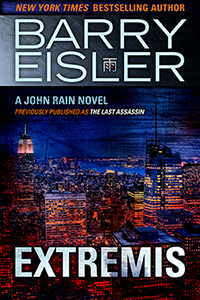
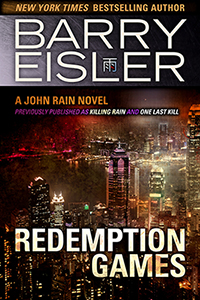
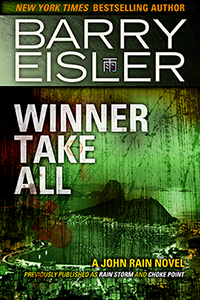
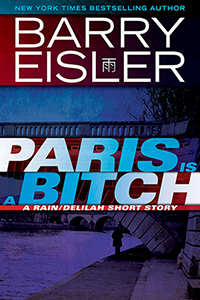
In case you didn't see the press release last week, John Rain is now part of the new Kindle Worlds program! Here's a Q&A I did with Philip Patrick about how it all works and touching on some pretty interesting related topics, too. Hope you find our discussion useful; it certainly was a lot of fun for me...

Barry: Hi Philip, congratulations to you and Amazon on yet another innovative development that’s sure to benefit readers and writers:  Kindle Worlds. I’m thrilled to be part of the program, and I thought it might be useful to anyone interested if you and I could share a few thoughts about how it works and what it’s all about.


To start with, how would you describe the program in a nutshell for anyone unfamiliar with it? I’d call it “licensed and commissioned fan fiction”—would that be accurate?


Philip:  Thanks for taking the time to talk about Kindle Worlds. Part of our mission at Amazon Publishing is to act as a laboratory to develop new ways for writers to be creative, connect to readers, and earn money. We hope that Kindle Worlds is a prime example of what we like to build. It’s a place for writers to create new stories inspired by popular books, shows, films, comics, music, and games. We’ve been calling them Worlds. Until now, selling stories based on somebody else’s World has been a big challenge for most writers. So we’ve worked to acquire licenses from Worlds to make it possible for writers—and yes some of them will be commissioned—to write new stories and earn royalties from every copy sold. We think it’s a win for everyone involved—the World rights holder, the writer, and ultimately the reader.


Barry:  Agreed. Not to get too political (I know, I know... it took me two whole paragraphs), but sometimes I think what the revolution in publishing really comes down to is choice—and whether you’re for or against it. I don’t care how authors choose to publish (Amazon, legacy, self, whatever); I just want them to have options. I don’t care how people read (iPad, Kindle, Nook, paper, whatever); I care that they read, and therefore that they can read in whatever way pleases them. And I don’t care how authors feel about fan fiction (Anne Rice hates it; Hugh Howey loves it); I care that they can license fan fiction if they choose. So naturally, when I first heard about Kindle Worlds, I loved the idea. Authors don’t have to participate; fans don’t have to opt in; free, unlicensed, unmonetized fan fiction can roll along as it always has. But now authors and fan fiction writers who are interested have a great new option for profiting from their Worlds and the fan-created works derived from those worlds.


Philip:  I think you’re spot-on. Giving writers and readers choices is at the heart of what we want to do. Many years ago, I had the good fortune to spend a weekend with the legendary publisher Ian Ballantine at his home outside New York. I remember walking into his house and seeing shelf after shelf of the mass-market paperbacks he’d published throughout his career. He looked at me and said: “It’s all about accessibility.” Fast forward a few decades and that concept of accessibility has only grown—and that is a good thing. Kindle Worlds is another avenue in this ongoing transformation.


Barry:  Yes. Other things being equal, if you make something easier to do, you’ll see an increase in the behavior in question. If you make that thing harder, you’ll see less of it. In fact, I remember reading an interview with Jeff Bezos years ago—way back when most people were still getting on the Internet with a dial-up connection. The interviewer asked Bezos something like, “What do you think is the greatest impediment to the growth of the online book-buying market?” I don’t remember the exact words, but Bezos responded along the lines of, “The amount of time it takes to get a dial-up connection.” I remember thinking, Yes, exactly! Just that one or two minutes of waiting can make all the difference. And there are countless other examples just like this one. Make something marginally easier, and rates of adoption explode. How can that be a bad thing when it comes to reading?


For me, Kindle Worlds is just a new form of subsidiary right. An author writes a manuscript and licenses, say, North American English-language publishing rights. But then there are also foreign language publication rights. No one is forcing an author to authorize, say, the French edition of her book, but if the opportunity is there, it’s nice to have. And if someone wants to option the film rights to the book, that’s great, too. No one is forcing the author to authorize a film; but not many authors would object to someone making them an offer. That’s the way I see Kindle Worlds. Another way authors can exploit the value of their underlying intellectual property rights—if they choose.


So how do interested authors and fan fiction writers learn more about Kindle Worlds and how they can participate?


Philip:  It’s all available at the Kindle Worlds website. There’s a good amount of information there as well as a sign-up for anyone who wants to be notified when the self-service submission portal goes live.


Barry:  Okay, I checked out the Kindle Worlds For Authors page, and I noticed that among your content guidelines you say you don’t accept pornography or offensive depictions of graphic sexual acts. Now, obviously there’s a lot of subjectivity at work here, though Woody Allen might have offered some helpful guidelines when he suggested, “Erotica is using a feather; pornography is using the whole chicken.”


But seriously, how do you draw a line? For example, there’s an explicit lesbian scene in my recent novella London Twist that some Amazon reviewers found shocking and offensive, and a pretty graphic scene in Redemption Games that some people have characterized (mischaracterized, in my opinion) as rape. Plus my friend Montie told me that one of my love scenes cost him thousands of dollars in therapy (though in fairness that’s because he was horrified to realize, as he put it, “My God, I have become sexually stimulated by the imagination of Barry Eisler.” I’ve really always wanted to use that as a blurb).


Anyway, how can participants in the program know what’s going to offend what I’m sure will become known as the Amazon Censors? And why did you decide to include a provision that you must have known so many people, not least erotica writers, will find troublesome?  Are you not worried that, in the service of preventing offense, you might in fact be causing it?


Philip:  In general, our strong bias is to give writers as much creative freedom as is appropriate to each World. The people who understand  that appropriateness best are the original rights holders—we’re calling them World Licensors—who will know what their audience expects and wants and how far the bounds can be pushed. There are shows, for instance, where mature content is part of the storytelling. And there are other shows where that isn’t the case. That makes sense to me on a lot of levels. So we’re asking each World Licensor to outline what is appropriate for their World’s audience in Content Guidelines. We’ll review submissions to see if they are within those guidelines. Our message to writers is pretty straightforward—follow any World’s guidelines and we will publish your story. And if something falls into a gray area, there’s always room for dialogue. We’ll talk to World Licensors as we review stories and we also will communicate back and forth with a writer if we have any questions.


Barry:  I get that each World Licensor can include his or her own guidelines, and I think that’s a great idea. It makes the program more attractive to potential World Licensors because they know they can customize fan fiction based on their Worlds in whatever way they want. Of course, if they customize too rigorously, there’s a chance they’ll be dissuading fan fiction writers who would otherwise want to participate, but that’s a decision each potential World Licensor can make for herself.  I have only very loose guidelines—pretty much just no titles the same as or misleadingly similar to the ones I use for my underlying works. Other than that, I’m happy to let fan fiction writers do whatever they like. Partly because I’m just pretty laissez faire about these things; partly because I don’t want to discourage people with too many restrictions.


But that’s all about the individual World guidelines, which are always up to the World Licensor. Again, I think that’s a great approach and a critical aspect of the program. But why not leave it at that? Why have, alongside those individual guidelines, program-wide guidelines of your own? It’s the latter class that will probably cause the most concern (is this love scene going to “offend” whoever at Amazon is reviewing with an eye toward the program-wide content guidelines?) and that I expect is going to cause some pushback.


Philip:  Looking across the entire program, it’s important to have some basic guidelines in certain areas. One of the guidelines, for instance, is about originality. The work submitted has to actually belong to the writer and can’t be copied from another source. As for the mature content it really does depend on the World. If slash fic is okay with the World it is okay with us. We want people to be creative and work within what the World Licensors tells us is appropriate for their World.


Barry:  When it comes to guidelines, what it comes down to for me is brand, and what a company wants its brand to stand for. I wouldn’t expect a publisher to surrender its ability to manage its brand any more than I’d expect an author to do so. (Personally, I’d love to see a kind of imprint for edgier stuff. You could even market it as Adult, Over-18, or otherwise as material so potentially offensive that it needs to come with a warning. Nothing like a “warning” to propel sales... “The book the CIA tried to ban!”)


What’s curious about the pushback I think you’re likely to receive is that establishment publishers aren’t held to the same standard. For example, I don’t think anyone has ever complained that a publisher exclusively catering to dry literary fiction refuses to publish erotica—at least, I don’t remember ever hearing someone claim that “Hey, that publisher is censoring erotica writers!” (or that Disney is censoring splatter movies, etc). One of the many things that interests me about the revolution in publishing is the way longstanding phenomena are often treated as both startlingly new and uniquely dangerous when these phenomena manifest themselves in digital. “But discovery is so hard!” “But you’ll have to market yourself!” etc. I could go on about this; for now, suffice to say that for some reason, a new context can make ancient challenges seem fresh and newly born.


I think the principled challenge to what I just said would be something like, “But Barry, that literary imprint is just one among many, and there are many erotica imprints that publish authors who write erotica and who therefore provide a means for erotic writers to reach readers. Kindle Worlds is different—it’s not just a kind of publisher, but also a platform, and the only platform of its kind. As such, it should be as inclusive as possible.”


I think that’s a fair point and I hope you guys will be flexible in your implementation of your guidelines. Remember, if it doesn’t offend at least twenty percent of people, it isn’t great art. :)


Okay, another question: how do the rights to new content work? In other words, what if a World writer invents a new character... can other writers who are writing in that World use that character? Can the World Licensor?


Philip Patrick: That’s a great and important question. Kindle Worlds is a creative community that includes the Kindle Worlds writers and the World Licensor. Every story you publish adds to a World and becomes part of that World. This means Kindle Worlds authors can build on each other’s stories. It also means that the World Licensor can build on or incorporate elements from those stories. My mental image is a sandbox: everyone is welcome to come in and be creative, but whatever is made stays there for the next writer and for the World Licensor. Our publishing agreement is an exclusive license to the story and its original elements for the term of copyright. Because of this, we recommend writers do not incorporate a character or new element into a Kindle Worlds story unless they want them an exclusive part of that World. If a writer wants to be creative with original ideas but not have their work under this kind of license, Amazon supports them fully and has great options with much more flexibility and control at Kindle Direct Publishing and CreateSpace. Again this is all about creating new models and options for writers. The writers we have been working with so far have found it great fun and a new creative challenge to write in somebody else’s World.


Barry:  I think this approach will be part of the key to the success of the program. Whatever you want to call it—a sandbox, a pool, a cookpot—the idea is that new writers will grow a World, and the more a World grows, the more there will be for new writers to do with it. The skew is in favor of inclusiveness rather than restrictions.


Philip:  Hey, I was thrilled to include John Rain--Valiant Entertainment, Blake Crouch, Hugh Howey, and Neal Stephenson--in our recent announcement about new licenses for Kindle Worlds. Thanks for being with us. Is there anything you’d like to share with your readers about John Rain?


Barry:  Ah, thanks for that. Well, as I mention above, I don’t have any particular guidelines, so if anyone out there feels compelled to write Rain/Dox slash or whatever, it doesn’t bother me.


Which actually brings up a point I think is worth emphasizing. Different writers feel differently (and sometimes very strongly) about these things, and I don’t think there’s any right or wrong answer for what at root is based on a feeling. Am I comfortable with other people writing stories set in my Worlds? Offering their own interpretations of my characters, their own insights, their own flavor? Or am I not?


I’m really only concerned about one thing: that readers know if I wrote it, or if someone else did. As long as there’s no confusion in that regard, I’m comfortable trusting readers to find whatever makes them happy, and to pass on anything that doesn’t. Again, for me this isn’t so different from authorizing a French edition, or a movie, or any other derivative work. I don’t speak French, so I can’t opine about the quality of a translation. And I’m not making the movie, so I can’t do much to influence the quality of whatever gets made. And as long as people know I didn’t write the book in French, or write and direct the movie, I’m okay with these kinds of derivative projects. They’re based on, or inspired by, my works, but they’re not my works themselves.


I’m not saying all that as a logical point—again, I think it comes down to how you feel. If you feel like seeing a movie that for you doesn’t do justice to your underlying works would be unduly upsetting, then you’ll be inhibited from licensing the movie rights. If you feel like, “Hey, it wasn’t my movie anyway,” then you won’t have a problem talking to Hollywood.


As I said earlier: for me, it really comes down to choice, and to the notion, which except at the margins I find axiomatic, that more choice is good. However various authors decide to approach Kindle Worlds, there’s still always going to be fan fiction. It’s just that now, rights holders and fan fiction writers have a way of making money from it—if they want to.


Philip: I couldn’t agree with you more. The world has gotten more creative. Whether it’s a laptop or mp3 recorder or digital camera, people have the tools to respond to what they see, feel, hear, taste, and read. And they have platforms to share those responses with others. Maybe just family and friends. Maybe millions of people across the planet. The work we’re doing at Kindle Worlds is just a sliver of that possibility—to respond and share. It isn’t necessarily perfect for every rights holder or every writer out there. And that’s okay. But for the ones who gravitate toward it, it has the ability to expand a World one story at a time—and that just seems like a win for everyone involved.