Saturday, August 22, 2020

Barton Gellman's Dark Mirror

I'm still trying to catch up on reviewing some of the great books I've listened to during the pandemic (and now the wildfires). Last time was Maija Soderholm's The Hustler. This week is Barton Gellman's Dark Mirror: Edward Snowden and the American Surveillance State.
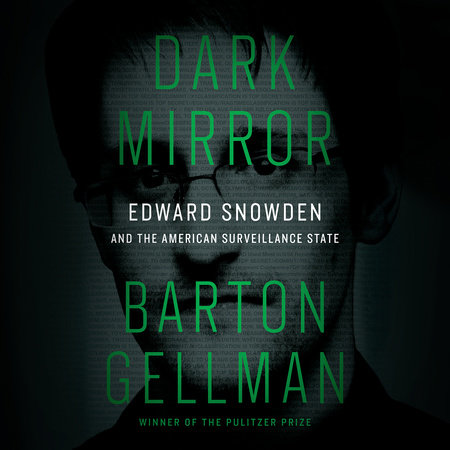
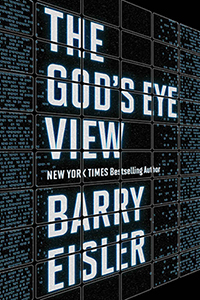
I've followed the reporting based on whistleblower Edward Snowden's revelations reasonably closely since June 2013, when I was working on The God's Eye View and was concerned that the secret bulk surveillance (sorry, "data collection") program I imagined for the novel was going to seem like too much. And then, as I dove into Gellman's and other reporting based on Snowden's revelations, I realized the program I had envisioned wasn't nearly enough, and that the reality of domestic spying had already far outpaced my imagination (more on how reality wound up informing God's Eye here).

Beyond the reporting itself, I read No Place to Hide: Edward Snowden, the NSA, and the U.S. Surveillance State, by Glenn Greenwald, along with Gellman one of the reporters to whom Snowden entrusted his revelations (my thoughts on No Place to Hide here and here). I also watched CitizenFour, the Oscar-winning documentary by filmmaker Laura Poitras, another of Snowden's handpicked journalist contacts. And of course Oliver Stone's biopic Snowden, in which Joseph Gordon Levitt, who physically bears little resemblance to the real Snowden, manages an uncanny imitation through body language and a remarkable imitation of Snowden's voice and vocal cadences. And I wrote an op-ed for Time Magazine urging then-president Obama to pardon Snowden (spoiler alert, Obama didn't listen).

Lastly, a few years ago I shared some thoughts on Snowden and whistleblowing alongside former director of the CIA and NSA Michael Hayden in front of the San Francisco chapter of the Association of Former Intelligence Officers. Hayden was promoting his memoir Playing to the Edge and I was promoting The God’s Eye View. I wouldn't say we all saw eye to eye, but it was a good discussion.

So that's the tale of how I've been following the Snowden story since 2013 (I'm chagrined to admit I haven't yet read Snowden's own memoir, Permanent Record). But as familiar as I am with Snowden's revelations and the story of how they came to be, I was still knocked out by the amount of fresh material in Gellman's book. Dark Mirror has plenty about the programs Snowden revealed, yes, but what made the book particularly compelling for me were the personal aspects Gellman detailed: how Gellman built trust with the anonymous source who initially reached out to him; the bordering-on-paranoia steps he took to protect their communications; the decisions he had to make about what news organization to work with on the stories. There's a scene where Gellman is negotiating with the leadership of The Washington Post—on what he would require if he was going to agree to work with them—that actually made me tear up! Which doesn't often happen when I'm reading nonfiction (or at least I can't admit that it does, because that would be bad for my brand).

Part of what made the audiobook so affecting, I think, is that Gellman narrated it himself. Given the personal aspects of the story, and given that Gellman did such terrific job, I'd say the publisher made the right call.

The dictum in detective fiction is that the best stories aren’t about how the detective works the case, but about how the case works the detective. And that’s part of what makes Dark Mirror so gripping—how a set of incredibly high-stakes circumstances affected Gellman, what decisions he had to make, what it put him through and how it shaped and forged him. Anyone interested in investigative journalism will find these sections of the book fascinating and even moving.

Not long ago, I came across a video by screenwriter Michael Arndt on what makes a great story ending. Arndt makes a case for three sets of stakes: external; internal (emotional); and philosophical. I could go on and on about this, but for now I’ll just say that I think part of what makes Dark Mirror so unusual for nonfiction is that all three stakes are in play. External—the risks Gellman was running given the laws and resources the state could deploy against him (reputation, providing for his family, prison). Internal/emotional—how far beyond simply protecting a source can you go before you've drifted beyond journalism and into something else (journalism, advocacy, what is the proper role—can a journalist be “aiding and abetting” as David Gregory infamously suggested)? Philosophical—when it comes to secrets, who ultimately gets to decide (hint: whoever it is, it's not the government)?

And how do you grapple with these momentous questions when you can’t talk to anyone, not even the people you trust the most?

Anyone with an interest in how the government has created a giant one-way mirror through which the government knows more and more about the people and the people know less and less about the government; in why whistleblowing and investigative journalism are our last line of defense against this metastatic asymmetry; and in the mechanics of reporting on one of the most explosive set of national security revelations of all time, will get a lot out of this book. I know I did.

Monday, August 10, 2020

Maija Soderholm’s The Hustler: Sword Play and the Art of Tactical Thinking

I’ve been meaning to share some thoughts about Maija Soderholm’s latest book, The Hustler: Sword Play and the Art of Tactical Thinking, since finishing it a couple months ago. Alas the pandemic and the new manuscript have been a distraction. But here we are at last…


If Maija’s name sounds familiar, it might be because she was one of Livia’s mentors in Livia Lone.


Maija is also the author of a previous book on martial arts tactics, The Liar, The Cheat, and The Thief: Deception and the Art of Sword Play. And she's one of the real-world designers of Livia’s favorite knife—the Somico Vaari. A few of my thoughts on the Vaari in this video.


The Hustler is every bit as useful and insightful a book on tactics as its predecessor. It’s true that Maija, an expert with swords, presents her thoughts on violence in the context of her chosen art. But it’s equally true that her observations have applicability far broader than swordplay itself. In this respect, her work is in keeping with with martial arts classics like Miyamoto Musashi’s Book of Five Rings, which is of course about sword combat but is also read in corporate boardrooms, and Sun Tzu’s Art of War, which likewise is about far more than its titular topic.

Parenthetically, it occurs to me that in at least one important sense, great books on strategy can be like great stories. The best stories are about something, but really about something else. Think about your favorite television shows. Among mine is Breaking Bad. It’s about a milquetoast high school chemistry professor who’s diagnosed with terminal cancer and turns to cooking meth to make sure his family will be provided for after he dies. But it’s really about self-actualization: how far would you go to become your authentic self—even if your authentic self were a master criminal?


So don’t think of Maija’s books as being only about swords. They’re really about far more. As Maija’s teacher, Sonny Umpad, put it, “There is no art in killing. There is no art in dying. The art is in the living.”

There were two passages in the book I particularly lovedboth because they rang so true for me and because they made me feel I’m getting these things right in my fiction. The first is this:

It has been my experience that putting a sword in a person’s hand will bring out their natural personality. You can see people become who they really are—scared, aggressive, joyous, dark, tentative, enthusiasts, killers, or players. It is hard to hide who you are with a blade in your hand. Maybe it is some ancestral DNA that understands what blades can do? After all, the sword has been a killing weapon since the bronze age. Who knows? In any case, it is the best forum I have ever come across to truly be able to “see” people, to learn who they are and how they can be trapped.

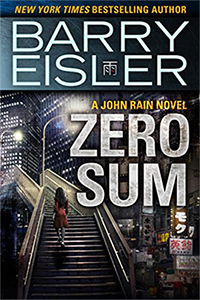
Which reminded me of this scene between Rain and his older paramour, Maria Grazia, in Zero Sum:


We walked over to the swords. There were at least a dozen, each resting on a wooden stand holding two components. On top of each stand was a koshirae scabbard and tsuka hilt, suggesting a sword at rest within. But the gorgeous lacquered scabbards and tsukaito ray-skin-and-silk grips were for combat, not storage; for the latter, on the lower tier of each stand was a shirasaya, a plain wooden scabbard, with the blade inside and a plain wooden hilt attached...

“Do you remember any of them?” Maria said. “They’ve been with the museum for a long time.”

I nodded, feeling a little wistful, and pointed to the one I was already looking at—a classic katana resting in its shirasaya scabbard below a gold lacquer koshirae. “This one was always my favorite.”

“Would you like to handle it?”
I glanced at her, remembering how badly I’d wanted that as a boy. “Are you kidding?”
“Just please be careful.”
“Don’t worry, I won’t hurt the exhibits.”
“I’m more worried about you than the exhibits. They’re extremely sharp. I know you know, but still.”

I gripped the shirasaya in my left hand and the wood tsuka with my right, lifted the sword from the stand, and then, taking care to draw the mune, the back, along the inside of the shirasaya so as to protect the ha, the edge, unsheathed the slightly curved blade. I held it horizontally at eye level, manipulating it with my wrist, watching the expertly worked steel catch the light, dazzled by the perfect weight and balance, the sudden sense that what I held in my hand was more than mere metal, but was instead alert, purposeful, almost alive. I gazed at the hamon, the temper pattern along the edge, wondering how many battles this weapon had seen, how many lives taken, and for a moment, I felt a strange connection to it—both of us born in Japan, both of us forged for killing.

“It suits you,” Maria said, her voice slightly strange.

I blinked, realizing I’d been gone for a second. “Hmm?”

She was frowning slightly. “Just . . . you seem very comfortable holding a sword. Not like when you wear a tuxedo.”

I didn’t know quite what she had seen, but instinctively wanted to conceal it. I looked at the blade again. “I just always liked the kotō, the old swords, better than the shintō, the newer ones. The shintō were expertly made, of course, with beautiful tempering patterns. But I think I liked the more utilitarian presentation of the classic blades. They were less about beauty, and more about business.”

The second passage was this:
Sonny referred to the ability to “see,” when applied to individual opponents, as “reading,” and of this he was an expert. However, a higher skill he called “writing,” a skill at which the Maestro was most adept. His much talked about “ghostlike” quality came from this. It meant that he was virtually impossible to block and impossible to touch. Seemingly always just out of reach whilst striking you at will. His ability to set you up, coupled with his precision in judging range and his pinpoint accuracy, created the impression of fighting someone who wasn’t there.

This “writing” skill meant creating a situation in which he knew what his opponent would do next. Not only could Sonny read people, he could use this knowledge to move them to where he wanted them to go. Fascinatingly, he used this skill to teach as well as to fight.
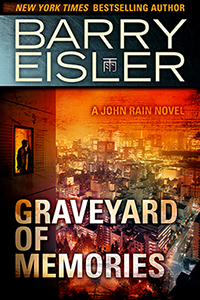
Which reminded me of this scene from Graveyard of Memories, where Rain is describing how his judo has evolved:
My play had reached a level at which for the most part I was able to anticipate an opponent’s attack in the instant before he launched it, subtly adjust my position accordingly, and frustrate his plan without his knowing exactly why he’d been unable to execute. After a while of this invisible interference, often an opponent would try to force an opening, or muscle a throw, or would otherwise over-commit himself, at which point, depending on my mood, I might throw him. Other times, I was content merely to flow from counter to counter, preventing battles rather than fighting them. A different approach than had characterized my younger days at the Kodokan, when my style had more to do with aggression and bravado than it did with elegance and efficiency.
In fairness, I borrowed that concept from one of my own teachers, Stephen Blower of the Kodokan, whose judo was the most elegant I’ve ever known. When I once asked Stephen how his play had evolved as he got older (he had been a relatively young third dan when we met), he described it in terms similar to the ones above.

If you’re looking for a short work about a fascinating art that’s really about much more, I highly recommend The Hustler. I’ll certainly be drawing on it in my fiction, and of course outside it, too.

Tuesday, May 19, 2020

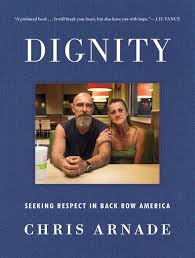
Dignity: Seeking Respect in Back Row America

I just finished reading Chris Arnade's Dignity: Seeking Respect in Back Row America.


There's so much that's impressive about this book. The four-year, zigzagging cross-country journey that undergirds it. The beautiful, moving photographs. The originality and insights, including the abandonment of the sclerotic and increasingly propagandistic left/right framework in favor of "front row/back row."

But for me, what might be most notable is Arnade's ability and inclination not to judge others, but to instead ask, "Am I myself guilty of anything comparable?" A question that is induced by empathy and results in compassion.

I'm not religious, but there's wisdom in Matthew 7:5. Arnade's book is a manifestation of it.

Monday, April 13, 2020

Pandemic Writing...Plus Some Sharp Pointy Things

Recently Amazon Publishing posted a video we did about writing during the pandemic (embedded below). It was a lot of fun and people seem to be enjoying it, which makes me happy.

During the intro, I had discussed and displayed a few weapons some of my characters have used, but that part got cut from the finished product. So for anyone interested in such matters, here are two minutes on the Somico Vaari, the Cold Steel Natchez Bowie, and the RMJ Tactical Berserker tomahawk... :)


Saturday, February 22, 2020

Why Biden is Down and Sanders is Up

A theory:

A year ago, Biden was polling nationally in first place. But a significant amount of his support was coming from people who supported him because of a belief in his “electability.” As soon as the myth of Biden’s electability was punctured, the bubble burst, and Biden’s polling numbers collapsed.

Sanders is the opposite phenomenon. For substantive reasons, a lot of people wanted to support Sanders, but hesitated because they were afraid he wasn’t sufficiently electable. And as Sanders began to raise unprecedented amounts of money from small-dollar donations, rise in the polls, perform strongly in debates, and win the popular vote in Iowa and then in New Hampshire, people who previously doubted his electability began to support him.

If I’m right about this phenomenon, Sanders is only at the beginning of a virtuous cycle. His massive win in Nevada—despite all establishment attempts to stop him—is going to draw even more supporters who had previously hesitated because of electability concerns. And as electability concerns are increasingly replaced by a belief that “Sanders could actually win this,” and as “Sanders could actually win this” is replaced by “Sanders is going to win this,” he is going to become unstoppable, no matter how much the Democratic establishment and the establishment media throws at him.

Of course I could be wrong; having watched innumerable television “experts” humiliate themselves prognosticating, it’s best to be humble about how much one might be missing.

But at this point, this is how I see it.

By the way, I got some of the idea for this post by a fascinating business book I read years ago—Crossing the Chasm: Marketing and Selling Disruptive Products to Mainstream Customers—about how a new technology first attracts early adopters before crossing over to mass-market appeal.

Friday, February 14, 2020

Eminent Monsters

Last night I attended a screening of the documentary Eminent Monsters: A Manual for Modern Torture. This is a horrifying account of how various western psychologists devised the “mind-control” techniques of MKUltra, and how those techniques were then deployed against the “Hooded Men” in the UK, and revived yet again in America’s torture of prisoners at Guantanamo.

I’ve been writing about torture for 16 years. My initial attempt to grapple with the issue was, I realize now, emotional and ignorant. What I’ve learned since then is that the impulse to torture is a product of emotional urges: the rush of utter dominance over another human being; the satisfaction of instilling fear into a population; the comfort of a talisman. It’s also an outstanding way to produce false confessions. And because we humans are so superbly designed to provide intellectual rationalizations for actions that are in fact driven by emotion, we invent fantasy scenarios like “ticking time bombs” to explain actions we could never honestly justify.


Consider these quotes:

Perhaps the most significant moral characteristic of a nation is its hypocrisy. We have noted that self-deception and hypocrisy is an unvarying element in the moral life of all human beings. It is the tribute which morality pays to immorality.
  —Reinhold Neibuhr

From pacifist to terrorist, each person condemns violence—and then adds one cherished case in which it may be justified.
  —Gloria Steinem

What makes torture eternally tempting isn’t that it “works.” It’s that humans are drawn to it for emotional reasons, and are extraordinarily adept at rationalizing.

(For more, consider the long and horrifying history of unwitting human experimentation in America. This isn’t a topic on any school curriculum I’m aware of. Which in one sense is unsurprising, because what society wants to look in the mirror and see something so hideous staring back? But which in another sense is both tragic and dangerous, because to pretend that atrocities are a product of culture and not of human nature—that is, to pretend that we good people could of course could never do such thingsis the best way to guarantee their return.)

Which is why President Reagan’s signing of the UN Convention Against Torture and Other Cruel, Inhuman or Degrading Treatment or Punishment—and the Senate’s ratification, which by Article VI of the Constitution made the UNCAT the law of the land in America—was such a remarkable achievement. The treaty is a triumph of logic and morality over powerful and ever-present base emotional impulses. It’s also why the bipartisan conversion of torture from a crime to be prosecuted to a policy choice to be argued about is such a setback.

In the face of that setback, I fear our last line of defense against a torture recrudescence is to try to raise consciousness by telling the truth about torture. Eminent Monsters is a worthy contribution in that fight.

Sunday, February 09, 2020

More On How to Discuss Capitalism! and Socialism!

Not long ago I wrote a blog post about how the best way to talk about socialism was to not talk about socialism. This Nathan Robinson article from Current Affairs is a good example. Rather than cheering for Socialism! or Capitalism! (words that, in my experience, are so charged in America that they tend to prevent rather than foster meaningful thought and discussion), it simply poses a question. Which is:

Why are publicly financed fire departments good, while publicly financed health insurance is bad?

Of course there may be excellent reasons for why one is good and the other is bad! But in my opinion, this is the right way to approach questions of policy. Declaring Socialism! and Capitalism! is about as substantively meaningful as cheering for your favorite football team.

So please…if you want to comment on this link, don
t offer definitions, dont shout Venezuela!…just try to consider how publicly financed fire departments and publicly financed health insurance might be similar, how they might be different, and what those similarities and differences might suggest for policy.

No society has ever, or will ever, be built on agreement about substantive conclusions. But there are better ways to reach disagreement, and worse ones. Ways that leave the disagreeing people respecting each other and open to further discussion. And ways that degenerate into pathological antagonism and tribal warfare.

I think the Robinson article is one of the better ways. Here’s hoping it will provide an example…and some inspiration,
too.

Friday, January 31, 2020

The Best Way to Talk About Socialism is to Not Talk About Socialism

Updated Below

Why do most discussions of socialism shed so much heat and so little light? Because they’re about socialism! A word that has been so demonized in America (just as the word capitalism has been deified) that it prevents thought and discussion, rather than encouraging it.

For the record, I should say that I myself am not a socialist. Nor am I a capitalist. And the same is true of America, and of every other country and system on earth. There’s no pure one or the other, and discussing the two concepts as though they’re some sort of Manichean binary either-or choice is at best a misleading and sterile approach to the topic.

May I propose something I think would be better?

Here are some things we have in America that are taxpayer-funded for everyone’s benefit and apparently not socialism:

1.  Roads and highways.
2.  K-12 education.
3.  Parks
4.  Police.
5.  Fire departments.
6.  The military.
7.  The postal service.
8.  Catastrophe planning and response (National Guard, FEMA, etc).

Do you see what I’m getting at? To use just one of the foregoing examples, I think a useful framework for discussion would be, “Why is public K-12 education not socialism, but public college education is socialism?” Or, to put it more broadly while avoiding scare words entirely, “Why is public K-12 education good, but public college education (which in any event already exists at the state level) is bad?”

I have my opinions about such matters, naturally, but I care less about my (or anyone else’s) conclusions than I do about using a proper framework. There might be excellent, defensible reasons to distinguish between the costs and benefits of public K-12 education and those of public college education. That’s a discussion worth having. But reflexively looking at the first as the embodiment of the American Capitalist Way and the latter as Evil Foreign Socialism! isn’t likely to lead anywhere productive.

The same applies to taxpayer-funded health insurance for everyone’s benefit. If Medicare and Medicaid are good, and if free healthcare to soldiers and veterans is good, and if free or subsidized health insurance for congresspeople is good, what is it about taxpayer-funded health insurance for everyone that would be different or bad?

FWIW, my ideal society would be one where no one has to fear being homeless, or being hungry, or of being bankrupted by a medical emergency. And where everyone would have equal access to decent public transportation and to the kind of education that would offer the best chance of stable employment. My personal ideal is an outgrowth of my view (which I grant could be wrong) of human nature—I think humans are adequately motivated by hope, and generally don’t also need to be motivated by fear.

Now it’s possible that my ideal society is some sort of fantasy socialist utopia. But before anyone dismisses it as such, may I ask: how is my ideal so different from what we already believe with regard to crime? That is, I think most Americans would agree that in an ideal society, no one would fear being victimized by crime. No one would be reluctant to leave the house, or visit a park, or walk down the street out of fear of being mugged or worse. And we devote public resources—police, the judicial system, etc—in the service of that goal.

So I think a productive framework to considering my ideal society would be, “How is creating a society where no one has to fear being homeless different from creating a society where no one has to fear being victimized by crime?”

There might be important differences—differences so significant that in the end, you might decide that public resources devoted to freedom from fear of crime are good while public resources devoted to freedom from fear of homelessness are bad. And that opinion, even though I would disagree with it, is okay with me. I just want us to be able to have a productive conversation.

Itinteresting to consider what prevents us from approaching things by asking, “How is this new thing similar to and different from what we already have,” and instead shutting down the whole inquiry by invoking scare words, instead.

I think some of it is just the innate human tendency to be comfortable with the familiar and to fear the new. This is anecdotal, but a few years ago when I read an article about how one day soon drones will deliver packages to our doorsteps, my first thought was, “That’s horrible, what’s going to happen when one of those things crashes into a pedestrian?” And then I laughed at myself, because I realized, “What happens when a FedEx truck crashes into a pedestrian?” As it turns out, there’s a whole body of law on the topic, called Agency Law, and whatever else Agency Law does, outlawing FedEx isn’t part of it.

Anyway, if you think I’m on to something here, give it a try. The next time someone says to you, “Socialism!”, see if you can elevate the conversation by avoiding fraught labels and just comparing and contrasting the new to the existing, instead. It’s been my experience that doing so can lead to some really interesting and satisfying conversations even with people who don’t agree with you. And best of all, at the end you can still disagree, while liking and respecting each other, too. Which, if we could manage it, might not be a bad thing for society as a whole.

Update:

This Nathan Robinson article from Current Affairsabout how publicly financed fire departments and publicly financed health insurance might be similar, how they might be different, and what those similarities and differences might suggest for policyis an outstanding example of how to approach the topic productively.

Thursday, January 30, 2020

Phoniness and Electability

Updated Below

In September 2015—over a year before Trump was elected president—Rula Jebreal wrote what I think is still one of the most insightful takes ever on Trump’s appeal, comparing him to another rich demagogue, Italy’s former prime minister Silvio Berlusconi.

Given the current obsession with the electability of whichever Democrat will face off against Trump in the general election, Jebreals article is at least as worth reading now as it was at the time. But the gist: conmen like Berlusconi and Trump make their audience feel in on the joke. “We’re all liars and conmen,” the subtext goes; “the difference is, I’m honest about it!”

The reason Trump—who himself is such an obvious phony—is Kryptonite to other phonies is that subtext. “You can trust me because I’m letting you in on the joke—the other candidates are laughing at you, while I’m laughing with you!”

I recommend Adam Johnson on why so many electability discussions are nothing more than disguised ideological attacks (and from people with breathtakingly bad records on the topic). But it’s also true that electability matters, and if you’re factoring electability into your calculus of who to vote for, I think it’s important to consider the paradoxical withering effect Trump has on other phonies.

Of course I have my opinions about which Democratic candidates are more genuine and which are more phony. But it’s been my experience that as soon as specific politicians become the focus of a political conversation, the conversation’s heat-to-light ratio tends to worsen (in that regard, I regret that if you’re inclined to support Trump, you’ve probably already stopped reading)

That said, because so much support for Joe Biden has to do with notions of electability, I’m going to take a chance and say this:

No matter how much you might like Biden (and in many ways there is a lot to like, and even to admire), if you’re concerned about electability, I think you have to consider Biden’s long history of personal fabrications. Shaun King has compiled a list here, including video, and it’s devastating. On top of which, there’s also Biden’s attempt to rewrite his vote for, and support for, America’s 2003 invasion of Iraq, and his attempt to revise his long history of attempting to cut social security.

Again, I have my opinions about the 2003 Iraq invasion and about social security, but here the substance of such things isn’t my point. It’s the electability vulnerability of a candidate who is so breathtakingly dishonest about his involvement in themand the related vulnerability of any other candidate with a history of personal and political inconsistencies.

When I’m trying to decide on which candidate to support, I try to focus more on the person’s track record than on electability (though obviously the two topics overlap). But to the extent I’m considering who would be strongest against Trump and who would be weakest, I give a lot of weight to the question of which candidates are most genuine and which are most phony. We have plenty of evidence that other phonies dont do well against Trump. I think the more formidable matchup would be a candidate characterized by genuineness.

Update

This Zephyr Teachout op-ed is related and worth considering.

Friday, December 13, 2019

The Report: A Necessary Antidote to Torture Propaganda

UPDATED BELOW:

Recently I watched Amazon Studios’s The Report, written and directed by Scott Z. Burns. It’s a superb dramatization of how Senator Dianne Feinstein’s staffer Daniel Jones spent five dogged years ferreting out the truth about the CIA’s post-9/11 torture program, and provides an important corrective to Jack Bauer, Zero Dark Thirty, and other such pro-torture fantasy propaganda.


I’ve followed Americas descent into torture closely over the years and lobbied against it with Human Rights First, and in my opinion the movie did admirable work getting the facts right, and presenting them in the context of a gripping story. Given that this was a movie and not an essay, I don’t think Burns could have done much better. But I do think a few thoughts are worth noting as a postscript:

1.  Senator Feinstein’s reaction to the revelation that the CIA had hacked into her staff’s computers is best understood not as at attempt to thwart lawlessness, but as an attempt to protect the system the six-term senator is part of and identifies with.

2.  Then-President Obama’s “ban” on torture should be condemned, not praised. By treaty and federal implementing legislation, torture is illegal in America. A president has no more power to prohibit than to permit it, and purporting to do so has the insidious effect of converting torture from criminality into policy--as Obama’s “ban” has indeed done.

3.  To date, none of the architects of America’s torture regime has been prosecuted. It’s worth reflecting on what this failure means with regard our cherished myth that we are a nation under the rule of law and that no one is above the law. It’s worth reflecting on how even as America imprisons more people than any other country on earth, the worst punishment Americas torturers are likely to face will be a negative portrayal in movies like The Report.

4.  To date, the 6,700-page eponymous torture report of the title--The Committee Study of the Central Intelligence Agencys Detention and Interrogation Program--has not been released for public review. Only a redacted summary is publicly available. And given the widespread acceptance that a “ban” and a desire to “look forward as opposed to looking backwards” would prevent any torture recrudescence, it’s especially important that the full report see the light of day. As Daniel Jones himself notes in a recent Washington Post op-ed:


Still, five years after the release of the torture report’s executive summary, and with many of the details about the CIA program still restricted from public view, former CIA leaders continue to defend the torture program as appropriate and effective. Their influence is felt in movies such as “Zero Dark Thirty,” and at the International Spy Museum in Washington, where children can climb into a replica of the CIA’s smallest confinement box and hear a former CIA official promote the torture program as “successful,” one that “saved American lives.” This is unacceptable and indicates that declassifying the full torture report is necessary.

I hope The Report will foster greater understanding that torture is illegal, immoral, and counterproductive. For more on this topic, here are some posts Ive written over the years, sadly still relevant today.

UPDATE:

Thanks to Geri Danton for linking to a great article about the weirdness of Jones saying, “If it’s going to come out, it has to come out the right way.” It may be that Jones really feels that way. But as I argued in a talk to the Association of Former Intelligence Officers, the notion that whistleblowing isn’t “right is logically and empirically incoherent.

Thanks to Wes V for linking to this great Intercepted podcast interview with Jones.

Finally, a friend emailed me to point out that its not just that Americas torturers havent been punished; many of them have actually prospered, for example with Gina Haspel being promoted to Director of Central Intelligence. A point ably made in the movie but I should have mentioned it myself.

Tuesday, November 26, 2019

The Kings Bay Plowshares 7 and Nuclear Annihilation

Below is a copy of a letter I sent today to the judge overseeing sentencing for the Kings Bay Plowshares 7, a group of activists, several of them elderly, who in April 2018 entered the Kings Bay Trident nuclear missile submarine base in St. Mary’s, Georgia to protest the dangers of nuclear weapons. In October they were found guilty of various federal crimes. They now face up to a quarter century in prison; their sentencing is set for early in 2020.

If you’d like to send your own letter in support, you can learn how here.

****************************

November 26, 2019

Dear Judge Wood,

As a former CIA officer—these days a novelist, activist against torture, and patriotic American—I’m writing on behalf of the Kings Bay Plowshares 7.

I respect the law and I understand it’s your job to follow it. I would only ask that, to the extent possible, you consider how rare and valuable in America are citizens like the accused.

Our country spends almost a trillion dollars a year on the militarymore than the next seven countries combined, four of whom are our allies. Of this, approximately $626 million per year alone is dedicated to public relations. In addition, the Pentagon and various corporate news networks cooperate to promote scores of retired generals as television talking heads. Yet amid all this spending and marketing and information domination, you would be hard-pressed to ever hear how frequently mistakes and miscalculations have taken the world to within an eyeblink of nuclear Armageddon.

There are obvious and unique dangers inherent in fallible humans possessing weapons that, if ever used, will end human civilization and extinguish almost all human life. Yet the government devotes tremendous resources to preventing discussion of these dangers. In such an unequal contest, I believe that anyone with the conscience, courage, and conviction to engage in civil disobedience intended to increase awareness of how close we are tottering to the edge of a final abyss should be cherished and celebrated, not punished.

Thank you for considering these thoughts as you grapple with what would be just for the Kings Bay Plowshares 7, and best for America and the world.

Sincerely yours,

Barry Eisler

Wednesday, November 20, 2019

The Sadness of Being Human

Yesterday I came across this passage from a recent New York Times article on the Japanese love of cherry blossoms:


The theme of many of Kenko’s passages is impermanence, a central tenet of Buddhism. Wealth, material goods, position, knowledge—all are passing, and all are meaningless. “The truly enlightened man has no learning, no virtue, no accomplishments, no fame,” Kenko writes in another essay, concluding, “All is unreality. Nothing is worth discussing, worth desiring.”
That idea—that everything in life is temporary; that all desire, whether altruistic or selfish in nature, is meaningless—helps explain the culture’s adoration of the sakura. If the cherry blossom can still be relied upon to bloom at a specific time, it can also be relied upon to die soon after: For 51 weeks, one waits, and within seven days at most, one is consigned to waiting once more. The pleasure of seeing a cherry tree in bloom is the sorrow of knowing that it will soon be over. To be in the presence of one is to be humbled before nature, and moreover, to be welcoming of that humiliation. A sakura is the human life condensed into the period of a week: a birth, a wild, brief glory, a death. It is to us what we are to the sweep of time—a millisecond of beauty, a memory before we are even through.
The article continues:
Even now, there is something haunted about the sakura; it is associated with death in a way that people cannot articulate to their satisfaction…

Which of course put me in mind of John Rain's thoughts about Aoyama BochiAoyama Cemeteryin A Lonely Resurrection:

I found myself near Nogizaka Station, and realized I had been unconsciously moving northwest. I stopped. Aoyama Bochi was just across from me, silent and brooding, drawing me like a gaping black hole whose gravity was even greater than that of surrounding Tokyo.

Without thinking, I cut across the road, hopping over the metal divider at its center. I paused at the stone steps before me, then surrendered and walked up to the graves within.
Immediately the sounds of the street below grew detached, distant, the meaningless echoes of urban voices whose urgent notes reached but held no sway over the park-like necropolis within. From where I stood, the cemetery seemed to have no end. It stretched out before me, a city in its own right, its myriad markers windowless tenements in miniature, laid out in still symmetry, long boulevards of the dead.

I moved deeper into the comforting gloom, along a stone walkway covered in cherry blossoms that lay like tenebrous snow in the glow of lamplights to either side. Just days earlier, these same blossoms had been celebrated by living Tokyoites, who came here in their drunken thousands to see reflected in the blossom’s brief and vital beauty the inherent pathos of their own lives. But now the blossoms were fallen, the revelers departed, even the garbage disgorged by their parties efficiently removed and discarded, and the area was once again given over only to the dead.

I thought of how Midori had once articulated the idea of mono no aware, a sensibility that, though frequently obscured during cherry blossom viewing by the cacophony of drunken doggerel and generator-powered television sets, remains steadfast in one of the two cultures from which I come. She had called it “the sadness of being human.” A wise, accepting sadness, she had said. I admired her for the depths of character such a description indicated. For me, sad has always been a synonym for bitter, and I suspect this will always be so.

Hoping I'll be back there this spring, researching the next Rain book, A Killing Affair.

Monday, September 30, 2019

Livia Lone is Back in All The Devils!

And...Livia Lone is back, in ALL THE DEVILS!


A search for a pair of serial rapists leads Livia Lone down the darkest and most dangerous trail of her life in a pulse-pounding thriller by New York Times bestselling author Barry Eisler.

Ten years ago, the daughter of Homeland Security Investigations agent B. D. Little vanished into thin air. So did seven other girls—the crimes all bearing the same signature characteristics.

Now the disappearances have begun again. And Agent Little’s efforts to investigate are being blocked by forces far above his pay grade. Desperate, he turns to Seattle sex-crimes detective Livia Lone, the most obsessive hunter of predators Little knows.

Livia will need that obsessiveness, and a lot more. Because the two men Little is pursuing are fearsome. Both Special Forces veterans with a dozen tours in Iraq between them. Both sadists and serial rapists. And one, the congressman scion of the vice president of the United States—a man who will use all the power of the White House to protect his son’s secrets and further his own ambitions.

The conspirators have all the assets and all the angles. And every reason to believe they’ll evade justice, as they always have before.

They don’t understand that for Livia Lone, justice is only a guideline. Revenge is the rule.

Praise for Barry Eisler’s Livia Lone:

An Amazon Best Book of 2016

Kirkus Reviews Best Fiction of 2016 Selection

“An absolutely first-rate thriller…Emotionally true at each beat.” New York Times Book Review

“An explosive thriller that plunges into the sewer of human smuggling…Filled with raw power, [Livia Lone] may be the darkest thriller of the year.” Kirkus Reviews (starred review)

“Readers may be reminded of Stieg Larsson’s beloved Lisbeth Salander when they meet Livia Lone, and will be totally riveted by the story of this woman on a mission to right the wrongs in her past.” —Bookish

“You won’t be able to tear yourself away as the story accelerates into a Tarantino-worthy climax and when you’re left gasping in the wake of its gut-wrenching vigilante justice, you’ll belatedly realize you learned a lot about a social travesty that gets far too little attention…Livia Lone is a harrowing tale with a conscience.” Chicago Review of Books

Praise for Barry Eisler’s The Killer Collective:

“Impossibly cool.” Entertainment Weekly

“As usual with an Eisler novel, the plot is full of twists, the prose is muscular, and the action unfolds at a torrid pace. The result is another page-turner from one of the better thriller writers since James Grady published Six Days of the Condor in 1974.” —Associated Press

“In this crackling-good thriller from bestseller Eisler, Seattle PD sex crimes detective Livia Lone, assassin John Rain, and former Marine sniper Dox form a testy alliance to combat a vile conspiracy involving corrupt and toxic government agencies…The feisty interplay among these killer elites is as irresistible as if one combined the Justice League with the Avengers, swapping out the superhero uniforms for cutting-edge weaponry and scintillating spycraft. By the satisfying conclusion, the world has been scrubbed a bit cleaner of perfidy. This is delightfully brutal fun.” Publishers Weekly (starred review)

“Vicarious pleasure for anyone wanting to see the scum of the world get its due.” Kirkus Reviews

“Riveting…Barry Eisler pulls off an Avengers-like feat…” The Mercury News
“Eisler turns the heat up like never before to deliver a fun, fast-paced thriller that’s tailor-made for fans of nonstop action.” —The Real Book Spy

Tuesday, August 27, 2019

Republic vs Democracy and Other Drugs

The question of how much weight to give individual votes vs regional concerns is an important one on which reasonable people can differ. But the notion that America is either a democracy or a republic is irrelevant to that question (and to pretty much everything else). Worse, these labels, like so many others, while shedding virtually no light also shed a ton of heat.

Not asking for anyone to take my word for it. Just Google “America Democracy Republic” and see where it takes you.

A few examples:

“For all practical purposes, and in most contexts, ‘republic’ and ‘democracy’ are synonyms. The big difference is that the first comes from Latin and the latter from Greek. To say that the U.S. is a republic, not a democracy, is like claiming to eat beef and pork but not cows and pigs.”

“To say that the United States is not a democracy is correct if democracy is defined in a way that no government on Earth, past or present, qualifies as one. It is as useful to say, ‘The Vietnam War wasn’t a war, because Congress didn’t declare war.’”

“I often hear people argue that the United States is a republic, not a democracy. But that’s a false dichotomy. A common definition of ‘republic’ is, to quote the American Heritage Dictionary, ‘A political order in which the supreme power lies in a body of citizens who are entitled to vote for officers and representatives responsible to them’ — we are that. A common definition of ‘democracy’ is, ‘Government by the people, exercised either directly or through elected representatives’ — we are that, too.”

“If there’s substance behind ‘We’re a republic, not a democracy,’ it’s not as a description of American government. There’s really no difference, in the present, between a ‘republic’ and a ‘democracy’: Both connote systems of representation in which sovereignty and authority derive from the public at large.”

If the concern is over how much weight to give individual votes vs regional concerns, why not just talk about that?

There are tons of other topics poisoned by an addiction to nomenclature. For example, instead of a Manichean death match over capitalism vs socialism (as though there’s a single example of either/or anywhere on earth), why not discuss what services are best provided by the government, and what services are best left to the private sector? An important topic on which reasonable people can disagree, and probably one we could discuss with less shouting, if we could get past our love of labels.

So many labels shed more heat than light. I can’t decide if people are attached to them despite this, or because.

Monday, August 19, 2019

The Red Pill

At a party this past Saturday, I got to talking to a couple people about politics. They asked for my recommendations on what they ought to be reading, so I followed up with an email. And because the thoughts in the email might be useful to others, I thought Id publish them here, as well.

************

Hi B&D, great talking the other night and I hope I didn’t rant too much…!

If you want to take the red pill, here’s what I’d recommend as a start:

1. Left/Right/Center. We’re constantly fed a framework of left/right/center. But how useful is that framework for understanding what’s going on in our society? I’d argue that powerful/disempowered; insider/outsider; 1%/99%; front-row/back-row (hat tip to Chris Arnade for that terminology); establishment (what we call in other countries “oligarchy, but thankfully we don’t have oligarchs, at worst we have only billionaires)/everyone else) is a far more accurate and useful framework.

You mentioned Axios, for example. Beyond the curious notion that a self-declared cross between The Economist and Twitter could on balance offer anything beneficial, what does the sites funding suggest about its ideology (hint: think corporate and establishment)? Not saying funding is necessarily dispositive (The Intercept, which I think is great, was founded by Pierre Omidyar, and does good work in bringing transparency to America’s powerful factions (we have factions, remember; only primitive, dark-skinned countries have tribes)). But I think it’s sensible to ponder what Axio’s (or anyone’s) funders, all of whom are presumably smart, sophisticated people, are hoping to get out of their investment.

Also note that Axios’s founders came out of Politico, the world’s premier media for insider baseball and vapid horserace coverage—what NYU media professor Jay Rosen calls “savvy” journalism. I’d argue that the “savvy” ideology is far more consequential in America than left/right. Certainly it’s more insidious. Listen to political conversations among citizens—how much do we discuss substance, such as “X program would be good or bad for society,” and how much have we been trained to focus on “Oh, X program was a smart/dumb move by Y candidate, it will fire up/disappoint the base, provide difficult/easy attacks for her opponents…”

But “savvy” is barely recognized as a journalistic style or means of political discourse, much less an ideology.

2. Bias. The notion of “bias” in media is bullshit and inherently propagandistic. Bias is just the bad word for worldview—that is, “worldview I don’t agree with.” But everyone has a worldview, so “X is biased” is a truism that conveys zero useful information. What we should be asking instead is, “Is this coverage coherent and defensible, is the journalist aware of and open about her biases, does she show her work?” Again, Jay Rosen, linked to above, is terrific on this.

More on the “bias” dodge in The Greatest Trick the Devil Ever Pulled. With some links to writers to follow if you’re curious.

3. American Violence Is Always A Force For Good. Of course we don’t call it “American violence.” We don’t even have wars anymore, with “military interventions” more the done thing. Here’s me trying to explain to a Martian why American violence is good and indeed exceptional (how could it not be, given American Exceptionalism? A phrase well worth pondering). I did my best, but I think the Martian was more persuasive.

I think it’s critical to remember that we’re all wired to cut ourselves (and, by extension, our in-groups) enormous slack. See, for example, the Fundamental Attribution Error. This is why Ken Burns could conclude that America’s war in Vietnam—where we killed as many as two million civilians and another million North Vietnamese and Viet Cong fighters was a “tragedy,” like a hurricane or cancer or other act of God that isn’t subject to human policymaking and deliberate decisions. And why no western journalist would ever describe, say, the Soviet Union’s war in Afghanistan in similar terms.

But what should we say about a country that goes all the way to the other side of the world and kills three million people to spread its ideology (I know, I know, all our wars are about defending, never about spreading, only Putin spreads;)) if we didn’t know the country in question was us? Would we say, “Oh, they meant well, and sure, maybe mistakes were made, but only with good intentions, and when they kill three million people in pursuit of their geopolitical objectives, on balance they’re always a force for good, thank God for that country and we should absolutely trust them with thousands of nuclear weapons, because on balance we’re all safer because of those weapons…?”

(Especially when you consider that the country in question is the only one to have used nuclear weapons in anger, ever. And that’s leaving aside the long and terrifying history of nuclear mistakes and terrifying current vulnerabilities. But I digress.)

Or would we reserve that narrative exclusively for ourselves?

4. Chomsky. The ultimate red pill is Chomsky. Here’s a five-minute cartoon primer on his seminal book, Manufacturing Consent. Note the need for an external enemy, which by amazing coincidence, we always seem to have.

5. Democracy Now! The Chomsky video above is narrated by Amy Goodman of Democracy NowThis is a great general news program. It’s easy to understand DN as leftist media, but again, consider whether left/right is the most useful and accurate framework for understanding what DN is doing, or whether there is something more relevant and important about their priorities.

6. Socialism. I know, I know, the bogeyman! Almost literally, in the sense that the bogeyman doesn’t exist and was invented as a means of scaring powerless children into compliance. America is so massively a corporatist society (but how often do you hear about corporatism in establishment media?) that the notion of socialism as something we should fear actually happening here would be hilarious if the demonization of this word hadn’t been so effective at shutting down conversation about what programs the government can and should sensibly provide, and which are better left to the private sector. Instead, anything America’s oligarchy doesn’t want, it can just label with the fear word “Socialism!” and the conversation is over. In fact, politicians have traditionally been so afraid of being branded socialist that the conversation never even gets started.

Thank Bernie for changing that, BTW. :)

And remember, it’s worth considering “But how can we afford that?” is only asked of social programs, never of our endless wars and trillion-dollar annual war budget. Medical insurance for all? How can we afford that? Space Force? No questions even asked!

Why would that be? Where does it come from?

“We can’t afford X” simply means “X is not a priority.” The same as, “I don’t have time for X” means “X is not a priority.” We’ve all had relatives die of cancer. I don’t know about you, but sometimes I wonder whether, if we diverted a bit of our annual near trillion-dollar war spending orgy—in which we spend more on the military than the next seven countries on earth, five of whom are our allies—to cancer research, whether it might have helped my mother. No way to know, of course. But it couldn’t have hurt.

Still, no matter how you cut it, there’s no way anyone can dispute that America cares more about maintaining a grotesquely bloated military than it does about curing cancer. And pretty much everything else. That’s not because we can’t afford those other things. It’s because we’ve decided spending money on war (oops, I meant to say defense!) is more important.

Anyway, given how effective America’s various power brokers have been in demonizing the S word, and given how marginalized the concept is in America, it stands to reason that an avowedly socialist magazine could be a useful antidote for the nonstop western self-congratulation and endless cheerleading for western wars (sorry, interventions) you’ll find in, say, The Economist. In this regard, I recommend Current Affairs.

The main thing is, whatever flavor of establishment media you might be consuming, you’re still consuming an establishment ideology. The Wall Street Journal isn’t a meaningful balance to the New York Times. Likewise MSNBC and Fox. If you want balance, you have to look beyond the obvious, which is what’s most readily available. And all we’re supposed to see.

A final thought:

As a species, we’re hardwired to pursue pleasure and avoid pain. It follows that we would tend to consume news that comforts us by supporting background assumptions rather than news that discomforts us by calling those cherished assumptions into question. If I’m right about this, it follows that we should probably discount the comforting news, knowing our attraction to it is probably more a function of our internal emotional and psychological longings than of its inherent accuracy or utility as anything more than a kind of security blanket.

If you’re still reading, thank you for listening. And of course feel free to disregard. Theres always the blue pill, and in fairness it is much easier to swallow.

:)