Hugely enjoyed doing this three-part talk with violence expert Tim Larkin, one of the people with whom I've been privileged to train and whose influences appear in my books. Part 1, Part 2, and Part 3.
Sunday, November 28, 2021


Saturday, October 16, 2021
Flash-Forward Preambles: What, How, and When
Updated Below
For various reasons, recently I got a little obsessed with flash-forward movie and television preambles. That is, presentations that begin with a scene from later in the story, and then spend some amount of screen time catching up to the “later” scene that came at the start. How much catch-up varies. Sometimes the catch-up happens only a few scenes later; sometimes the preamble was actually the end of the movie.
I started by casually going through a bunch of movies I’d already seen and thought I knew well, and was surprised to find many more examples of the technique than I had expected. The flash-forward preamble gets used in all kinds of stories: action, comedy, drama, horror. My guess is that opening with a flash-forward has become more common as it’s become easier for viewers to switch to something else. Once upon a time, a movie meant something of a commitment—a drive, parking, $20 for tickets…various opportunity and transaction costs. If something didn’t hook you right away, your alternative was to get up and leave, eat the $20 and the other costs, come up with a new plan and go someplace else. All of which meant you’d be incentivized to stay, which in turn meant movies could take their time warming up.
Today, going to a cinema has become an ever smaller part of how people consume movies, and hundreds, maybe even thousands of alternatives are always just a click away. Meaning filmmakers are motivated to find ways to hook an audience immediately, and keep them hooked. One popular method seems to be the flash-forward preamble. I’ve even seen the technique creep into previews, which are now often presented with a quick flash-forward from something later in the preview before the preview opens and plays sequentially.
It’s worth emphasizing that the fundamental objective of the preamble is to hook the viewer. How the preamble achieves this is important but ultimately secondary. If the viewer is hooked, the preamble was a success. If the viewer isn’t hooked, the preamble failed.
Now let’s talk a bit more about: (1) what the technique consists of; (2) how it works (that is, what makes it work); and finally (3) when you might want to use it (that is, what kinds of stories lend themselves to the technique). And then we’ll finish with a list of examples. Sound good? Okay, here we go...
What It Consists Of
As already noted, the flash-forward preamble consists of something that happens later in the story, presented upfront. But that’s merely necessary, not in itself sufficient, and in the best executions there were other commonalities, which we can distill out as principles (no spoilers in here because hey, these are all openings):
- A presentation of something central to the story. Examples:
- Breaking Bad—the impossibility of simultaneously trying to be a meth criminal mastermind and inoffensive high school teacher family man (duty to others vs self actualization)
- City of God—how to escape the favela when trapped between its warring forces (physical survival vs following your dream)
- Goodfellas—the cost of becoming a gangster, which “I always wanted to be”
- The Hangover—“Getting married in five hours,” “Not gonna happen, we lost the groom”
- Nobody—“Who are you, really?” (which identify defines us and which should we be true to)
- A complete presentation—that is, no fragments, no shadows, no direct mystery about what you see in the preamble, only an indirect mystery about how what you see in the preamble relates to the larger story. You can see everything, you just don’t yet know (but you badly want to know) how we got here, which makes you want to watch the rest of the movie or show.
How to Hook
The hook consists of two things:
- doling out certain critical information on who, what, and where, to draw in the viewer and ground the viewer in the story; and
- simultaneously causing intense curiosity about each piece of doled-out information, and ultimately instilling an even greater global curiosity about how and why we got here—a global curiosity that can only be satisfied by watching the rest of the show.
Sometimes preambles are expressed in terms of “teasing” the audience. I think this is a misnomer. Getting teased is easy to walk away from. Getting hooked, by definition, is not. So the goal isn’t to tease. The goal is to hook.
And because the goal is to hook—which requires both grounding and curiosity—it follows that more information in a preamble is good. But only as long as the curiosity created is commensurate. Lots of grounding plus lots of curiosity—answering lots of questions while posing other and more compelling ones—makes for the most effective hook, and therefore the most effective preamble.
Think of how much information is conveyed in the four-minute Breaking Bad preamble, or the one from Goodfellas. These are complete story moments—linear, chronologically intact fractals. The one exception I found is The Accountant, where too little information was presented (you can’t even see who’s involved), and not coincidentally that preamble was a relatively weak hook.
To put it another way: the preamble must offer substantial nourishment—while simultaneously, insidiously, and paradoxically famishing the viewer for more. That is, when it comes to preambles, less is not necessarily more. More can be more (another reason I don’t like the “teaser” nomenclature).
For more general thoughts on how a story engages an audience, I recommend this terrific TED talk by Pixar’s Andrew Stanton, The Clues To A Great Story.
It’s interesting to observe that among the examples below, almost every one involves a depiction of violence—either the violence itself, or the threat of violence, or its aftermath. This doesn’t mean that violence is necessary in a preamble; in fact, we know it’s not, because there are powerful instances of non-violent preambles (The Hangover, True Romance). But it certainly seems to be the case that violence can be useful.
And if most of this sounds relevant to story openings generally—it is! All openings should aim to hook, and all will do so with the paradoxical combination of nourishing and famishing discussed above. The flash-forward is just a particular way to do it.
Okay, now you know what it is and how it works. How do you decide if your story would benefit from it? After all, there are innumerable movies and television shows that hook you immediately without a preamble (though I do sometimes wonder whether even a masterpiece like Die Hard, were it made today, would have some studio executive saying, “Opening on the airplane is too slow and low stakes…do a flash forward to the explosion on the Nakatomi Tower rooftop and Bruce Willis leaping off with the firehose, then show a title card saying Six Hours Earlier and cut to the plane...”).
When To Use It
I think the stories that benefit most from a preamble are ones that in the absence of a preamble would begin with something slow, low-stakes, or otherwise not immediately gripping. If Vince Gilligan had opened the Breaking Bad pilot with Walter White in bed, then exercising, then eating breakfast, then getting disrespected at school and at his second job at the car wash, viewers might have grown impatient. But begin with that crazy Winnebago preamble, and for the rest of the pilot, viewers will be wondering, “How the hell do we get from this boring life to whatever that Winnebago thing was all about?”
Likewise, Brick is a noir mystery, but it’s set in a contemporary suburban high school. If Rian Johnson hadn’t opened with the dead girl in the culvert and Joseph Gordon-Levitt crying over her body, it would take much longer for viewers to understand that the stakes in this teenaged high-school world are actually life and death (and Johnson would have lost the opportunity to hook by making viewers wonder how and why the girl died, and what Gordon-Levitt’s connection with her was).
That said, while some stories might need a flash-forward preamble more than others, there are lots of reasons to use the technique beyond bare necessity, such as tone. But no matter what, the preamble should hook, or you risk losing your audience to one of the other thousand forms of entertainment always a click away.
Examples
I put together the following list from movies I know pretty well (and the television show Breaking Bad). I’m sure there are many more examples I haven’t thought of or don’t know of. Anyway, here you go.
Breaking BadBrickCasinoCenturionCity of GodDeadpoolDeadpool 2FallenFight ClubGoodfellasHacksaw RidgeThe HangoverJohn WickKiss Kiss Bang BangLet Me InLimitlessNobodyOnce Upon A Time In AmericaOut of SightPulp FictionTrue RomanceThe Usual Suspects
And some notables that start with a flashback preamble, but one that functions similarly to the flash-forward variety (interestingly, both are extremely violent):
Bad Times At The El RoyaleCasino Royale
Okay, those are my thoughts. Take it all with a grain of salt because though I’ve written a bunch of novels and short stories, I’ve never had a movie or television show made. So I could be off base about any of this, and even if I’m not, I still have a lot to learn. To that end, please don’t be shy about mentioning any additional flash-forward preamble examples in the comments section, along with any thoughts about how you think the technique works and when it’s best to use it. Thanks and I hope these thoughts have been useful.
Update:
Should have thought to check Wikipedia earlier—lots of interesting thoughts and examples under In Medias Res and Flash-Forward.
Monday, October 11, 2021
It's Not a "Bad Art Friend." It's a Bad Artist
Recently the New York Times published an article by Robert Kolker called Who Is the Bad Art Friend, which purported to be about the incredibly silly question of what constitutes a “bad art friend,” even the diction of which is markedly childish (for a short, incisive rejoinder, see Elizabeth Bruenig’s The Harsh, Central Truth of the Viral “Bad Art Friend” Story in the Atlantic).
Perhaps because the Times article itself was so confused, it’s led to some confusion. This is unfortunate for a number of reasons, among them that the article indirectly raises, while managing never to squarely address, the far more consequential question of what constitutes a bad artist.
If you’ve already read the Times article, you know the outline of the story. If not, a quick summary:
In 2015, a person named Dawn Dorland donated a kidney to a stranger. In preparation for the procedure, Dorland started a private Facebook group where she discussed her decision to donate and invited various people to join, including writers Dorland knew from a Boston organization called Grub Street. Some of those people failed to react; among them was a Grub Street writer Dorland thought of as a friend, Sonya Larson (I slightly know Larson because she handled the logistics for a talk I gave at Grub Street, I think about ten years ago. We also have some friends in common. I don’t know Dorland, although it’s possible we met when I gave my talk at Grub Street). When Larson failed to react to Dorland’s posts about her donation, Dorland pinged Larson to ask why. Larson then replied with some polite praise.
Later, Dorland learned that Larson had written The Kindest, a short story about someone who donates a kidney but with fundamentally narcissistic intentions. This upset Dorland, who signs off letters with “kindly.” Still later, Dorland learned that in Larson’s story, the narcissistic fictional character writes a letter to her kidney recipient, a letter that echoed a real letter Dorland had posted to her private Facebook group and incorporating something like 50 words from the real letter.When The Kindest started winning awards and garnering other acclaim, Dorland began contacting various parties to complain—an awards committee, a book festival, the Boston Globe, Grub Street, a writing conference where Larson had once had a scholarship, various friends of Larson’s. She also hired a lawyer and threatened litigation (strangely, Dorland claims “I'm not threatening,” but her threat to sue the Boston Book Festival—which planned to distribute 30,000 copies of The Kindest in connection with its One City, One Story program—for $150,000 succeeded in getting the festival to cancel the program for that year out of fear of being embroiled in a lawsuit).
Larson beat Dorland to the courthouse, alleging defamation and tortious interference; Dorland counterclaimed for copyright violation and intentional infliction of emotional distress, including alleging that Larson had caused Dorland to engage in self-slapping (apparently Dorland had previously sued a writing workshop Dorland was part of, also for causing emotional distress).Pursuant to the discovery Dorland demanded in her lawsuit, Larson provided Dorland’s lawyer copies of private texts between Larson and her friends in which they commiserated about Dorland, deriding her as annoying, self-important, unselfaware, and creepy.The judge has thrown out Dorland’s emotional-distress claims; her copyright claims haven’t been ruled on. The Times article doesn’t mention the status of Larson’s tortious interference claims; presumably they haven’t yet been ruled on either.While the case was pending, Dorland contacted the New York Times and pitched them the story that became Who Is the Bad Art Friend—which is Dorland’s own framing, the prism through which she views the situation.
So much for the TL;DR version of what happened. On to the online confusion.
1. Plagiarism. Some people seem to have bought into Dorland’s claim that Larson’s fictional use of about 50 words of Dorland’s Facebook letter is plagiarism. Which in some ways is understandable, because plagiarism is one of those words people are so eager to deploy as an accusation that they don’t want to let anything, let alone a definition, get in the way.
First, note that Dorland began her campaign against Larson long before even knowing of Larson’s use of the letter. Dorland’s original complaint, posted on Facebook, was that “a writer friend has based a short story on something momentous I did in my own life, without telling me or ever intending to tell me.” Or, as she emailed friends of Larson, “Why didn’t either of you check in with me when you knew that Sonya’s kidney story was related to my life?”
But to whatever degree Larson’s story might have been inspired by or based on Dorland’s donation, no one—neither Dorland nor anyone else—has or should be granted the right to prevent artists from incorporating kidney donations into their art. The reasons for denying individuals this much control over other’s artistic freedom ought to be obvious: doing so would drastically reduce the scope of permissible art and the societal benefits of art (though in fairness, Dorland’s position would be a boon to trial lawyers, as indeed it has been).
We can probably come up with hypotheticals about acts or strings of acts so unusual that we might agree that underlying rights should remain with the actor—the kind of “life rights” studios need to obtain before making a biopic, for example. But whatever else might be said about donating a kidney to a stranger, the act itself is not in this category. Donating a kidney to a stranger isn’t a life story; it isn’t even unique. In fact, Larissa MacFarquhar dedicated an entire chapter to the topic in her 2015 book Strangers Drowning: Impossible Idealism, Drastic Choices, and the Urge to Help, an examination of the nuanced, complicated, and not always admirable motives of people driven to help others in extreme ways (the chapter in question is called “Kidneys”).
So the origins of Dorland’s campaign against Larson had nothing to do with Dorland’s Facebook letter, but rather with the fact of the donation itself. Still, once Dorland realized Larson had used about 50 words of the letter in the story, she made claims of plagiarism central to her complaint. So whatever might actually be behind Dorland’s campaign, let’s talk about plagiarism.
Plagiarism is Joe Biden repeating portions of Bobby Kennedy’s or Neil Kinnock’s speeches in his own speeches, or Melania Trump doing the same thing with Michelle Obama. Or a comedian, presenting another comedian’s joke as her own. There’s no transformation there—someone else’s speech delivered as your speech; someone else’s joke delivered as your joke.
So if Larson had taken Dorland's letter and presented it as her own letter, that would have been plagiarism. But instead, Larson repurposed about 50 words of the real letter as fiction, written by a fictional character in a larger story. All of this seems to me to be classic transformative use, part of the Section 107 fair use exception to copyright law. And there’s good policy behind the fair use exception. As Cormac McCarthy says, “Books are made out of books,” and society benefits when artists have wide latitude to draw on everything around them in their art. We should want artists to be willing to take risks, question pieties, and attack shibboleths, and we should encourage them to sample widely in doing so. And we should be extremely cautious—as Section 107 is—about granting individuals so much control over their own deeds and their own words that the progress of art and the benefits art offers society are impeded in the process.
Some people have argued that Larson should have informed Dorland of what she was doing, or credited her as the writer behind a real letter Larson repurposed as fiction. But really, what was Larson supposed to do here? Inform Dorland, “Hi Dawn, not only am I aware of your donation, but it inspired me to write a short story about a profoundly unselfaware narcissistic white savior whose own donation is anything but heroic—oh and by the way, your Facebook letter was so perfect an exemplar that I used about 50 words of it in the story. Happy to give you explicit credit if you like; just let me know. Best, Sonya”?
Maybe in retrospect that would have been the better course. But doing so would have been an unusually blunt act, and Larson was clearly reluctant to share with Dorland her honest, negative opinion of her—a pretty common reluctance among humans who prefer not to hurt other people’s feelings, I would say, and certainly not an uncharitable one. And even if brutal honesty would in retrospect have been the better course, retroactively imposing such an expectation on someone dealing with a person she obviously found increasingly difficult seems a touch unrealistic. Certainly it’s not a standard many people would want to be held to themselves.
Personally, I would have advised Larson not to use the letter—not because using it was in any way immoral, illegal, or otherwise culpable, but because so many people have a knee-jerk reflex to plagiarism charges that the distraction from the more important question of artistic freedom might not have been worth it. That said, everyone, every artist, has to run these risk-reward calculations for herself. And while I doubt even Larson feels she handled this thing perfectly from the beginning, no one who survives a mugging ever handles it perfectly—much of the time, you don’t even realize it is a mugging until it’s well underway, and then you’re playing catch-up, just trying to figure out what’s happening and doing the best you can to get through it.
Again speaking personally, I’ll note that people have used my writing in various ways, and periodically I get mail informing me that so-and-so writer has ripped me off. I never bother even to look into the allegations. Life is short and I have more meaningful things to do than trying to lock up every handful of words I’ve ever strung together so I can stop other artists from using them. This suits my priorities and I think is good for society, too. Dorland obviously has a quite different value system.
The other misunderstanding I’ve encountered is that Larson and her friends were somehow being “mean” to Dorland because in private texts they made fun of what they perceived as Dorland’s annoying and even creepy tendencies and because they questioned the purity of the intentions behind Dorland’s donation decision (I hope it goes without saying that interrogating the purity of “altruistic” intentions shouldn’t be off-limits—nor is it, otherwise someone better get to work on suing Larissa MacFarquhar for writing a nonfiction book that does this very thing).
What’s primarily weird about the “mean” criticisms is that these were private conversations. Dorland (and the world) learned of the conversations’ existence only because Dorland demanded such communications in the course of her lawsuit. No one was saying these allegedly “mean” things to Dorland or in public; in fact, given what the texts reveal about what Larson and her friends really thought of Dorland, it seems they were all going out of their way to treat Dorland respectfully, politely, and kindly in public (while at the same time hinting to her without apparent effect that they would prefer she leave them alone).
Note that every contact Dorland had with Larson over the course of this years-long saga was initiated by…Dorland, beginning with the email she sent Larson asking why Larson hadn’t reacted to any of Dorland’s Facebook posts about the donation. It must have been obvious to everyone but Dorland that the friendship Dorland told herself she had with Larson and others in Larson’s circle was distinctly one-way.
What’s also weird about the “mean” criticisms is that commiserating about—or gossiping, laughing at, deriding, ridiculing, questioning, whatever—people you privately find irritating is a widespread, possibly even a universal human behavior. So to criticize Larson and her friends for engaging in it is almost certainly hypocrisy. As the Japanese expression goes, Saru mo shiri warai—The monkey laughs at the other monkey’s butt. Or, in this case, criticizes it. Humans rarely pass up sanctimony opportunities, and criticizing someone else for doing what we all sometimes do—privately deriding an individual perceived to be annoying—is a classic case.
Some of the “mean!” accusations might be the result of the Times extremely credulous adoption of Dorland’s belief that Larson et al were her friends and thought only well of her. But everything becomes much more understandable when you realize that these people weren’t Dorland’s friends, but were instead trying to distance themselves because she made them uncomfortable, while still trying to spare her feelings. This is the opposite of “mean.”
Among the various things I’ve learned about humans in my 57 years living among them is that “She’s just not that into you” is almost impossible for the “you” in that equation to accept, no matter how obvious it is to everyone else. People will cling to almost any belief about why someone is brushing them off rather than accept the simplest, most straightforward, most widespread and obvious explanation: She’s just not that into you.
It’s frequently surprising, and never comfortable, to realize that others might not share your own high regard for yourself. And it’s hard to error-correct for the powerful bias nature has built into our psyches, where our egos distort our perceptions with effects such as Illusory Superiority (which is why everyone thinks they’re above average) and the Fundamental Attribution Error (where we judge ourselves and our in-group by motives and others and out-groups by behavior). Still, if only on an intellectual level, healthy people will admit at least the possibility that they might be grading themselves and their own motivations on a curve. But don’t take my word for it; listen to Reinhold Niebuhr:
Perhaps the most significant moral characteristic of a nation is its hypocrisy. We have noted that self-deception and hypocrisy is an unvarying element in the moral life of all human beings. It is the tribute which morality pays to immorality, or rather the device by which the lesser self gains the consent of the larger self to indulge in impulses and ventures which the rational self can approve only when they are disguised. One can never be quite certain whether the disguise is meant only for the eye of the external observer or whether, as may be usually the case, it deceives the self. Naturally this defect in individuals becomes more apparent in the less moral life of nations. Yet it might be supposed that nations, of whom so much less is expected, would not be under the necessity of making moral pretensions for their actions. There was probably a time when they were under no such necessity. Their hypocrisy is both a tribute to the growing rationality of man and a proof of the ease with which rational demands may be circumvented.
I don’t know Dorland, but I also don’t know how to account for someone launching a years-long campaign of third-party contacts, threats, a lawsuit, stalking, and now a pitch to the New York Times to write a story about “bad art friends,” over…what? Someone not adequately congratulating you for sharing a kidney? Someone not sharing your belief that your act was the result only of unimpeachable motives? Someone repurposing in a short story a few words you wrote in a Facebook post? Even if someone hurts your feelings, even if you feel someone has treated you dishonorably or otherwise badly, it’s up to you what to do about it. Dorland had many options, including just shrugging off the whole thing. She chose something else.
Speaking personally again for a moment, I tend to distrust people who seem too quick and too public to share their traumas and tribulations. I tend to suspect, at least until proven otherwise, that the behavior is a con. Dorland strikes me as one such, and while of course I could be wrong, I doubt my impression is unique or even particularly unusual. I would hope that Dorland could accept that not everyone will share her high opinion of herself, in the same way that writers can accept that not everyone will think their books are as wonderful as the writers themselves do.
I think Bruenig summed this up beautifully in the article I link to above:
Especially now, especially working within the arts, especially in educated and liberal-leaning circles, there’s a certain cachet in having been wounded, wronged, injured in some way—not only a cachet, but a near-limitless license for aggression. What could never be justified as offense can easily be justified as self-defense, and so the key to channeling antisocial emotions into socially acceptable confrontations is to claim victimhood. Dorland, in particular, went looking for hers, soliciting Larson for a reason the latter hadn’t congratulated her for her latest good deed, suspecting—rightly—a chillier relationship than collegial email etiquette would suggest. She kept seeking little indignities to be wounded by—and she kept finding them. Her retaliations quickly outpaced Larson’s offenses, such as they were.
To take Bruenig’s observation up one level of generality about human nature: anything that can be weaponized will be weaponized. Anything that can be turned into a con, will be. To deny this isn’t just foolish; it’s to make yourself complicit in the con, as the New York Times writer did.
It should go without saying, but it’s okay—it really is!—for not everyone to share your high opinion of yourself. Here’s a McSweeney’s article purporting to be the actual kidney recipient deriding Dorland:
What an angel, right? A selfless act like that? Well, come to find out, she’s been yapping all over town about how she gave away one of her kidneys and isn’t she such a saint and whatnot. Okay, look. I’m grateful, I really am, but I didn’t sign up to be anybody’s big step on the stairway to heaven, you know what I’m saying?Why couldn’t I have gotten a kidney from some nice dead kid? A terrible boating accident, a traumatic head injury—something, as long as the kidney becomes available through an act of God that forces a bereaved and loving family to make a final gesture of kindness and generosity, not through some weirdo theatrical display of nephro-altruism that didn’t get enough likes on Facebook. I don’t know whether kidneys are imbued with the souls of their bodies of origin, but I’m starting to think I might just as well give it back…
Hopefully the McSweeney’s writer, Emily Flake, won’t be accused of plagiarism for basing her article on an actual instance of kidney donation. Or of having done something irredeemably mean. Hopefully Dorland won’t sue her, or be taken seriously if she does.
What’s funny about all this—or sad, depending on how you look at it—is that not even Dorland believes individuals should be able to lock up real life and deny it to artists. Questioned by the Times writer about why Dorland had shown up at three different online events that featured Larson as a panelist (remember when I noted earlier that Dorland is the one consistently initiating contact?), Dorland offered this as an explanation: “I proceed in this experience as an artist and not an adversary, learning and absorbing everything, making use of it eventually.”
Making use of everything as an artist? Dorland permits herself such license, but wants to deny it to others?
I don’t mean to be too hard on Dorland. Humans are wired for hypocrisy, and articulating an ideal (“Artists should be able to use everything in their art”) while simultaneously promulgating an exception for yourself (“And by ‘everything,’ I mean ‘everything except things I don’t like’”) is so commonplace there’s not much to say about it other than…it’s common.
But look, if you are “committed to free speech, but—” you’re not committed to free speech, only to speech you like. Similarly, if you’re “committed to artistic freedom, but not to freedom that hurts my feelings,” you’re not committed to artistic freedom, only to art you approve of.
As a novelist friend of mine likes to point out, behavior is the truth. And if you self identify as an artist but embark on a years-long campaign to prevent someone from using an event in your life or a short passage from a letter in the service of her fiction, you’ve made your priorities clear—and freedom, art, and being an artist are not among them.
Speaking just for myself: when weighing the balance between individual control over events, words, or other real-life events, on the one hand, and artistic freedom, on the other, I choose freedom (this is why even though as a writer I benefit from ever-expanding copyright terms, I believe those terms should be drastically curtailed for the sake of society—but that’s another story).
Dorland obviously has a quite different value system. She presents herself as a victim even as she victimizes Larson and artists generally; even as she tries to deny readers the opportunity to read an acclaimed, award-winning story they probably would enjoy and otherwise benefit from; even as she demands for herself the very rights she is attempting to deny Larson (and by extension other artists).
A person who signs her letters “kindly” and claims the mantle of altruism might be expected to behave differently. But when our egos are calling the shots, everything else becomes collateral damage.
That Dorland might be damaged or difficult is of little interest to me. That she’s destructive is my concern. This isn’t about an artist trying to protect her own rights; it’s about a person attacking the artistic rights of others.
Or, to put it another way: Dorland’s campaign is an attack on artistic freedom. It should be understood as such, and treated accordingly.
Friday, October 01, 2021
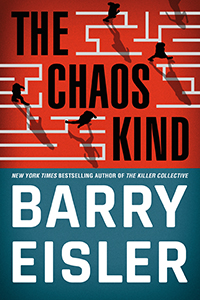
The Chaos Kind, Today!
If you enjoyed the #1 bestselling The Killer Collective, you're going to love the follow-up, The Chaos Kind. It's the whole gang plus Marvin Manus, the Berserker-wielding assassin of The God's Eye View, along with a few new characters, too.
Kirkus calls it "Another high-fatality, high-spirited revenge fantasy."
Publishers Weekly says, "Eisler juggles the complicated plot and large cast, imbuing his diverse characters with robust backstory and emotional motivation...Pure action seekers will gasp at the brutal violence and raw hand-to-hand combat."
I should add that it has its tender scenes, too... :)
I laughed and cried while writing it, and hope you will, too. Enjoy when you have a chance, and thanks for all your support over the years!
Cheers,
Barry
P.S.
I'll be doing a Zoom launch with Kepler's Books at 6:00 pm, October 5th. Signup is here—and Kepler's is the place where you can order autographed paper copies.
I also want to mention the Legislative Drafting Institute for Child Protection—an organization that does work Livia Lone would be proud of, and that deserves your support. A particularly easy and effective way to support the LDICP is through AmazonSmile. It's simple to sign up and have Amazon donate 0.5 percent of your purchases to the LDICP (or other charity of your choice).

The assassins of Barry Eisler's #1 bestseller The Killer Collective are back—and this time, it's chaos.
Assistant US Attorney Alondra Diaz hates traffickers. And she's determined to put one of America's most powerful financiers, Andrew Schrader, in prison forever for his crimes against children.
But Schrader has videos implicating some of the most powerful members of the US national security state. To eliminate Diaz, the powers that be bring in a contractor: Marvin Manus, an implacable assassin whose skills have been forged in intelligence, the military, and the hardest prisons.
Enter former Marine sniper Dox and black-ops veteran Daniel Larison with an unusual assignment: not to kill Diaz, but to keep her alive.
A lot of players are determined to acquire the videos and the blackmail power they represent. But with Seattle sex-crimes detective Livia Lone, "natural causes" killer John Rain, and Mossad honey-trap specialist Delilah, the good guys might just have a chance.
They're not going to play by anyone else's rules. They're not going to play by any rules at all. They want a different kind of fight. The chaos kind.
Thursday, May 13, 2021
The Salton Sea
I always try to visit the places I depict in my novels--realism matters to me personally, and has also become a key aspect of my brand as a novelist. This is why I have a Photos and Places page on my website, and more importantly a Mistakes page--people won't trust you to get it right if you don't own up to getting it wrong (media, take note).
But occasionally a place eludes me, forcing me to rely only on books, articles, and online images, maps, and videos. This was the case with the Salton Sea and All The Devils. I came close several times, most notably on a monster 350-bookstore, cross-country-and-back 2006 book tour, but I never made it all the way there.
Happily, last week I finally managed the trip. It was surreal--both because of the place itself, and also because after all the research and writing, I felt like I'd already been there. Here are some photos. I think I got my depicitions right, but of course that's for readers to decide.
 |
| If you looked up “desolation” in the dictionary… |
 | ||||||||||
“He opened the door and stepped out, his boots crunching on what sounded like gravel but what he knew instead were the pulverized bones of a million poisoned fish…”
|


 |
Some additional resources (more in the notes of All The Devils)
A brief history of the Salton Sea:
And some haunting photos, too. Careful of the Lost America site—it’ll suck you in.
https://www.katherinebelarmino.com/2016/07/photographing-salton-sea-ghost-towns.html
https://lostamerica.com/photo-items/the-salton-sea/
http://www.jimriche.com/salton-sea/
Great six-minute documentary film about the Salton Sea:
https://www.youtube.com/watch?v=otIU6Py4K_A
And the 2002 Tony Gayton noir film The Salton Sea is wonderful and surprisingly not well known.
https://www.imdb.com/title/tt0235737/
Saturday, April 24, 2021
Putin Looms Perennially Large For The Economist
Sometimes I can almost hear The Economist whispering, "Vlad, I wish I could quit you..."


Subscribe to:
Posts (Atom)