Monday, June 24, 2013

Q&A With Philip Patrick, Head of Kindle Worlds

In case you didn't see the press release last week, John Rain is now part of the new Kindle Worlds program! Here's a Q&A I did with Philip Patrick about how it all works and touching on some pretty interesting related topics, too. Hope you find our discussion useful; it certainly was a lot of fun for me...

Barry: Hi Philip, congratulations to you and Amazon on yet another innovative development that’s sure to benefit readers and writers:  Kindle Worlds. I’m thrilled to be part of the program, and I thought it might be useful to anyone interested if you and I could share a few thoughts about how it works and what it’s all about.


To start with, how would you describe the program in a nutshell for anyone unfamiliar with it? I’d call it “licensed and commissioned fan fiction”—would that be accurate?


Philip:  Thanks for taking the time to talk about Kindle Worlds. Part of our mission at Amazon Publishing is to act as a laboratory to develop new ways for writers to be creative, connect to readers, and earn money. We hope that Kindle Worlds is a prime example of what we like to build. It’s a place for writers to create new stories inspired by popular books, shows, films, comics, music, and games. We’ve been calling them Worlds. Until now, selling stories based on somebody else’s World has been a big challenge for most writers. So we’ve worked to acquire licenses from Worlds to make it possible for writers—and yes some of them will be commissioned—to write new stories and earn royalties from every copy sold. We think it’s a win for everyone involved—the World rights holder, the writer, and ultimately the reader.


Barry:  Agreed. Not to get too political (I know, I know... it took me two whole paragraphs), but sometimes I think what the revolution in publishing really comes down to is choice—and whether you’re for or against it. I don’t care how authors choose to publish (Amazon, legacy, self, whatever); I just want them to have options. I don’t care how people read (iPad, Kindle, Nook, paper, whatever); I care that they read, and therefore that they can read in whatever way pleases them. And I don’t care how authors feel about fan fiction (Anne Rice hates it; Hugh Howey loves it); I care that they can license fan fiction if they choose. So naturally, when I first heard about Kindle Worlds, I loved the idea. Authors don’t have to participate; fans don’t have to opt in; free, unlicensed, unmonetized fan fiction can roll along as it always has. But now authors and fan fiction writers who are interested have a great new option for profiting from their Worlds and the fan-created works derived from those worlds.


Philip:  I think you’re spot-on. Giving writers and readers choices is at the heart of what we want to do. Many years ago, I had the good fortune to spend a weekend with the legendary publisher Ian Ballantine at his home outside New York. I remember walking into his house and seeing shelf after shelf of the mass-market paperbacks he’d published throughout his career. He looked at me and said: “It’s all about accessibility.” Fast forward a few decades and that concept of accessibility has only grown—and that is a good thing. Kindle Worlds is another avenue in this ongoing transformation.


Barry:  Yes. Other things being equal, if you make something easier to do, you’ll see an increase in the behavior in question. If you make that thing harder, you’ll see less of it. In fact, I remember reading an interview with Jeff Bezos years ago—way back when most people were still getting on the Internet with a dial-up connection. The interviewer asked Bezos something like, “What do you think is the greatest impediment to the growth of the online book-buying market?” I don’t remember the exact words, but Bezos responded along the lines of, “The amount of time it takes to get a dial-up connection.” I remember thinking, Yes, exactly! Just that one or two minutes of waiting can make all the difference. And there are countless other examples just like this one. Make something marginally easier, and rates of adoption explode. How can that be a bad thing when it comes to reading?


For me, Kindle Worlds is just a new form of subsidiary right. An author writes a manuscript and licenses, say, North American English-language publishing rights. But then there are also foreign language publication rights. No one is forcing an author to authorize, say, the French edition of her book, but if the opportunity is there, it’s nice to have. And if someone wants to option the film rights to the book, that’s great, too. No one is forcing the author to authorize a film; but not many authors would object to someone making them an offer. That’s the way I see Kindle Worlds. Another way authors can exploit the value of their underlying intellectual property rights—if they choose.


So how do interested authors and fan fiction writers learn more about Kindle Worlds and how they can participate?


Philip:  It’s all available at the Kindle Worlds website. There’s a good amount of information there as well as a sign-up for anyone who wants to be notified when the self-service submission portal goes live.


Barry:  Okay, I checked out the Kindle Worlds For Authors page, and I noticed that among your content guidelines you say you don’t accept pornography or offensive depictions of graphic sexual acts. Now, obviously there’s a lot of subjectivity at work here, though Woody Allen might have offered some helpful guidelines when he suggested, “Erotica is using a feather; pornography is using the whole chicken.”


But seriously, how do you draw a line? For example, there’s an explicit lesbian scene in my recent novella London Twist that some Amazon reviewers found shocking and offensive, and a pretty graphic scene in Redemption Games that some people have characterized (mischaracterized, in my opinion) as rape. Plus my friend Montie told me that one of my love scenes cost him thousands of dollars in therapy (though in fairness that’s because he was horrified to realize, as he put it, “My God, I have become sexually stimulated by the imagination of Barry Eisler.” I’ve really always wanted to use that as a blurb).


Anyway, how can participants in the program know what’s going to offend what I’m sure will become known as the Amazon Censors? And why did you decide to include a provision that you must have known so many people, not least erotica writers, will find troublesome?  Are you not worried that, in the service of preventing offense, you might in fact be causing it?


Philip:  In general, our strong bias is to give writers as much creative freedom as is appropriate to each World. The people who understand  that appropriateness best are the original rights holders—we’re calling them World Licensors—who will know what their audience expects and wants and how far the bounds can be pushed. There are shows, for instance, where mature content is part of the storytelling. And there are other shows where that isn’t the case. That makes sense to me on a lot of levels. So we’re asking each World Licensor to outline what is appropriate for their World’s audience in Content Guidelines. We’ll review submissions to see if they are within those guidelines. Our message to writers is pretty straightforward—follow any World’s guidelines and we will publish your story. And if something falls into a gray area, there’s always room for dialogue. We’ll talk to World Licensors as we review stories and we also will communicate back and forth with a writer if we have any questions.


Barry:  I get that each World Licensor can include his or her own guidelines, and I think that’s a great idea. It makes the program more attractive to potential World Licensors because they know they can customize fan fiction based on their Worlds in whatever way they want. Of course, if they customize too rigorously, there’s a chance they’ll be dissuading fan fiction writers who would otherwise want to participate, but that’s a decision each potential World Licensor can make for herself.  I have only very loose guidelines—pretty much just no titles the same as or misleadingly similar to the ones I use for my underlying works. Other than that, I’m happy to let fan fiction writers do whatever they like. Partly because I’m just pretty laissez faire about these things; partly because I don’t want to discourage people with too many restrictions.


But that’s all about the individual World guidelines, which are always up to the World Licensor. Again, I think that’s a great approach and a critical aspect of the program. But why not leave it at that? Why have, alongside those individual guidelines, program-wide guidelines of your own? It’s the latter class that will probably cause the most concern (is this love scene going to “offend” whoever at Amazon is reviewing with an eye toward the program-wide content guidelines?) and that I expect is going to cause some pushback.


Philip:  Looking across the entire program, it’s important to have some basic guidelines in certain areas. One of the guidelines, for instance, is about originality. The work submitted has to actually belong to the writer and can’t be copied from another source. As for the mature content it really does depend on the World. If slash fic is okay with the World it is okay with us. We want people to be creative and work within what the World Licensors tells us is appropriate for their World.


Barry:  When it comes to guidelines, what it comes down to for me is brand, and what a company wants its brand to stand for. I wouldn’t expect a publisher to surrender its ability to manage its brand any more than I’d expect an author to do so. (Personally, I’d love to see a kind of imprint for edgier stuff. You could even market it as Adult, Over-18, or otherwise as material so potentially offensive that it needs to come with a warning. Nothing like a “warning” to propel sales... “The book the CIA tried to ban!”)


What’s curious about the pushback I think you’re likely to receive is that establishment publishers aren’t held to the same standard. For example, I don’t think anyone has ever complained that a publisher exclusively catering to dry literary fiction refuses to publish erotica—at least, I don’t remember ever hearing someone claim that “Hey, that publisher is censoring erotica writers!” (or that Disney is censoring splatter movies, etc). One of the many things that interests me about the revolution in publishing is the way longstanding phenomena are often treated as both startlingly new and uniquely dangerous when these phenomena manifest themselves in digital. “But discovery is so hard!” “But you’ll have to market yourself!” etc. I could go on about this; for now, suffice to say that for some reason, a new context can make ancient challenges seem fresh and newly born.


I think the principled challenge to what I just said would be something like, “But Barry, that literary imprint is just one among many, and there are many erotica imprints that publish authors who write erotica and who therefore provide a means for erotic writers to reach readers. Kindle Worlds is different—it’s not just a kind of publisher, but also a platform, and the only platform of its kind. As such, it should be as inclusive as possible.”


I think that’s a fair point and I hope you guys will be flexible in your implementation of your guidelines. Remember, if it doesn’t offend at least twenty percent of people, it isn’t great art. :)


Okay, another question: how do the rights to new content work? In other words, what if a World writer invents a new character... can other writers who are writing in that World use that character? Can the World Licensor?


Philip Patrick: That’s a great and important question. Kindle Worlds is a creative community that includes the Kindle Worlds writers and the World Licensor. Every story you publish adds to a World and becomes part of that World. This means Kindle Worlds authors can build on each other’s stories. It also means that the World Licensor can build on or incorporate elements from those stories. My mental image is a sandbox: everyone is welcome to come in and be creative, but whatever is made stays there for the next writer and for the World Licensor. Our publishing agreement is an exclusive license to the story and its original elements for the term of copyright. Because of this, we recommend writers do not incorporate a character or new element into a Kindle Worlds story unless they want them an exclusive part of that World. If a writer wants to be creative with original ideas but not have their work under this kind of license, Amazon supports them fully and has great options with much more flexibility and control at Kindle Direct Publishing and CreateSpace. Again this is all about creating new models and options for writers. The writers we have been working with so far have found it great fun and a new creative challenge to write in somebody else’s World.


Barry:  I think this approach will be part of the key to the success of the program. Whatever you want to call it—a sandbox, a pool, a cookpot—the idea is that new writers will grow a World, and the more a World grows, the more there will be for new writers to do with it. The skew is in favor of inclusiveness rather than restrictions.


Philip:  Hey, I was thrilled to include John Rain--Valiant Entertainment, Blake Crouch, Hugh Howey, and Neal Stephenson--in our recent announcement about new licenses for Kindle Worlds. Thanks for being with us. Is there anything you’d like to share with your readers about John Rain?


Barry:  Ah, thanks for that. Well, as I mention above, I don’t have any particular guidelines, so if anyone out there feels compelled to write Rain/Dox slash or whatever, it doesn’t bother me.


Which actually brings up a point I think is worth emphasizing. Different writers feel differently (and sometimes very strongly) about these things, and I don’t think there’s any right or wrong answer for what at root is based on a feeling. Am I comfortable with other people writing stories set in my Worlds? Offering their own interpretations of my characters, their own insights, their own flavor? Or am I not?


I’m really only concerned about one thing: that readers know if I wrote it, or if someone else did. As long as there’s no confusion in that regard, I’m comfortable trusting readers to find whatever makes them happy, and to pass on anything that doesn’t. Again, for me this isn’t so different from authorizing a French edition, or a movie, or any other derivative work. I don’t speak French, so I can’t opine about the quality of a translation. And I’m not making the movie, so I can’t do much to influence the quality of whatever gets made. And as long as people know I didn’t write the book in French, or write and direct the movie, I’m okay with these kinds of derivative projects. They’re based on, or inspired by, my works, but they’re not my works themselves.


I’m not saying all that as a logical point—again, I think it comes down to how you feel. If you feel like seeing a movie that for you doesn’t do justice to your underlying works would be unduly upsetting, then you’ll be inhibited from licensing the movie rights. If you feel like, “Hey, it wasn’t my movie anyway,” then you won’t have a problem talking to Hollywood.


As I said earlier: for me, it really comes down to choice, and to the notion, which except at the margins I find axiomatic, that more choice is good. However various authors decide to approach Kindle Worlds, there’s still always going to be fan fiction. It’s just that now, rights holders and fan fiction writers have a way of making money from it—if they want to.


Philip: I couldn’t agree with you more. The world has gotten more creative. Whether it’s a laptop or mp3 recorder or digital camera, people have the tools to respond to what they see, feel, hear, taste, and read. And they have platforms to share those responses with others. Maybe just family and friends. Maybe millions of people across the planet. The work we’re doing at Kindle Worlds is just a sliver of that possibility—to respond and share. It isn’t necessarily perfect for every rights holder or every writer out there. And that’s okay. But for the ones who gravitate toward it, it has the ability to expand a World one story at a time—and that just seems like a win for everyone involved.

Sunday, June 23, 2013

Of Course We Can Trust Them. They're The Government

One of the things I find most fascinating about whistleblower Edward Snowden's NSA revelations is the way so many Americans reflexively defend the very government that has been caught illegally, unconstitutionally spying on them.  Doubtless, some of the defensiveness is produced more by partisan identification with Obama than by identification with the government generally (can you imagine how much differently the Democratic leadership and rank and file would be reacting had Snowden blown the whistle under a Republican president?).  But I also sense that a good deal of the defensiveness comes from a reflexive identification with the government generally.  As Digby has repeatedly observed, many Americans would rather be subjects than citizens.

What's so revealing about the hostile reactions to Snowden's revelations is the way many people try to articulate a principle to justify their hostility, but then immediately selectively apply it.  For example, has even one of the people crying out some version of "Snowden broke the law, he should be punished!" ever made the same argument about Director of National Intelligence James Clapper for lying to Congress?  How can people be concerned about the consequences to our safety and freedom of a contractor leaking secrets about a massive domestic spying operation, but sanguine about the head of America's entire intelligence apparatus perjuring himself in denying such a program exists?

Let's talk about Clapper for a moment.  The fact that Congress is so in thrall to the intelligence industrial complex that it can't muster the balls even to *complain* about being lied to by an intelligence bureaucrat tells us a lot about the current fragile state of our democracy.  And in the face of this, many Americans are more upset that someone has revealed the NSA is spying on them than they are about the spying.  That's not good.

And it gets worse.  Have you read about Obama's Insider Threat Program?  The Most Transparent Administration Ever has figured out that the best way to foster greater transparency is to "Hammer this fact home… leaking is tantamount to aiding the enemies of the United States;" to get coworkers to inform on each other; and to gin up suspicion of anyone who's going through a divorce, facing financial problems, or even just under stress.  It sounds like a pretty good idea… in fact, wait, I think it's been tried before!

And worse still.  The Obama Justice Department has now charged Snowden with espionage.  However you want to characterize what Snowden did -- whistleblowing, leaking, whatever -- what he did was selectively provide secret information to the press (The Guardian and The Washington Post).  He had much more information he could have turned over but didn't because he thought the harm of releasing that additional information would outweigh the good.  And he asked the Guardian and the Post to also take care to edit the information he provided so as to minimize any potential harm.  What he did *not* do was secretly sell the information to which he had access to a foreign government.  He could have made millions had he chosen to do so.  Instead, he provided the information openly to the American people.  You can call his actions various different things, but you can't coherently call them "espionage."  Not unless you're Humpty Dumpty, and words mean whatever you want them to mean.

On the other hand, we do call it the "Justice" Department -- a name that becomes more akin to Ministry of Love by the day.  So maybe the government *can* just make words mean whatever it wants them to mean.  Obama claims to be running The Most Transparent Administration Ever, after all, even as he prosecutes his eighth whistleblower for espionage -- compared to a grand total of three people charged under the Espionage Act under all previous administrations combined (including those of Richard Nixon and George W. Bush, naturally).

Look, so far as I know, no one is claiming Snowden didn't violate a contractual and legal obligation to preserve secrecy (though the rhetoric about his violating some secrecy "oath" is propagandistic bullshit suggestive of a weirdly authoritarian mentality).  But what kind of person -- what kind of citizen -- thinks Snowden's NDA violation is more important, more consequential, more deserving of discussion and debate than the fact that the government has constructed a massive, unaccountable, domestic spying operation totally in secret?  Or that the head of America's intelligence apparatus was just caught lying to Congress about the existence of this program?  Which is the greater potential threat to democracy -- one guy leaking secrets to the press (given the self-glorifying ongoing flood of such leaks coming from the Obama administration, you better hope that's the wrong answer)?  Or a massive intelligence organization spying on the American people, and the head of that organization lying to Congress about it?


The answer is obvious.  And if in spite of that obvious answer, you find yourself more exercised about Snowden than about the NSA and Clapper, I respectfully submit that you have a bit of soul-searching to do.

Fortunately, the establishment media has all the right priorities.  Here's courageous truth-seeker David Gregory of Meet the Press, suggesting that The Guardian's Glenn Greenwald, who along with The Washington Post's Bart Gellman broke the NSA story, should be prosecuted for aiding and abetting the enemy.  If you can find a more docile, subservient, bootlicking, Stockholm Syndrome level of pseudo-journalistic cravenness than Gregory's, please let me know.

And for the "I don't care of anyone is reading my mail or listening to my calls or compiling my metadata, I have nothing to hide" people out there, I want you to consider this:

The patterns the NSA is searching for as it scours domestic communications aren't patterns exclusive to terrorism.  They are patterns of clandestine behavior (in particular, we now know the NSA is heavily focussed on encrypted email).  Some such clandestine behavior might involve terrorism.  Some will involve other types of crime.  A lot of it will involve communications between, say, lawyers and clients.  And most of it, probably nearly all, will involve things that are embarrassing or illicit, such as closeted homosexuality, sexual affairs, and other personal matters people would prefer to keep private.


I wonder what a massive intelligence organization might do with information it uncovered about embarrassing or illegal activities on the part of politicians, journalists, and other powerful and influential people.  It's enough to make you wonder why Congress is acting so blasé about Clapper's baldfaced lie.

Nah, that's crazy talk.  It could never happen here.

But just in case it could happen here… just in case an operation like PRISM, even if you don't think it's being misused today, might provide a turnkey program for totalitarian control tomorrow... isn't it important that we as citizens have the opportunity and means to discuss it openly and intelligently?  And can you come up with some other realistic opportunity and means beyond the actions of Edward Snowden and the rare people like him?

Put all these things together.  The president is prosecuting all non-Obama-glorifying leaks as espionage.  Congress is so captured and craven it shrugs when intelligence bureaucrats lie to it under oath about the scope of domestic spying operations.  The establishment media so identifies with the government that it wants journalists prosecuted for doing core First Amendment journalism.

Oh, and the NSA is spying on us, and what's been revealed of that spying so far is probably just a fraction of the reality.

If you find any of this, let alone all, acceptable, you have more faith in the inherent resiliency of American democracy than I do.  But if Congress is craven, and the establishment media is complicit, and even average citizens are eager to let the government do whatever it wants as long as it claims It's For Your Own Safety and/or as long as someone from the citizen's favored wing of the war party occupies the Oval Office, who is left to guard the guardians?

Or maybe we can just let the NSA guard itself.  They're the government, after all.  I'm sure they mean well.

Wednesday, June 19, 2013

Michael Hastings, A Sad And Terrible Loss

Incredibly sad news. Rolling Stone and BuzzFeed journalist Michael Hastings, only 33, died in a car accident in Los Angeles yesterday.  Michael was funny, fearless, and acerbic to anyone sucking up to power -- a model for what a real journalist should be.  This exchange, from his Buzz Feed obituary, sums up a lot of what he was about:  "'Why do you bother to ask questions you've already decided you know the answers to?' [Hillary Clinton aide Philippe] Reines asked.  'Why don't you give answers that aren't bullshit for a change?' Hastings replied."  When his editor warned him this exchange would make him look like an asshole, Michael responded, "Everyone knows I’m an asshole. The point is that they’re assholes."
One of the best things about being a writer is that every now and then, you learn someone you admire from afar is a fan of your books.  This was the case with Michael.  Another terrific journalist -- Barrett Brown, now being persecuted by the US government -- knew of our mutual admiration and put us in touch.  After that introduction, Michael and I exchanged maybe a half dozen emails and had as many phone conversations.  I feel fortunate to have known him, however slightly.  Professionally, he was fierce and focused.  In person, he was thoughtful, generous, and hilarious.  He had a keen nose for and visceral hatred of bullshit, so as you can imagine we bonded over several conversations about the publishing industry.  I loved his book "The Operators: The Wild and Terrifying Inside Story of America's War in Afghanistan."  When I told him there were passages as good as James Ellroy, he laughed and told me he had been reading Ellroy while writing it.  Occupational hazard.
Michael was best known for his Rolling Stone article The Runaway General, which led to the resignation for insubordination of Afghan War commander Stanley McChrystal.  The Operators is, among other things, the story behind that story, detailing the angst Michael felt about reporting something so momentous about a group of people he admired and who had treated him seductively well.  He was attacked afterward by numerous "journalists" for whom integrity and courage like Michael's are threatening and incomprehensible.  Nothing makes a sell-out more uncomfortable than to be faced with someone who refuses to be bought.

I hate to think of what was ahead for this fine person, the professional and the personal, and that will now never be.  His death is a loss to journalism and to everyone who loves truth.  I didn't realize how good it was to know Michael was out there in the world, doing great work, comforting the afflicted and afflicting the comfortable.  I woke up sad this morning, feeling the world is not as good a place today as it was yesterday.  I'll miss him.

Thursday, June 13, 2013

Intel Is Not Used To Shape Policy, But To Justify It


The primary purpose of intelligence -- accurate or distorted, real or fake -- isn't to shape policy.  It is to *justify* policy.  The way politicians use intelligence -- what they leak, what they suppress, what they demand collected and how they insist it be understood -- is almost entirely driven by their desire to justify policies upon which they have already decided.  Remember that, as we increasingly intervene in Syria.

Tuesday, June 11, 2013

Memo To Authoritarians: The "Oath" is to the Constitution, Not to Secrecy

It's been interesting to read pundits like David Brooks of the New York Times and Josh Marshall of Talking Points Memo prattling about how whistleblower Edward Snowden violated his "oath" of secrecy.  I was in the CIA, and I can tell you there was no secrecy "oath," just a contract.  The oath was to protect and defend the Constitution against all enemies, foreign and domestic.

I find the misnomer revealing.  I don't think Brooks, Marshall, and the many others like them are misusing the word "oath" in a deliberate attempt to mislead.  My guess instead is that their deference to government secrecy is so strong that they reflexively equate a contract to maintain secrecy -- a nondisclosure agreement, really -- with something as strong as, say, a sworn oath to preserve, protect and defend the Constitution.  You know, like one the president takes.


In fact, I'd go further.  That these pundits aren't even discussing the real oath CIA and other government employees take -- the one to protect and defend the Constitution against all enemies, foreign and domestic -- suggests they don't believe such oaths are important enough to bother mentioning.  Now, admittedly oaths to protect and defend the Constitution are all very pre-9/11, but shouldn't an intelligent and honest pundit at least offer a nod of the head toward the fact that someone like Edward Snowden might have felt faced with two competing obligations -- his secrecy contract, on the one hand, and his sworn oath to protect and defend the Constitution, on the other?

Of course, if deference to governmental secrecy prerogatives trumps all other values, then there's no trade-off even to mention.

And look, even if you think that "oath" and "contract" are interchangeable terms (in which case you'd have to explain why Brooks, Marshall et al consistently use the former regarding secrecy while eschewing the latter, and why the drafters of the Constitution did the same with regard to oaths of office), you still have to explain why various pundits are so intent on referring to only one of the "oaths" while ignoring the other.

Here's another way of looking at it.  Say you're the employee of an intelligence agency.  You've signed a contract to maintain secrecy and also sworn an oath to protect and defend the Constitution.  And you become aware of a secret program that you believe violates the Constitution you have sworn to protect and defend.  Reasonable people can argue about how you might best redress that violation, but reasonable people can't deny, whether explicitly or implicitly, that you are faced with a dilemma and that, if you have a conscience, you should and hopefully will grapple with how to resolve it.

Here's a terrific piece from Daniel Ellsberg, the previous generation's heroic whistleblower, on why in revealing the scale of the NSA's secret spying on millions of innocent Americans, Snowden has done America such a noble service.

Maybe you'll disagree.  That's fine; there are competing interests in all cases of whistle blowing, and reasonable people might balance those interests in different ways.  But arguing as though a contractual obligation to maintain secrecy trumps all other values, including actual sworn oaths to protect and defend the Constitution, just makes you look like an authoritarian.  As well as a fool.

Thursday, June 06, 2013

Interview With A Brain Scientist, And More

Updated Below

Three quick items:


1.  Brain scientist (really!) and novelist Livia Blackburne and I had a fun discussion about the extent to which radically low-priced sales are a useful tool for selling digital books, why some readers freak out about lesbian short stories, and whether buyers of 99-cent novels are more apt to leave bad reviews.

2.  The second edition of Violence: A Writer's Guide is now available.  As I said in the blurb I was proud to offer, the book is an amazing resource and written by a man who really knows his stuff.  The beginning to the intro says it all:

"My name is Rory Miller, but I've been called 'Sarge' in a jail, 'sensei' in a dojo and 'abu Orion' in Baghdad.  Rory is fine. 
"I don't write fiction.  I do write fight scenes.  I have written some of the most realistic fight scenes ever… because they have to stand up in court.  Conflict is the core of drama and much of my adult life has centered around conflict.  The good side is that I know a lot about real violence.  One of the many downsides is that I know enough that most fiction is infuriating to read…"

The book is incredibly informative, eye-opening, and at times hilarious.  For under six bucks, you can learn all about what this guy has paid for in blood and broken bones.  I guarantee you this is a bargain you don't want to miss.


3.  The Guardian has revealed that the NSA has been collecting the phone records of millions of Americans daily (glad to see that the New York Times is following up -- more interesting details here).  I posted a link on Twitter and Facebook along with a comment that "This must be okay because it's Obama."  Obviously I meant the comment as a dark joke.  Incredibly, many people are finding ways to at least partly agree with it.  Within the average mind, the battle between principle and partisanship seems barely even a struggle.

UPDATE:  A Facebook reader assures me regarding the NSA program, "If you are doing the right thing and minding your own business you have nothing to hide."  I know I'm being naive, but I can't stop being amazed when Americans blithely spout statements like this one, which would be perfectly at home in the North Korean Politburo or in 1984.  As I said in response:


"It's not a question of having something or nothing to hide.  If you were at a dinner party and someone took out a dictaphone and said he just wanted to record the conversation so he could listen to it later, what sort of impact do you think this would have on people's behavior?  Now, what sort of impact do you think there will be on the creativity, spontaneity, amount of dissent, and other aspects of the free flow of information that are critical to the healthy functioning of a free society if people have reason to believe the government is monitoring everything?

"If the framers had wanted the government to have a free rein surveilling the populace because 'if you are doing the right thing and minding your own business you have nothing to hide,' we wouldn't have or need a Fourth Amendment.  But we do -- unless you would prefer to abolish it."

Wednesday, June 05, 2013

Democrats Make Defiant Gesture... Scary!

This morning I came across a New York Times article about Obama's impending appointment of Susan Rice as his National Security Advisor.  The Times claims that this is "a defiant gesture to Republicans who harshly criticized Ms. Rice for presenting an erroneous account of the deadly attacks on the American mission in Benghazi, Libya."

What's the message?  That Democrats are strong -- after all, they're defying Republicans!


What's the metamessage?  That Democrats are weak -- after all, in any relationship, only the weak party is in a position to defy.  Children can defy their parents, for example.  But would it be coherent -- can you even imagine -- a situation where parents could be described as "defying" their children?  If you did hear about such a thing, you'd immediately and instinctively recognize that the power balance in that family is radically out of sync.


Now, in all communications, which matters more -- the message, or the metamessage?  You already know the answer from common sense and everyday experience.  The message is always eclipsed by the metamessage.


(By the way, for novelists, this understanding is critical for writing good dialogue.  The greater the gap between the message and the metamessage -- the text and the subtext, the words and the meaning -- the more engaging the dialogue.  For more, I recommend Robert McKee's Story: Substance, Structure, Style, and the Principles of Screenwriting.)


What's interesting is that the Times is commonly understood to be a liberal media outlet.  To the extent this is true (in fact, I don't think right/left is the most productive prism for understanding the way America's media works -- establishment/insurgent, or corporate-owned/independent, provides a more accurate and useful framework), here we have the spectacle of a liberal-leaning media outlet presumably believing they're portraying the Democrats as tough, while implicitly revealing they believe (correctly, in my view) that Democrats are in fact weak compared to Republicans.

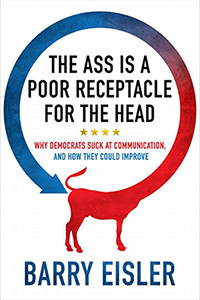
I find this kind of messaging, and Democratic cluelessness about it, fascinating.  If you want to learn more, here's my short book on the subject:  The Ass is a Poor Receptacle for the Head: Why Democrats Suck at Communication, and How They Could Improve.


Friday, May 24, 2013

All My Books, Only 99 Cents, Only Three Days


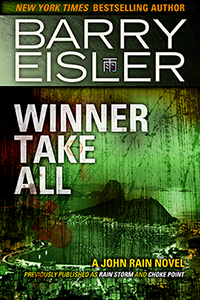
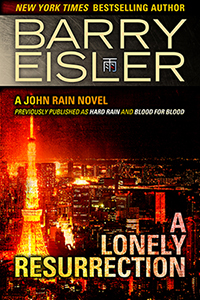
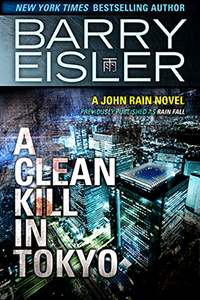
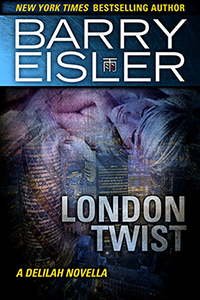
To celebrate a great partnership, Thomas & Mercer and I are coordinating a limited-time sale of all my titles. For three days only, every one of my stories except The Detachment—self-published, T&M-published, novels, short works, fiction and non fiction—is on sale for only 99 cents. Only in the Kindle Store, and only from today through Sunday (May 24, 25, and 26). Been thinking about acquiring the entire Rain backlist in digital? This is your chance to do it for less than a buck a book. Get 'em while you can!

Click on the covers below to buy—and here's more information on all the books, including the new covers and titles.

Barry
FaceBook Twitter Blogger

A Clean Kill in Tokyo

A Lonely Resurrection

Winner Take All

Redemption Games

Extremis

The Killer Ascendant

Fault Line

Inside Out

The Lost Coast

Paris is a Bitch

The Khmer Kill

London Twist

The Ass is a Poor Receptacle for the Head

Be the Monkey

Tuesday, May 14, 2013

Jeremy Scahill's "Dirty Wars"

Last week, I had the honor of hosting a Commonwealth Club discussion with premier investigative journalist Jeremy Scahill in which Jeremy discussed his new book, "Dirty Wars: The World Is A Battlefield."  You can listen to an audio of the one-hour talk here, and see some photos from the event here.


It's a Commonwealth Club tradition to ask participants at the end of a talk to name a 60-second idea for changing the world.  Jeremy's, I thought, was profound:  American kids should be assigned essays in which they would research and report on the lives of innocent people killed in America's drone wars.  The president personally eulogized the three people killed in the Boston bombing, yet we almost never hear the stories or see the faces of the innocent lives our wars cut short (well, in fairness, according to the Obama administration, it's not possible for someone killed by an American drone to be innocent).  Imagine how different the world might be if we were to deny ourselves the luxury of that ignorance.


I don't blurb many books (here's why) but I was honored to blurb Dirty Wars.  Here's what I said:

"Dirty Wars is the most thorough and authoritative history I've read yet of the causes and consequences of America's post 9/11 conflation of war and national security. I know of no other journalist who could have written it:  For over a decade, Scahill has visited the war zones, overt and covert; interviewed the soldiers, spooks, jihadists, and victims; and seen with his own eyes the fruits of America's bipartisan war fever. He risked his life many times over to write this book, and the result is a masterpiece of insight, journalism, and true patriotism."

You can learn more about the book -- and about the accompanying film, which opens on June 7 -- at the Dirty Wars website.

Sunday, May 12, 2013

Don't Worry, US Imperialism is Cost-Free

UPDATED BELOW

Recently I watched a terrific exchange between Glenn Greenwald and Bill Maher on Maher's show Real Time.  Maher was arguing that there's something peculiarly violence-prone about Islam; Greenwald countered (devastatingly, in my opinion) that Muslim violence is likely caused more by US imperialism than by anything intrinsic to Islam itself.


This led to an odd post by David Atkins at the excellent blog Hullabaloo (Digby, who runs Hullabaloo, has her own response to Atkins here) in which Atkins argues that because we haven't seen in other countries and cultures subjected to US imperialism the kinds of reactions we've seen in the Islamic world, it means Islamic violence is not being caused by US imperialism -- quod erat demonstrandum.

There's something that's been bugging me about Atkins' post (bugging me beyond the fact that he attributed to Greenwald something that not only did Greenwald not say -- "Imperialism is to blame for everything" -- but that Greenwald specifically and repeatedly disclaimed).  What's been bugging me is Atkins' logic.  Or, more precisely, his lack of it.

I tweeted that the shorter version of Atkins is "If blowback doesn't happen everywhere, it can't happen anywhere," and that's part of what I find illogical about his overall argument.  But here's another way of understanding it.

Suppose I walked up to a dozen people at random and spit in each of their faces.  Maybe some of them would ignore me.  A few might cry.  Others might spit back.  Some might sue.  Some might respond with their fists.  Some might respond with lethal force.  A few might even track down my family members and kill them to teach me a lesson.

The point is, my spitting would likely provoke a range of reactions, each of them different on the surface (different people, like different cultures, will respond to the same stimulus in a variety of ways), but all of them having in common the fact that each is a reaction to my spitting.

What Atkins is arguing is that if some of the people I spit at did nothing significant in response, it means the behavior of the other people must have nothing to do with my spitting.  But this makes no sense, neither the methodology nor the result.  The proper way for Atkins to test his thesis would be ask, "The one guy who went after my family after I spit in his face, even though the other eleven people reacted differently… would he have done so had I not spit in his face?"

(And look, let's not get too sidetracked by my spitting analogy, all right?  Even if you believe that when America supports dictators, and invades, occupies, and drones other countries, it is doing nothing other than protecting these benighted cultures from their own savagery and magnanimously gifting these countries with the blessings of freedom and prosperity, you can't seriously argue that the recipients of these gifts will view them as you do.  In other words, I'm arguing here not about US intentions, but about perceptions of US actions by the people on the other end of those actions).

This is pretty basic, is it not?  If someone theorizes that "Y is being caused largely by X," the most obvious and logical way to test the theory is to remove X, and see if Y persists.  On some level, I think Atkins realizes this.  He mentions America's experience in Vietnam, after all.  There, Vietnamese violence against western forces ceased when western forces departed.  Yet judging from Atkins' conclusions, it's as though he believes the Vietnamese cessation of violence was just a coincidence and had nothing to do with America's withdrawal.

So the question Atkins should really be asking -- and it's so obvious as a matter of logic I can't help wonder what's preventing him from asking it -- is this.  If America withdrew its support for dictators in the Muslim world, and withdrew its military forces from the Muslim world, what would be the likely effect on Muslim violence against the west?

The only reason to avoid asking this question is that the answer is so obvious -- and so obviously uncomfortable for anyone intent on arguing for the benefits of imperialism while determined to deny its costs.

If there's one thing I find continually strange about political discourse in America (actually, there are many things, but this is a big one), it's naiveté -- naiveté to the point of denial.  I would respect (though I would disagree with) an argument such as, "The world is a messy, dangerous, chaotic place.  It needs a strong policeman to enforce rules and order, and that policeman is America.  Certainly many people will resent America's self-appointed role as policeman, and among them some will react violently.  But violence in response to our policing is just a cost of doing business, a cost worth incurring if we're to secure the overall benefits our policing entails."

Instead, what we're continually fed -- and what many people eagerly ingest -- is a self-serving narrative about how they hate us for our freedoms and/or how violence against America is intrinsic, innate, and spontaneous among the people who engage in it (don't you love that phrase "self-radicalized," for example, as though someone is sitting quietly in a room and just -- poof! -- suddenly becomes a radical, all by himself?).  According to this narrative, violence against America never has anything to do with American behavior.  If there's an example of psychological denial more profound than this, I'd like to know what it is.

(I'm not talking specifically about Atkins in the paragraph above -- these aren't his arguments, and in fact he explicitly argues that Islam seems no more violent than various other religions.  But what he does argue is that violence against America is primarily caused by something other than American behavior -- according to Atkins, fundamentalism).

After the last ten years, if they really hated us for our freedoms, don't you think they'd hate us a bit less by now?  With two successive presidents claiming the right to imprison people indefinitely without charge, trial, or conviction, and to spy on Americans without warrants, and with our current president claiming in addition the power to execute American citizens without any recognizable due process, we have a lot less freedom to hate.

I guess we just haven't given up enough freedom for them to stop hating us.  We really should give up even more.

Or, instead, we could try invading, occupying and droning Muslim countries a little less, and see if that helps.  Maybe prop up fewer corrupt and tyrannical Muslim regimes.

Nah.  Islamic violence against America has nothing to do with any of that.  It's all hatred of our freedoms, or something innate to Islam, or it's just that violence is what fundamentalists do.  I mean, people never react violently to violence.  After all, look how calmly and rationally America responded to 9/11.

The most amazing thing about this topic?  That it even needs to be discussed.  Martin Luther King pointed it out almost fifty years ago, when he described America as "The greatest purveyor of violence in the world today."  Violence carries terrible costs.  We ought to accept those costs, not deny them.  Not least because the denial is such a large part of what enables the violence.

UPDATE:  Shame on me for not linking to this excellent post by actual middle east expert Juan Cole on Islamic violence and violence we might attribute to other religions.

Monday, April 29, 2013

More on Digital Denial

Here's an article the Guardian asked me to write after the brouhaha over my Pikes Peak Writers Conference keynote:

The Digital Truths Traditional Publishers Don't Want To Hear

Enjoy.

Monday, April 22, 2013

Guest Blogging and Talking Like Dox

This week I'm talking like Dox -- with Brilliance Audio, narrating the audiobooks for The Khmer Kill, London Twist, and my first novel, A Clean Kill in Tokyo.  So much fun, though man, narrating a book is draining!  Will let you know when they'll be available.  In digital download, it ought to be soon.

Meanwhile, I'm guest-posting at Joe Konrath's blog A Newbie's Guide to Publishing.  Topic:  Digital Denial at the Pike's Peak Writers Conference.  Also don't miss the excellent follow-up by Porter Anderson at Publishing Perspectives.

Y'all have a good evening, now.

(Sorry.  Still in character. ;))

Wednesday, April 10, 2013

Monday, March 25, 2013

That Power of Accurate Observation Is Called Political By Those Who Have Not Got It

I'm glad to say that most of the Amazon customer reviews for my new short novel, London Twist, have been positive.  Among the negative ones, there's an interesting theme:  that the story is either disturbingly pro-gay or disturbingly anti-drone, and in all events too liberal.  I think it's worth examining these claims, and the premises behind them.

1.  The Story Is Disturbingly Pro-Gay.  I suppose if someone in the story made a speech in favor of marriage equality, or if I depicted the unjust suffering of gays due to discriminatory laws, there might be a basis for the claim that the story is pro-gay.  In fact, the story involves (among other things) two straight women who, while circling each other on opposite sides of an espionage operation, find themselves attracted to each other, and wind up acting on that attraction.  It's hard for me to understand how depicting something like this could be pro-gay.  I'm guessing that some people find implicitly political a depiction of same-sex attraction and of gay sex itself?  In other words, if you don't try to deny the existence of homosexuality, or if you don't try to depict homosexuality in a negative light, you're doing something political.


There might actually be something to this view.  Because if marginalizing gays in fiction is political, then mainstreaming them must be political, too.  If depicting gay sex as immoral and unhealthy is political, then depicting it as normal and healthy must be political, too.


What's revealing, though, is that I don't think I've ever read a critique of a story that has no gay elements as "too pro-straight" or as "anti-gay."  I doubt, for example, that anyone has ever posted the "it's too straight" equivalent of this reviewer's thoughts:  "Eisler's usual good work. But I get a little bit tired of the social cheer leading for gays.  I hear and read enough of that stuff already."


I think what causes this odd reaction is this:  Prevailing political prejudices are rarely recognized as political at all -- an insidious blindness that permits one side to attack the other as "political" when in fact a more honest criticism would be "political in a manner that differs from my politics."  So if you're straight and would prefer to live in an all-straight world, fiction devoid of gays won't feel political to you.  It'll feel normal, comforting, a reflection of the world you take to be true.  But fiction with gay characters or gay sex?  Political!


By the way, I have to add that the odd phrase "pro-gay" is my attempt to paraphrase some of what's been written about the story.  In fact, I don't think of myself as pro-gay any more than I think of myself as pro-straight.  What I am is pro-equality-before-the-law.  And while certainly that means I'm not anti-gay (I'm not anti-straight, either), some people have a worldview in which if you're not anti-gay, you're pro-gay -- one more manifestation of the condition in which someone is blind to his own politics and finds "politics" at work only in those who disagree with or otherwise challenge his implicit assumptions.


2.  The Story Is Disturbingly Anti-Drone.  I have an easier time understanding the basis for this claim than I do for the "pro-gay" one.  After all, one character, Fatima, a Pakistani living in London who lost her two younger brothers as "collateral damage" in a drone strike, gives a speech at an anti-drone rally, and two other characters -- a Mossad operative and an MI6 operative -- discuss the way drone warfare increases hatred for the west.  So here, at least, critics can point to something more political than the mere possibility of a same-sex attraction or the depiction of gay sex.


But is it really particularly political to create a character who lost two brothers in a drone strike and is motivated to take revenge as a result?  After all, it's simply a fact that drone strikes kill civilians.  And it's simply a fact that making war on Muslim countries increases hatred against the west, as a 2004 Pentagon study, undertaken at Donald Rumsfeld's direction, concluded (did we really need an official study to figure out that bombing, invading, and droning people makes them hate us?  Apparently so).  Now, you can logically (if not persuasively) argue that the civilian deaths and hatred of the west are worth it, but you can't reasonably argue that the civilian deaths and hatred don't exist.  So I can only conclude that people who favor drone strikes as a response to our fears of terrorism would prefer to deny that drone strikes cause civilian deaths and hatred, and that such people therefore feel that to acknowledge that drone strikes in fact do cause civilian deaths and do produce hatred is to do something remarkably political.

Again, I wonder:  are stories depicting brown-skinned, dark-bearded Islamic fanatics trying to slaughter innocent Americans solely because they hate us for our freedoms typically criticized for being too political?  Not that I'm aware of.  And this is so because the "we're blameless, they hate us for our freedoms" narrative is the prevailing narrative in America today (easy to peddle because it flatters and comforts its audience), and because prevailing narratives aren't viewed as "political" by the people who've adopted them, but rather simply as "truth."  Only people who challenge that "truth" are guilty of committing politics.


In fairness, I think you could argue that any depiction in a novel of the causes of terrorism will be inherently and unavoidably political.  But what's interesting, again, is that charges of "too political" are typically leveled only in one direction.  What's even more interesting is *which* direction.  Because while there is actual, empirical, Pentagon-sponsored evidence in favor of the incredibly obvious proposition that people who are bombed, invaded, and droned tend to hate the people doing the bombing, invading, and droning, there is no evidence I'm aware of for the proposition that our policies have no causal connection to terrorism and that terrorists simply hate us for our freedoms.  So between depicting something evidence-based, obvious, and accurate on the one hand, and depicting an evidence-free, self-pleasuring fantasy on the other, which depiction is more fairly termed the "political" one?

It's enough to make you suspect that charges of "political!" might themselves be an insidious tool of propagandists, akin to charges of "bias" in journalism.  Because like bias -- which is just the accusatory form of the word "viewpoint" -- everyone's got politics, and there's really no way to avoid it.  Even trying to avoid being political is political.

But more commonly, I suspect what's going on is simply projection.  And more commonly still, just ignorance.  As the saying goes, "Never attribute to malice what can adequately be explained by stupidity."

3.  The Story Is Disturbingly Liberal.  This is another one that's a little hard to figure out, given the absence from the novella of anything about abortion rights, a decent minimum wage, universal health insurance, or other such classical liberal issues.


Instead, at the heart of the story is an Israeli spy whose assignment is to get close to a Pakistani woman, learn the whereabouts of the woman's brother, and provide the brother's location to western governments so he can be killed.  During the course of that assignment, the spy increasingly comes to care about the woman and to feel increasingly ambivalent about the devastation her own actions will cause to the woman and the woman's family.  I'm not sure what would be liberal about such a storyline, but my guess is that anything that acknowledges the humanity of The Other, or that otherwise might render The Other sympathetic, is at the heart of this particular political transgression.  Or perhaps it's unacceptably political to depict any ambivalence on the part of western spies and soldiers about the efficacy of their means and the morality of their ends?  If so, you'd have to argue that only depictions of spies and soldiers untroubled by conscience can be deemed non-political.  To paraphrase Oscar Wilde, I'd call a story like that worse than unrealistic.  I'd call it boring.

And of course it would still be political, too.


It's not that I don't think my stories are political.  They are -- that's why I call them political thrillers.  It's just that they're no more political than are stories faithfully depicting prevailing political narratives.  And while I don't mind my novels being criticized for being political, I do hope that people will recognize that on some level, probably *all* stories are inherently, unavoidably political, and that criticizing someone else's politics for being "political" while believing your own politics are nonexistent betrays an unfortunate lack of candor, or, more likely, a lack of self-awareness.


Another paraphrase, this one of George Bernard Shaw, who was referring to cynicism:  "That power of accurate observation is called political by those who have not got it."

Tuesday, February 19, 2013

London Twist, Available Today!


Hi everyone, I’m beyond excited (what is beyond excited, anyway?  Ecstatic?  Delirious?  Orgasmic?  Maybe all of the above) to share two big announcements today.  First, my new Delilah novella, London Twist, is available at last; second, my publishing contracts for my first eight novels have been amicably terminated and all rights reverted to me!

Here’s more about London Twist, published by Thomas & Mercer and available exclusively from Amazon (and available in the UK Kindle Store, too):

For Delilah, the Mossad’s top seductress, the parameters of the assignment were routine.  The contractor:  MI6.  The objective:  infiltrate a terror network, this one operating out of London.  The stakes:  a series of poison gas attacks on civilian population centers.

There’s just one wrinkle.  The target is a woman—as smart, beautiful, and committed as Delilah herself.  And for a cynical operative thrust suddenly out of her element, the twists and turns of the spy game are nowhere near as dangerous as the secrets and desires of the human heart.


This story is approximately 36,000 words—the equivalent of about 145 paper pages.  It is a novella, not a novel.

And hey, no skipping to the dirty parts.

For now, London Twist will be available exclusively in digital.  Here are my reasons why, along with information on how to read the novella if you don't have a Kindle.

As for the first eight novels, I’m thrilled to be publishing them with the titles and covers I’ve always wanted.  Why have I changed the titles and covers?  I thought you might ask...

What’s really great is that with my rights reverted, the Rain books will finally be available in digital outside the United States.  This is a huge win for Rain fans in the UK, Australia, New Zealand, and elsewhere—especially at a price of US$4.99 (or foreign currency equivalent).  If you care about more people reading, as I do, then you’ll want books available everywhere, at low prices, as soon as possible, in as many formats as possible.  Anything else comes at the expense of readers, authors, and the general public.  There’s a better way, and I’m proud to be part of it.

Stay tuned for one more big announcement in the coming months—I’m busting to tell you more, but for now, mum’s the word.  Thanks as always for all your support and for enjoying the stories!

Barry

Sunday, February 03, 2013

Mali and the Memory Hole

There's a lot to like about The Economist, in particular the magazine's long-time, free-thinking stance on gay marriage equality and an end to drug prohibition.  But when it comes to western military interventions, they have a weird blind spot.  I've been reading the magazine for decades, and I can't remember them ever arguing against the use, or the escalation, of western military force.  Their latest war cheerleading is for western intervention in Mali, where "the real danger is that the world turns its back on another poor place threatened by jihadists."


The support for a western war in Mali isn't itself surprising; as noted above, for The Economist, the support is in fact entirely consistent.  What struck me was something else -- a kind of selective memory at work on the magazine's editorial board, a selective memory that's necessary for anyone who wants to continue to argue for more western involvement in foreign wars.  Here's how the magazine describes the causes of strife in Mali that now require a western military response.  I don't know how they managed it while keeping a straight face.

Since time immemorial, lawlessness and violence have had a toehold in and around the vast Sahara desert and the terrain that stretches eastward across to Somalia in the Horn of Africa.  But in the past few years the anarchy has worsened -- especially since the fall of Libya’s Muammar Qaddafi in late 2011, when arms flooded across the region’s porous borders.  Hostage-taking, cash from ransoms, smuggling, drug-trafficking and brigandage have bolstered an array of gang leaders.  Some of them, waving the banner of Islam, have seized on legitimate local grievances fuelled by poverty, discrimination and the mismanagement of corrupt governments.

Has The Economist forgotten that the west's attack on Libya was another war The Economist cheered for?  Apparently they have.  Because how else can you write an article calling for more military intervention while acknowledging the new intervention is necessitated by the results of the previous intervention, without acknowledging or explaining that you yourself supported the previous intervention that caused this new problem you now argue the west must intervene to solve?

Economist, meet George Orwell's Memory Hole.

But wait -- there's still more:

Islamist fighters from Libya and elsewhere brought violent jihadism to Mali in the wake of the fall of Muammar Qaddafi in 2011… How the Mali campaign develops will be shaped by yet another international link forged by extremists.  After the fall of Qaddafi, an insane pack-rat when it came to lethal toys, many loyalists fled into the desert loaded with weaponry, including heavy machine guns, rocket-propelled grenades and, it is believed, shoulder-fired anti-aircraft missiles.

Again, no mention of The Economist's role in cheering for the previous war that's the magazine's claimed reason for the need for a new one.  And I was also struck by the reference to Qaddafi as "insane" for stockpiling arms.  If the UK, America, and Qaddafi were all to open up their arms cabinets, who would have the most "lethal toys?"  Given which two of these three stockpile lethal nuclear toys, singling out Qaddafi for squirreling away arms seems either demented or propagandistic or both.  And given that NATO deposed Qaddafi in an operation The Economist itself supported, and given that Qaddafi was murdered in the course of that operation, it's hard to argue that there was no rational basis for his attachment to armaments.  In fact, I'd argue that what's insane -- or dishonest -- would be to argue otherwise.

Part of the reason war is so dangerous is because its prospect excites otherwise intelligent people to such a degree that they lose their ability to reason.  When people drink, they know they're impaired.  A pity more people don't recognize a similar phenomenon at work when they're advocating for war.

It all puts me in mind of an Economist ad I saw recently, in which the magazine proudly quotes Oracle founder Larry Ellison as saying, "I used to think, now I just read The Economist."

Perhaps, then, it would be appropriate to include this tagline under the magazine's masthead:  "The Economist.  The Substitute For Thought."

Wednesday, January 09, 2013

The Governent's Dutiful Spokesperson: the New York Times


Read this New York Times piece accusing Iran of attacking US banks.  Can you identify anything about it that would be at all different if it were a press release posted on the White House's website?

Where did the information in the report come from?  Is there any critical analysis of the information's validity?  Who benefits from its dissemination -- does the Times even bother to ask?

Note the wonderful imagery, too.  "The attachers engineered networks of computers in data centers, transforming the online equivalent of a few yapping Chihuahuas into a pack of fire-breathing Godzillas."  I haven't read one that good since learning that rendered terrorist suspects have to be gagged and hooded to prevent them from chewing through airplane hydraulic cables.  Islamic terrorists... they're just that rabid!

The primary function of America's establishment media is to launder government propaganda into something the citizenry will believe is objective news.  The New York Times is a dutiful exemplar.