Wednesday, May 08, 2024

Dark Matter!

Update, June 25, 2024

Just finished watching the Dark Matter episode 9 finale and holy shit, did they stick the landing! No spoilers and so much still to think and talk about, but three initial impressions:

1. Part of what makes the show so special is the authenticity and consistency of the human reactions and emotions. In one sense, the premise is crazy--a guy from another version of our reality somewhere in the multiverse travels to this reality to steal his doppleganger’s life--but Blake, Jacque, and the other writers used that premise to compellingly explore real human emotions and quandaries, even questions about what makes us human and makes us the individuals we are.

2. They did such a great job of relentlessly, inexorably building on the central premise--if you feel like your mind is blown by the first few episodes, wait, by the end you’ll feel like your head has exploded! But in such a good way, because none of the mind-blowing stuff felt cheap or gratuitous. On the contrary, it was always both grounded in and a logical extension of the story’s central premise, and always in service of the human elements the show explores.

3. Dark Matter is rightly classified as science fiction or speculative fiction, but again they ingeniously use the sci-fi elements to include so many other genres: action thriller, mystery, family drama. There were even some moments I found laugh-out loud funny (in fairness I can be a little weird that way). And there were far more moments that were so poignant they made me cry (but obviously only in a dignified and manly way).

Overall, I think the thing I loved best about the show is how it uses a science fiction premise not just to entertain (and JFC yes, it does entertain), but also to explore critical elements of our humanity, here questions involving what makes us the individuals we are, what bonds us to the people we love (and them to us), how can we reconcile ourselves to the costs and consequences of choices we’ve made--and would it really be possible to undo those choices, even if in theory we could?

So much more to say but I’ll stop now and just say I loved it, and expect many other people are going to feel the same.

*****

Dark Matter launches today on Apple TV+ with Alice Braga, Jennifer Connelly, and Joel Edgerton. I’ve seen only the first four episodes, but so far the show isn’t just good. It’s extraordinarily good.


How extraordinarily good? The kind of extraordinarily good where you want to watch it again and again, knocked out by what you’ve already seen while also noticing layers you didn’t catch the first time (yes, I’ve watched the first two episodes three times already because that’s all I have access to!). The kind of extraordinarily good that I expect is going to win awards—for the writing, the acting (all these amazing actors playing subtly different versions of themselves!), the directing, the cinematography, the music, the main titles…everything.


If you’re into science fiction, you’ll love the genre elements—the notion of a multiverse, and how consciousness creates reality, and the science behind these notions. But for me, the science and speculative aspects, while fascinating, take a back seat to the human drama, which involves questions about the impact of the decisions we make, and how we know whether we’re living the right life, and what love means and what’s really important on this short ride of life.


In the way it’s built on science, the show reminds me a bit of 3 Body Problem. But while 3DP was intriguing and certainly beautifully produced, I can’t say I was ever particularly moved by it (a little by the plight of the character Will Downing, who’s battling metastatic cancer while grappling with a love he’s always been afraid to declare). I was glad when the first 3DP season was done and had no urge to rewatch any of it. By contrast, I can’t stop thinking about Dark Matter, or talking about it with my wife Laura (who’s as obsessed with the show as I am). And it’s killing us to have seen episodes 1-4 and to now have to wait three more weeks for episode five.


Another thing Dark Matter slightly reminds me of (in a more favorable way): the book and movie Altered States. The science there was also interesting, but far more consequential was the human drama, the costs of pursuing knowledge, the power of love in the face of the otherwise nothingness of existence.


I should note that Blake Crouch, who created the show based on his novel of the same name, is a friend. Ditto Jacque Ben-Zekry, also a writer and producer on the show. Blake and I have known each other since we were both fledgling novelists; we read and comment on each other’s pre-publication stuff (I read and loved an early version of Dark Matter the book). And Jacque was an editor at Amazon Publishing when I started working with them in 2011 (after she left, she became one of my freelance editors). They’re both wonderful people and Laura and I love them both. So you should discount my enthusiasm for Dark Matter any way you feel is sensible.


I’ll only say this: if I weren’t as mad about the show as I am, as a friend I would just post something like “Dark Matter drops today on Apple TV+, you should check it out!” I wouldn’t rave about it. I seem constitutionally unable to pretend to be wild about something I actually think is just okay—which is why I’ve blurbed so few books over the course of a 20+-year career in writing. You can’t just say, “This is a good story; if you like thrillers, I think you might enjoy it.” You have to say, “OMG, this book changed my life and I am starting a new religion about it!” And while such over-the-top blurbs are common, that kind of true sentiment isn’t usually the case.


But sometimes it is. And while I’m not about to start any new religions about Dark Matter, I would happily be a charter member of a fan club. Everything I’ve said in this post is from the heart and I’m pretty sure millions of people are going to feel the same way. Give the show a try on Apple TV+ and let me know if you’re one of them.


And if you can’t wait for all nine episodes…the book is awesome, too.

Monday, September 18, 2023

The Real Reason Voters Have Soured on Biden

According to numerous recent polls, Americans believe the economy is in bad shape and don’t trust President Biden to manage it.

In response, the president’s supporters have been arguing strenuously that the gloom is mistaken because in fact the economy is doing well—“extremely well,” according to New York Times columnist Paul Krugman; “astoundingly” well and “better than any other peer country in the world…Joe Biden’s America is on the right path to pull off one of the greatest macroeconomic policy tricks of all time,” according to MSNBC personality Chris Hayes.


Of course, multi-millionaires telling hurting Americans that they’re feeling only phantom pain is inherently cringe-worthy, but I’m not going to argue about whether the economy is in fact doing well or doing poorly. In fact, I’m going to assume for the sake of argument that Biden’s supporters are correct and that the economy is in great shape. What really interests me here is the fundamental error continually made by these highly educated, heavily credentialed people whose sole ostensible job is to accurately and usefully explain to the rest of us what’s really going on.


The error in question? Assuming self-reported reasons for political preferences are typically reliable.


In my experience, humans tend to form conclusions based on emotional elements we understand only vaguely, if at all. But for whatever reason, we’re uncomfortable acknowledging that there’s no sound logical or empirical foundation undergirding those conclusions, and so we reverse engineer logical or empirical foundations that seem to provide a degree of solid support.


Weirdly, this universal human tendency is so underappreciated that when polls show something like “Seventy percent of voters say they disapprove of a politician because of X,” pundits take the purported explanation at face value. The pundits then energetically try to convince people that they’re wrong—in this case by lecturing them that in fact the economy is doing surreally and astoundingly well and that they should therefore be more appreciative of President Biden.


As a trivial but funny example of the phenomenon, a few years ago someone, I think in the Kindle Store, unfavorably reviewed my book The Killer Collective. The gist of the review was, “I didn’t like this book because nothing ever goes wrong for the protagonists and they never face any danger.” Immediately I thought, “That’s not true! What about that helicopter attack, where Rain kept missing with the .50 cal and they all almost died as a result? And I actually killed off a major series character, how much more danger could you ask for?”


And then I laughed at myself, thinking, “What would happen if you could convince this guy that he’s mistaken, that things do go wrong and the characters do face danger? Would he suddenly say, ‘Gee, Barry, you’re right, I actually did like the book?’”


Of course not. The guy genuinely didn’t like the book, which is of course fine (though highly unusual!). There could be dozens of reasons for his dislike, or none at all—he just didn’t like it. But, being human, “I just didn’t like it” feels flimsy, so this guy did what humans do: he reverse engineered a sturdier-seeming foundation. And because the foundation was reverse engineered, undermining it would do nothing to change the conclusion it was placed under, a conclusion that was independent of the foundation and in fact preceded it.


This is just how we’re wired as a species. And yet, when humans report, “I don’t like Biden because the economy is weak,” even (or maybe especially) the most academically credentialed and elite thinkers in the country instinctively respond by trying to undermine the stated reason for the dislike, rather than trying to divine what is really going on.


Krugman in particular does a lot of this in a recent discussion with CNN personality Christiane Amanpour, where paradoxically he comes across as both befuddled and incurious: “We don’t really understand why this [economic gloom in the face of a strong economy] is happening,” he says. “And I could come up with multiple stories, but it’s important to point out that there’s a real and profound and peculiar disconnect going on.” Whoever this “we” is—Nobel Prize-winning economists? New York Times pundits? Cognoscenti generally?—wouldn’t their proposed “stories” (presumably, explanations) for what’s causing the profound and peculiar disconnect Krugman describes be more useful than simply noting the phenomenon itself? And though Krugman, Hayes, and others do periodically point to partisanship, propaganda, and media failures as the underlying causes of voters’ incorrect belief that the economy is doing poorly, even if true such Duckspeak explanations still rely on the erroneous notion that self-reported reasons are inherently reliable.


But if I’m right in suggesting that humans aren’t typically good at self-identifying the real causes of their dislikes, then the entire notion of whether the economy is weak or strong is a distraction. I think something else is going on, not just in America, but in the whole western world. I think ordinary people have become increasingly aware that, as George Carlin put it in 2005’s Life is Worth Losing, our rulers “don’t care about you. At all. At all. At all.”


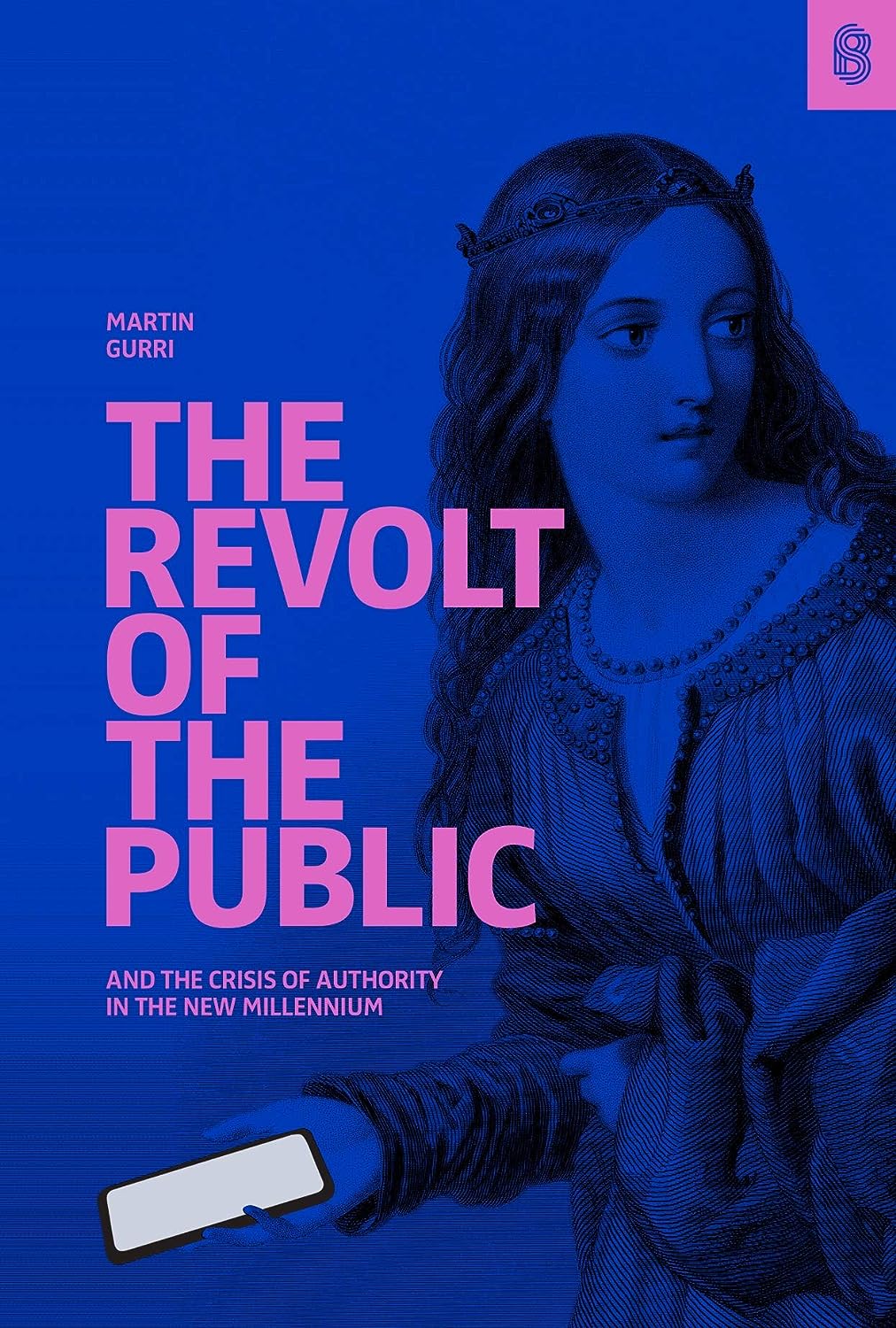
Martin Gurri describes this phenomenon in his excellent book The Revolt of the Public and the Crisis of Authority in the New Millennium. Popular disgust with the ever-worsening “Let them eat cake” ethos of the ruling class has expressed itself in a variety of ways: Trump in America. Bolsonaro in Brazil. Brexit in the UK. Populist upsets all over Europe. The gilets jaunes movement in France. The Canadian trucker convoy. Day traders rising up against Wall Street titans just for the joy of making them bleed. And perhaps most tellingly in QAnon, which reifies the metaphorical parasitism of the ruling class into a belief in literal establishment cannibalism and child abuse.


So Biden’s problem isn’t so much that voters don’t trust him on the economy, but rather that they just don’t trust him. And why don’t they trust him? Because whatever else you think of him, Biden is as much of an establishment insider as anyone could possibly be. He’s been a politician for virtually the entirety of his adult life, having been elected to a Delaware county council in 1970 at age 27 and to the US Senate two years later, where he remained for 36 years until becoming vice president for another eight. In fact, he’s so much an insider that despite his poor showing in the first three 2020 primaries, the Democratic establishment, fearing Bernie Sanders, united to install him as the general election candidate in 2020. The only politician who might rival Biden in establishment credentials would be Hillary Clinton, who the Democratic establishment also selected after sidelining Sanders in 2016 and who went on to lose to Donald Trump.


To put it another way: I doubt most voters distrust Biden specifically. My sense instead is that voters distrust him for what he represents. And while Democratic Trump horror and Covid proved just enough for the 78-year-old former senator and vice president to eke out a victory in 2020, in a world where the public is increasingly not just distrustful of but nauseated by its rulers, an establishment background presents an ineradicable taint.


But this would be a lot to articulate in a survey, and so most humans will attribute their dislike and distrust to something that feels discrete and defensible, such as “He’s not managing the economy well.” And then pundits like Krugman, his conservative colleague Ross Douthat, and Hayes will engage that stated reason, believing it to be the actual cause for discontent. In fairness, you can’t really blame the Krugmans and Douthats and Hayes’s of the world; after all, they’re all part of the establishment voters increasingly detest. For them to acknowledge how loathed their class is would involve a lot of difficult self-reflection, and in this sense they’re like West World’s Bernard, who couldn’t see the door positioned right in front of him because he’d been programed to be blind to it.


Two things seem axiomatic to me: the public wants meaningful change, and neither wing of America’s political duopoly is willing to offer it. Maximum disgust will therefore be directed at an establishment incumbent like Biden, against whom almost any challenger will have some claim to relative outsider status.


The thing is, Trump isn’t just any challenger. Everyone understands that Trump is hated by the establishment, and after four years of Russiagate, two impeachments, and four (and counting) indictments, Trump is well positioned to blame any of his failures as president on the establishment—what Trump calls “the swamp.” By comparison, a candidate like Biden is the swamp.


The only way either wing of the duopoly might meaningfully mitigate the downside of running an insider would be to allow in an outsider. The Democratic wing has prevented such a thing twice in a row, while the Republican wing tried but failed, accommodating themselves to Trump as their leader after having done all they could to stop him. But regardless of the risks or the outcomes, I don’t expect either wing to become more open to outsiders. As the Iron Law of Institutions posits, the people who control institutions care more about their power within the institution than they do about the power of the institution.


If I’m right about the public’s general outlook, voter pessimism about Biden’s accomplishments isn’t really what’s pulling him down. And in arguing that in fact those accomplishments are surreal or historical or otherwise stunning—even if true—is as likely to boost his numbers as my flapping my arms is likely to get me to fly.

Wednesday, June 21, 2023

If You Care About Privacy...

If you care about privacy, please stop referring to "privacy advocates." This reflexive phrase implies that certain individuals are trying to increase privacy or otherwise change the status quo--an uphill battle regardless of the issue at hand because most people instinctively distrust and even fear change.

In fact, privacy is under increasing assault by government and corporate deployment of new technologies. So the far more accurate--and tactically useful--phrase would be "privacy defenders."

Sadly, when it comes to nomenclature, rulers tend to be much more clever than the ruled. Renaming the War Department the Defense Department was genius in this regard. Now even otherwise excellent journalists reflexively refer to "defense" spending, a phrase far less likely to trouble the citizenry than "war" spending or even "military" spending.

The government understands that "defense" makes good marketing. I wish whoever came up with "privacy advocates" were half as effective.

More such own-goals here.

Thursday, March 02, 2023

Talking MA, SD, Violence, and of Course Writing With Coach Tony Blauer

Had a blast talking with Tony Blauer, an innovator in self defense I've learned a ton from over the last 20 years or so.

As we discuss in the podcast, I first met Tony when he wrote to me around the time my first book was published. He praised me for my fictional depiction of various aspects of violence, and told me that in his opinion I was really getting it right. My response was, "I hope so, I read your newsletter and have learned a lot from you!" Following which a beautiful friendship was born, which has included several trips to Tony's seminars and a couple of memorable sushi meals, too.


Anyway, it was a treat to catch up this morning about various areas of common interests on Tony's Know Fear podcast. Enjoy.


Wednesday, January 18, 2023

Amazon Smile, No More

In 2018, at the suggestion of novelist Andrew Vachss, I did what I could do get out the word about Amazon Smilea program that enabled Amazon customers to direct a portion of their purposes to a favored charity. Mine was an organization Andrew established: the Legislative Drafting Institute for Child Protection.

The good news is, you can still donate to the LDICP. The bad news, per the email copied and pasted below, is that Amazon is disbanding Amazon Smile.

***********************

Dear customer,

In 2013, we launched AmazonSmile to make it easier for customers to support their favorite charities. However, after almost a decade, the program has not grown to create the impact that we had originally hoped. With so many eligible organizations—more than 1 million globally—our ability to have an impact was often spread too thin. 

We are writing to let you know that we plan to wind down AmazonSmile by February 20, 2023. We will continue to pursue and invest in other areas where we’ve seen we can make meaningful change—from building affordable housing to providing access to computer science education for students in underserved communities to using our logistics infrastructure and technology to assist broad communities impacted by natural disasters.

To help charities that have been a part of the AmazonSmile program with this transition, we will be providing them with a one-time donation equivalent to three months of what they earned in 2022 through the program, and they will also be able to accrue additional donations until the program officially closes in February. Once AmazonSmile closes, charities will still be able to seek support from Amazon customers by creating their own wish lists.

As a company, we will continue supporting a wide range of other programs that help thousands of charities and communities across the U.S. For instance:

  • Housing Equity Fund: We’re investing $2 billion to build and preserve affordable housing in our hometown communities. In just two years, we’ve provided funding to create more than 14,000 affordable homes—and we expect to build at least 6,000 more in the coming months. These units will host more than 18,000 moderate- to low-income families, many of them with children. In one year alone, our investments have been able to increase the affordable housing stock in communities like Bellevue, Washington and Arlington, Virginia by at least 20%.
  • Amazon Future Engineer: We’ve funded computer science curriculum for more than 600,000 students across over 5,000 schools—all in underserved communities. We have plans to reach an additional 1 million students this year. We’ve also provided immediate assistance to 55,000 students in our hometown communities by giving them warm clothes for the winter, food, and school supplies.
  • Community Delivery Program: We’ve partnered with food banks in 35 U.S. cities to deliver more than 23 million meals, using our logistics infrastructure to help families in need access healthy food – and we plan to deliver 12 million more meals this year alone. In addition to our delivery services, we’ve also donated 30 million meals in communities across the country.
  • Amazon Disaster Relief: We’re using our logistics capabilities, inventory, and cloud technology to provide fast aid to communities affected by natural disasters. For example, we’ve created a Disaster Relief Hub in Atlanta with more than 1 million relief items ready for deployment, our Disaster Relief team has responded to more than 95 natural disasters, and we’ve donated more than 20 million relief products to nonprofits assisting communities on the ground.
  • Community Giving: We support hundreds of local nonprofits doing meaningful work in cities where our employees and their families live. For example, each year we donate hundreds of millions of dollars to organizations working to build stronger communities, from youth sport leagues, to local community colleges, to shelters for families experiencing homelessness.

We’ll continue working to make a difference in many ways, and our long-term commitment to our communities remains the same—we’re determined to do every day better for our customers, our employees, and the world at large.

Thank you for being an Amazon customer.

Tuesday, December 06, 2022

Dox Origin Story AMOK, Out Today!

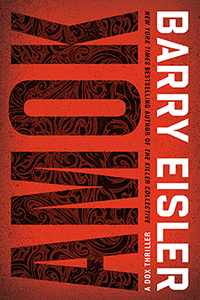
Today’s the day—my long-gestating Dox origin story, AMOK, is available at last! Hardback; trade paper; Kindle; audiobook narrated by yours truly…whatever you prefer.

The gist:

1991. A restless young man called Dox is back home in Texas. His friends have missed him and his mother and sisters need him, but after four years as a Marine and another two as a CIA contractor fighting alongside the Afghan Mujahideen against the Soviet Union, small-town life in Abilene is a suffocating dead end. Another secret war, this one in Southeast Asia, offers a big payday and the solution to his family’s dire straits. But secret wars are never what they’re billed to be, and Dox is about to get the education of his young life—among the lessons, that the only thing more dangerous than a secret war is falling in love with your enemy.

If you’re curious about how I got around the pandemic to research the Huntsville “Walls” Unit (yes, the same Texas prison depicted in the 1972 Steve McQueen movie The Getaway), life in Abilene and Tuscola, and Indonesia’s occupation of East Timor, all as they existed in 1991, you can find my notes, a bibliography, and a filmography here—and of course in the book itself.

And some research photos from Abilene and Tuscola here.

A small request: if you’ve read the book already via NetGalley or otherwise—or whenever you read it—please don’t be shy about posting a customer review here. For whatever reason, Amok didn’t get much in the way of pre-publication coverage, so the book will have to rely more than usual on word of mouth. Thanks very much in advance.

AMOK is a thriller; it’s a love story; most of all, it’s a bildungsroman (even though my editor wisely declined the opportunity to put A DOX BILDUNGSROMAN on the cover). I laughed and cried a lot while writing it—of course I did, it’s Dox, and he’s never been better! Enjoy and happy holidays.

Cheers,
Barry


Tuesday, August 30, 2022

Reading An Excerpt From AMOK On Lit With Lloyd

Had a blast doing the Lit With Lloyd podcast with KCAT Public Media! A wide-ranging conversation, including:

Craft: how to draw on experience, research, and imagination to create compelling characters.

Business: how the proposed Random Penguin/S&S merger is like the two wings of America's duopoly.

And—EXCLUSIVE—I read an excerpt from upcoming Dox prequel AMOK.

Enjoy!


Monday, August 08, 2022

How Do You Shape A Character Who's Had Experiences You Haven't?

Fiction involves a mix of experience, research, and imagination, with the first two both grounding and boosting the third. And if you’re familiar with the endnotes of my books, the photos I post of the places I visit for research, and my Mistakes page (because despite all my efforts, I sometimes fall short), you know I work hard in the service of accuracy and realism.

When I teach writing, I always suggest building characters on a foundation of what humans have in common, with what’s different or unique about the individual in question used more like a spice than like a fundamental ingredient. Of course differences are critical, but they tend to act on what we already have in common. Too much emphasis on differences and not enough appreciation of shared humanity can result in characters feeling two-dimensional or otherwise unrealistic and not compelling.

Some of my characters are more like me than others, and the more differences, the more I need to inform my imagination with research. It can be a lot of work, but I always feel the results are worth it. Some of that affirmation comes from within, but sometimes it’s delivered from outside. Here’s an example of the latter—from Chris Brainerd, who took the trouble to offer some thoughts about my Graveyard of Memories paraplegic character Sayaka and who gave me permission to post it here. Sayaka and I have a lot of differences. But I think starting with everything I know about humans, and shaping and sculpting that based on my research about the specifics, paid off.

Thank you Cameron for suggesting a character in a wheelchair and for helping me get the details right. I think Sayaka is incomparably richer for it, and her romance with Rain more poignant. And thank you Chris for the email below. I’m proud of my my Mistakes page (journalists might consider employing something similar), but it’s good to get feedback that doesn’t belong there, too.

* * * * *

Hi Barry,

I’ve been on bedrest since November, with not a whole lot to keep myself busy. Fortunately, I stumbled across Rain Fall on a streaming service and that led me to looking up the character and realizing there is a series of books. For a couple months now, I’ve been caught up in every book I can get. I just finished Graveyard of Memories, and it made me want to reach out.

I’m in a wheelchair and the character Sayaka really surprised me. I’m also a guy, so the parts about sex as a paraplegic woman I can’t comment on (haha), but damn! You nailed life in a chair. What I particularly found impressive was John trying to find common ground with Sayaka. Seeing her as any other person and doing his best to make sure he’d thought about how to treat her and get her around. And to make it more realistic, you made him miss things she had to teach him.

And then, Sayaka relating (and achieving) her dreams. Not wanting to be stuck in one place and knowing she could do more. I felt you were either writing from experience or getting great advice from a wheelchair user. I was surprised and impressed that you pulled that off with just internet research.

I wish Sayaka could be in further books, but I’m just glad you didn't kill her off!

Anyway, just wanted to let you know how your books are helping me, and again, praise your tactful approach to disabilities.

And as a proofreader and editor, I’d also say whoever you have doing these tasks is amazing. Your prose and dialogue are tight! I love it all.

Have a great day,

Chris Brainerd

Friday, August 05, 2022

Violence and the Principles of Good Storytelling, With Wim Demeere

I had so much fun doing this podcast episode with martial arts, self-defense, and violence expert (and fellow writer) Wim Demeere. We discussed all the foregoing topics and more in the context of the principles of good storytelling. For example:

Why the fascination with violence generally? And how do you depict it compellingly on the page or screen?

Why did the Equalizer writers introduce Denzel Washington's character the way they did...and what does that introduction suggest about character introductions generally?

Why was the bathhouse scene in Eastern Promises so riveting...even though it was so unrealistic?

And much, much more!


Friday, May 20, 2022

My CIA Instructor Dutch: The Life Behind The Legend

Updated Below

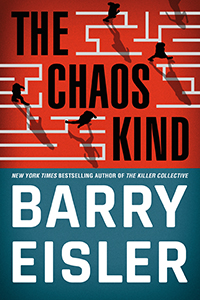
If you’ve read my book The Chaos Kind, you might remember a certain CIA SOG (Special Operations Group) character named Dutch. And while I don’t write characters based on real people, that doesnt mean none of my characters were inspired by them...

So yes, there is a real Dutch, who a long time ago I was extremely lucky to train under—and now you can read the story of the life behind the legend.


The other instructors I trained with at the time, who knew Dutch better and in a different context, treated their colleague with reverence and even awe—but also with great affection because Dutch inspires all those reactions, and more. But for me, Dutch was primarily a teacher, and one of the best I’ve ever had.

What makes Dutch so special?

I would say: his combination of deep knowledge based on extremely hard-won experience; his ability to translate that experience to make it comprehensible to people like me who had never been through anything remotely similar; and his patience with, and compassion and affection for, his students. All driven by his determination to impart to his students skills that would make them more capable in their roles, and on which if things went badly they would be relying on to save their lives.

My fellow trainees and I spent barely two months under Dutch’s tutelage, and yet thirty years later we still talk about him and our memories of our time with him—he makes that much of an impression. Thank you Dutch, and thank you Kim for writing this book!

Update, January 12, 2023

Dutch died this week. Many will miss him but no one could lead a fuller life.

Monday, March 28, 2022

Will Smith, Chris Rock, and "Violence Is Never The Answer"

Not taking a position on last night’s Smith/Rock incident. But for anyone piously intoning some version of “Violence never solves anything, violence is never the answer, violence has no place in XYZ, etc,” have you considered what discourse would be like with zero possibility of offense to words leading to violence?


Actually, you don’t have to consider it; just log on to Twitter, or spend some time on Facebook, or check out the comments section of any blog dealing with an even remotely controversial topic. This is how humans devolve into talking to each other when they know it’s impossible their words could entail physical consequences. Are you sure you want that kind of discourse in the real world, too?

Or ask any woman you know about being harassed while walking down the street or riding the subway, and again you’ll have some idea of what discourse is like when the people talking are certain there can be no physical ramifications for what they say.

Violence is a big topic. It involves more than just the physical—more even than the threat of the physical. It also involves the mere possibility of the physical. Violence and all its elements have been with humankind forever. Anyone calling for the banishment of violence should have a clear idea of what they want banished, and the roles (often hidden) violence or any other thing serves in the vast system they’re certain banishment would improve.

Cue the outrage claiming that I love violence, that I think Will Smith was justified or even that he didn’t go far enough, that I don’t think violence carries any negative consequences whether for the individuals involved or for society, that I’m saying violent offense to words is the same as self-defense to actual violence, etc. It’s social media, after all, and indulging spurious outrage is the quintessence of the medium.

But I’m really not saying any of those things. I’m just suggesting that bromides will probably deliver results less helpful than an open mind and careful thought.

Violence is a language. Before opining about how it’s good for nothing or exclusively counterproductive, it might be helpful to learn a few words.

Tuesday, March 08, 2022

Where's the Outrage?

 Someone asked me in another thread why I’m not outraged about Ukraine.


Of course the question assumes that if a person isn’t obviously displaying an emotion, it follows that he isn’t experiencing it. But that’s trivia. What’s important is the underlying notion that outrage is desirable. My response:

"I don’t parade my outrage and in fact distrust outrage because of its inherent pleasures. I wish more people would do the same—the Internet, at least, would be improved by it.

"Here, I’m trying to approach as rationally as I can the problem of “How can we avoid having Russia’s invasion of Ukraine become the destruction of all humanity?” There’s more than enough war fever all over the west right now. If we get through this crisis without blowing up the world, it’ll be despite outrage, not because of it. And that in a nutshell is why I work hard not to join the outrage party but instead try to stand outside it."

The person also said, "But just once, I’d like to see you say: 'Goddamnit, this must not stand.'”

My response to that:

"I’m going to have to disappoint you. I find talk like that suspiciously onanistic. Worse, if it gets loud and contagious enough, it becomes dangerous. And regardless, it does nothing to solve problems.

Numerous voices in the west have been warning for years if not decades that NATO’s relentless expansion risked provoking a war with Russia. I’ll link to just one such article below; there are countless others, coming from left, right, former US ambassadors to the USSR and Russia and other Russia experts, even from Tom Friedman. My view is those voices have been proven right. Your view, I think, is that Russia was always going to invade Ukraine no matter what because Putin is at least as inherently evil as those countless Economist covers have depicted. For the moment, what matters more to me is getting through this without a nuclear war that would turn the entire planet into something that would make what’s happening in Ukraine seem like trivia. Again, if we get that lucky, the luck will have been influenced by reason, which is a struggle, not by outrage, which is a reflex.”

A few more thoughts:

If you want to see what war fever outrage leads to, it’s interesting to consider that at the outbreak of WWI, dachshunds were slaughtered in America because of their association with the Kaiser. That was a bit before my time, but I remember so much outrage in America at France’s reluctance to become part of what turned out to be America’s disastrous second invasion of Iraq (100,000 innocent Iraqis killed; 4,000,000 refugees created) that calling French Fries Freedom Fries was all the rage (you can’t spell outrage without rage).

(I didn't have a blog at the time so I don't think there's a record of it, but I was part of that outrage. I'm not proud of it, but I have tried to learn from it.)

I think that as a species we have a better chance of survival if we keep this kind of mentality as far as possible from questions involving nuclear weapons.

More recently, innocent Russians are being punished because…they’re Russian (or at least might be).

Reason takes work. Outrage is as easy as any other reflex, and feels good, too. Which is why reason is always scarce and outrage always abundant.

Of course, this time it's different. It always is.

Saturday, March 05, 2022

What America Should do About Russia's Invasion of Ukraine

From a comment I left in a Facebook thread asking me what America should do about Russia’s invasion of Ukraine:


I try to look at all countries, including America, the way a Martian would. If a Martian were trying to identify the most peace-loving and the most war-loving countries on this planet, where would the Martian rank America?

Of course I could be wrong, but my guess is that the Martian—judging by military budgets, overseas military bases, and number of “military actions”—would find America to be off the charts. The Martian would probably be intrigued to note that it’s only Americans who can’t see this. I would try to address the Martian’s perplexity by explaining that human perception is massively distorted by something called the fundamental attribution error. Were the concept new to the Martian, I would advise the Martian to use the Internet to look up this extremely important key to human behavior.

Anyway. I think that unless Russia’s war in Ukraine blows up into something bigger, up to and including the end of human civilization, it will be resolved by guarantees of Ukraine neutrality, meaning no western forces in and no NATO for Ukraine (this would probably apply to Georgia, too). These have been Russia’s demands since 2008, when America first started urging NATO to admit Ukraine and Georgia as NATO’s 31st and 32nd member states, and when Russia began making clear that it would go to war rather than allow such a thing to happen.

It’s interesting to note that George Bush Sr.’s Secretary of State James Baker promised Gorbachev that in exchange for the Soviet Union acquiescing to a unified Germany becoming part of NATO (an extremely bitter pill for the USSR to swallow, given what Germany did to Russia in WWII), NATO would not expand “one inch” further east. After which, we flipped the entire Warsaw Pact into NATO and expanded the alliance all the way to Russia’s western border.

All of this is of course memory-holed in America, where Putin simply wantonly invaded Ukraine for no reason other than Peter the Great/Hitlerian dreams of conquest.

To me it feels like 1979, when Iranian students took the US embassy in Tehran and the hostage crisis began. Most Americans believed the whole thing started that day, that Iranians were just evil and for no reason wanted to give America a black eye, etc. I was 15 at the time and that’s what I thought. 1954, Mosaddegh, the entire history of US meddling and the coup that installed the murderous Shah regime…all memory-holed.

It’s always like this, but citizens seem not learn from the obvious patterns. Maybe it’s because the fight itself is so captivating; because the factors that led to the fight were hazy and not particularly cinematic and so went unnoticed by most people at the time; because once the fight is on, powerful, primitive emotions kick in and not just occlude the ability to reflect and to reason, but are so pleasurable that they cause people to *resist* reflection and reason, lest reason get in the way of the emotional high of The Good Fight.

It’s interesting to consider that the solution to conflicts is often obvious from the beginning, but ego prevents the actors from adopting the obvious solutions except at the brink. The 1962 Cuban Missile Crisis is a perfect example. America had positioned Jupiter nuclear missiles in NATO member Turkey, on the USSR’s border. America launched the Bay of Pigs invasion in Cuba in 1961 (followed by the Operation Mongoose terror campaign). Cuba asked the USSR to position nuclear weapons in Cuba to forestall another US invasion and further US meddling. Khruschev agreed. America picked up the activity in satellite photos, blockaded Cuba, and threatened to sink any Soviet vessels that tried to breach the blockade.

Again, all the foregoing history is memory-holed in America. In the American popular imagination, without provocation Khrushchev aggressively and wantonly moved nuclear missiles into Cuba, after which brave John Kennedy cooly and intelligently faced Khruschev down. All that’s taught is the story of how America *resolved* the Cuban Missile Crisis. You have to go searching on your own if you want to understand what America did to *provoke* the Cuban Missile Crisis.

None of this is about blaming America, hating America, or Whataboutism, or any other such bullshit that people commonly throw up to protect their emotional attachment to the feeling that their own country is Good and the adversary is Bad. Mostly it’s about understanding that other people don’t see us the way we see ourselves, and understanding that other people don’t see themselves the way we see them. This is as old as Sun Tzu, but it’s given not much more than lip service, again and again with disastrous results.

Anyway, eventually the Cuban Missile Crisis was resolved by the Soviets publicly agreeing to remove their nuclear missiles from Cuba; by America publicly promising not to invade Cuba anymore; and by America secretly promising to remove its Jupiter nuclear missiles from Turkey (secrecy required to save face for President Kennedy, even though “Please remove your nuclear missiles from just a few miles from our border, where they’re needlessly provocative” was exactly America’s complaint about what the Soviets were doing in Cuba).

The solution to Russia’s war in Ukraine seems equally obvious. Getting to it without blowing up the world is another matter.

It’s worth noting in this regard that we did almost blow up the world before resolving the Cuban Missile Crisis. There’s much more on this, but just from Wikipedia:

During the blockade, "the US Navy dropped a series of ‘signalling’ depth charges (practice depth charges the size of hand grenades) on a Soviet submarine (B-59) at the blockade line, unaware that it was armed with a nuclear-tipped torpedo with orders that allowed it to be used if the submarine was damaged by depth charges or surface fire. As the submarine was too deep to monitor any radio traffic, the captain of the B-59, Valentin Grigorievitch Savitsky, decided that a war might already have started and wanted to launch a nuclear torpedo. The decision to launch these normally only required agreement from the two commanding officers on board, the Captain and the Political Officer. However, the commander of the submarine Flotilla, Vasily Arkhipov, was aboard B-59 and so he also had to agree. Arkhipov objected and so the nuclear launch was narrowly averted.

“On the same day a U-2 spy plane made an accidental, unauthorised ninety-minute overflight of the Soviet Union's far eastern coast. The Soviets responded by scrambling MiG fighters from Wrangel Island; in turn, the Americans launched F-102 fighters armed with nuclear air-to-air missiles over the Bering Sea.”

That’s the kind of shit that happens during the Fog of War. We have been unbelievably lucky, more times than any species deserves to be lucky. If you doubt that, Google Nuclear Close Calls.

I wish that instead of relying on luck, we would spend a little more time considering what could be done to avoid these wars and other crises. Because once they’ve begun, they seem not to get resolved except at the brink. One day, maybe this time, we’ll get to the brink and still won’t resolve it. We’ll go over. Over and out.

Tuesday, December 28, 2021

RIP Andrew Vachss, A Warrior Protecting Children

This morning I received extremely sad news: Andrew Vachss, a lawyer and novelist who dedicated his life to protecting children, is gone.

About ten years ago, International Thriller Writers asked a collection of novelists to contribute to a forthcoming book: Thrillers: 100 Must-Reads. My entry was about Vachss, who I didn’t know at the time other than by his reputation and through his novels, which I’d been devouring since first discovering them through the work of another writer, violence expert Marc MacYoung, in 1989. Sometime after Thrillers was published, Vachss got in touch and we became friends. We never met, though we would talk on the phone every few months. Those conversations were long and involved, and my wife Laura could always tell when I was talking to Vachss—everything about my expression and posture revealed how closely I was listening.

Vachss had an unusual and insightful take on everything: politics, writing, publishing, and most of all, human nature. He had an encyclopedic knowledge of crime, and his website will remain an invaluable resource for anyone wanting to learn more about human predators and how to combat them (as well as for thriller and mystery novelists who aspire to greater realism).

You might think someone who had seen the things Vachss had seen would be consumed by pessimism about our species. But a pessimist wouldn’t fight as hard or as long as Vachss did. I once asked him how he managed not to despair. He said, “Barry, why do you think I always ask about Emma [my daughter]?” I understood then. His calling was a battle with poisonous evil. The antidote was hearing about love. I told Em as much about Andrew as I told Andrew about Em, and I know the hug I got when I shared with Em the news about Andrew’s death would have meant a lot to him.

Vachss had a way of summing up concepts with deadly accuracy and memorable brevity. Love is a behavior, not an emotion. Behavior is the truth. Blood makes you related—love makes you family. He had no patience with platitudes like “to heal, you have to forgive.” He knew that forgiveness is a choice, not an obligation. As he put it, justice was his vehicle, but hate was the fuel it ran on. I borrowed that concept for my character Livia Lone because it suited her so perfectly, and dedicated my book The Killer Collective to Andrew and his wife Alice Vachss, a former sex crimes prosecutor and herself a warrior against human predation. I don’t think any novelist has had as big an impact on my writing as Andrew, and without Alice’s book Sex Crimes: My Years on the Front Lines Prosecuting Rapists and Confronting Their Collaborators, Livia and her world would be far less real and compelling.

Andrew, who suffered from (though never complained about) various severe health problems, had no illusions about his own mortality. He often said that if he could go out carrying a bomb into a room filled with every child abuser on earth, he would do it gladly. Such a thing wasn’t possible, of course, at least not literally—but Andrew did give, he did dedicate, his life to the protection of children. If you want to honor his memory and his work, I’d suggest contributing to the Legislative Drafting Institute for Child Protection, an organization he founded and which even in his absence will continue to wage what Vachss called the only holy war worthy of the name.

If ever there was someone whose spirit will outlast him, it was Vachss. The world was made better by what he did with his time in it. And through all the children he saved, all the work he inspired, and all the battered souls he touched by speaking truth and abhorring bullshit, it will remain better even now that he’s gone.


Update

One more thought, about something I should have included in that last paragraph. Andrew liked to point out that child protection is crime prevention. So among the ways he made the world more positive is in a sense via a negative—crimes that would have happened, trauma that would have been inflicted, but didn’t because of Andrew’s work. Any of us might owe to Andrew the absence of some horror, and though we can’t measure such a thing, all of us are in his debt for it.

Sunday, November 28, 2021

Talking Violence in Fiction and Fact With Tim Larkin

Hugely enjoyed doing this three-part talk with violence expert Tim Larkin, one of the people with whom I've been privileged to train and whose influences appear in my books. Part 1, Part 2, and Part 3.


Saturday, October 16, 2021

Flash-Forward Preambles: What, How, and When

Updated Below

For various reasons, recently I got a little obsessed with flash-forward movie and television preambles. That is, presentations that begin with a scene from later in the story, and then spend some amount of screen time catching up to the “later” scene that came at the start. How much catch-up varies. Sometimes the catch-up happens only a few scenes later; sometimes the preamble was actually the end of the movie.

I started by casually going through a bunch of movies I’d already seen and thought I knew well, and was surprised to find many more examples of the technique than I had expected. The flash-forward preamble gets used in all kinds of stories: action, comedy, drama, horror. My guess is that opening with a flash-forward has become more common as it’s become easier for viewers to switch to something else. Once upon a time, a movie meant something of a commitment—a drive, parking, $20 for tickets…various opportunity and transaction costs. If something didn’t hook you right away, your alternative was to get up and leave, eat the $20 and the other costs, come up with a new plan and go someplace else. All of which meant you’d be incentivized to stay, which in turn meant movies could take their time warming up.

Today, going to a cinema has become an ever smaller part of how people consume movies, and hundreds, maybe even thousands of alternatives are always just a click away. Meaning filmmakers are motivated to find ways to hook an audience immediately, and keep them hooked. One popular method seems to be the flash-forward preamble. I’ve even seen the technique creep into previews, which are now often presented with a quick flash-forward from something later in the preview before the preview opens and plays sequentially.

It’s worth emphasizing that the fundamental objective of the preamble is to hook the viewer. How the preamble achieves this is important but ultimately secondary. If the viewer is hooked, the preamble was a success. If the viewer isn’t hooked, the preamble failed.

Now let’s talk a bit more about: (1) what the technique consists of; (2) how it works (that is, what makes it work); and finally (3) when you might want to use it (that is, what kinds of stories lend themselves to the technique). And then we’ll finish with a list of examples. Sound good? Okay, here we go...

What It Consists Of

As already noted, the flash-forward preamble consists of something that happens later in the story, presented upfront. But that’s merely necessary, not in itself sufficient, and in the best executions there were other commonalities, which we can distill out as principles (no spoilers in here because hey, these are all openings):
  • A presentation of something central to the story. Examples:
  • Breaking Bad—the impossibility of simultaneously trying to be a meth criminal mastermind and inoffensive high school teacher family man (duty to others vs self actualization)

  • City of God—how to escape the favela when trapped between its warring forces (physical survival vs following your dream)

  • Goodfellas—the cost of becoming a gangster, which “I always wanted to be”

  • The Hangover—“Getting married in five hours,” “Not gonna happen, we lost the groom”

  • Nobody—“Who are you, really?” (which identify defines us and which should we be true to)
  • A complete presentation—that is, no fragments, no shadows, no direct mystery about what you see in the preamble, only an indirect mystery about how what you see in the preamble relates to the larger story. You can see everything, you just don’t yet know (but you badly want to know) how we got here, which makes you want to watch the rest of the movie or show.
How to Hook

The hook consists of two things:
  • doling out certain critical information on who, what, and where, to draw in the viewer and ground the viewer in the story; and
  • simultaneously causing intense curiosity about each piece of doled-out information, and ultimately instilling an even greater global curiosity about how and why we got here—a global curiosity that can only be satisfied by watching the rest of the show.
Sometimes preambles are expressed in terms of “teasing” the audience. I think this is a misnomer. Getting teased is easy to walk away from. Getting hooked, by definition, is not. So the goal isn’t to tease. The goal is to hook.

And because the goal is to hook—which requires both grounding and curiosity—it follows that more information in a preamble is good. But only as long as the curiosity created is commensurate. Lots of grounding plus lots of curiosity—answering lots of questions while posing other and more compelling ones—makes for the most effective hook, and therefore the most effective preamble.

Think of how much information is conveyed in the four-minute Breaking Bad preamble, or the one from Goodfellas. These are complete story moments—linear, chronologically intact fractals. The one exception I found is The Accountant, where too little information was presented (you cant even see whos involved), and not coincidentally that preamble was a relatively weak hook.

To put it another way: the preamble must offer substantial nourishment—while simultaneously, insidiously, and paradoxically famishing the viewer for more. That is, when it comes to preambles, less is not necessarily more. More can be more (another reason I dont like the teaser nomenclature).

For more general thoughts on how a story engages an audience, I recommend this terrific TED talk by Pixar’s Andrew Stanton, The Clues To A Great Story.

It’s interesting to observe that among the examples below, almost every one involves a depiction of violence—either the violence itself, or the threat of violence, or its aftermath. This doesn’t mean that violence is necessary in a preamble; in fact, we know it’s not, because there are powerful instances of non-violent preambles (The Hangover, True Romance). But it certainly seems to be the case that violence can be useful.

And if most of this sounds relevant to story openings generally—it is! All openings should aim to hook, and all will do so with the paradoxical combination of nourishing and famishing discussed above. The flash-forward is just a particular way to do it.

Okay, now you know what it is and how it works. How do you decide if your story would benefit from it? After all, there are innumerable movies and television shows that hook you immediately without a preamble (though I do sometimes wonder whether even a masterpiece like Die Hard, were it made today, would have some studio executive saying, “Opening on the airplane is too slow and low stakes…do a flash forward to the explosion on the Nakatomi Tower rooftop and Bruce Willis leaping off with the firehose, then show a title card saying Six Hours Earlier and cut to the plane...”).

When To Use It

I think the stories that benefit most from a preamble are ones that in the absence of a preamble would begin with something slow, low-stakes, or otherwise not immediately gripping. If Vince Gilligan had opened the Breaking Bad pilot with Walter White in bed, then exercising, then eating breakfast, then getting disrespected at school and at his second job at the car wash, viewers might have grown impatient. But begin with that crazy Winnebago preamble, and for the rest of the pilot, viewers will be wondering, “How the hell do we get from this boring life to whatever that Winnebago thing was all about?”

Likewise, Brick is a noir mystery, but it’s set in a contemporary suburban high school. If Rian Johnson hadn’t opened with the dead girl in the culvert and Joseph Gordon-Levitt crying over her body, it would take much longer for viewers to understand that the stakes in this teenaged high-school world are actually life and death (and Johnson would have lost the opportunity to hook by making viewers wonder how and why the girl died, and what Gordon-Levitt’s connection with her was).

That said, while some stories might need a flash-forward preamble more than others, there are lots of reasons to use the technique beyond bare necessity, such as tone. But no matter what, the preamble should hook, or you risk losing your audience to one of the other thousand forms of entertainment always a click away.

Examples

I put together the following list from movies I know pretty well (and the television show Breaking Bad). I’m sure there are many more examples I haven’t thought of or don’t know of. Anyway, here you go.

Breaking Bad
Brick
Casino
Centurion
City of God
Deadpool
Deadpool 2
Fallen
Fight Club
Goodfellas
Hacksaw Ridge
The Hangover
John Wick
Kiss Kiss Bang Bang
Let Me In
Limitless
Nobody
Once Upon A Time In America
Out of Sight
Pulp Fiction
True Romance
The Usual Suspects

And some notables that start with a flashback preamble, but one that functions similarly to the flash-forward variety (interestingly, both are extremely violent):

Bad Times At The El Royale
Casino Royale

Okay, those are my thoughts. Take it all with a grain of salt because though I’ve written a bunch of novels and short stories, I’ve never had a movie or television show made. So I could be off base about any of this, and even if I’m not, I still have a lot to learn. To that end, please don’t be shy about mentioning any additional flash-forward preamble examples in the comments section, along with any thoughts about how you think the technique works and when it’s best to use it. Thanks and I hope these thoughts have been useful.

Update:

Should have thought to check Wikipedia earlier—lots of interesting thoughts and examples under In Medias Res and Flash-Forward.